
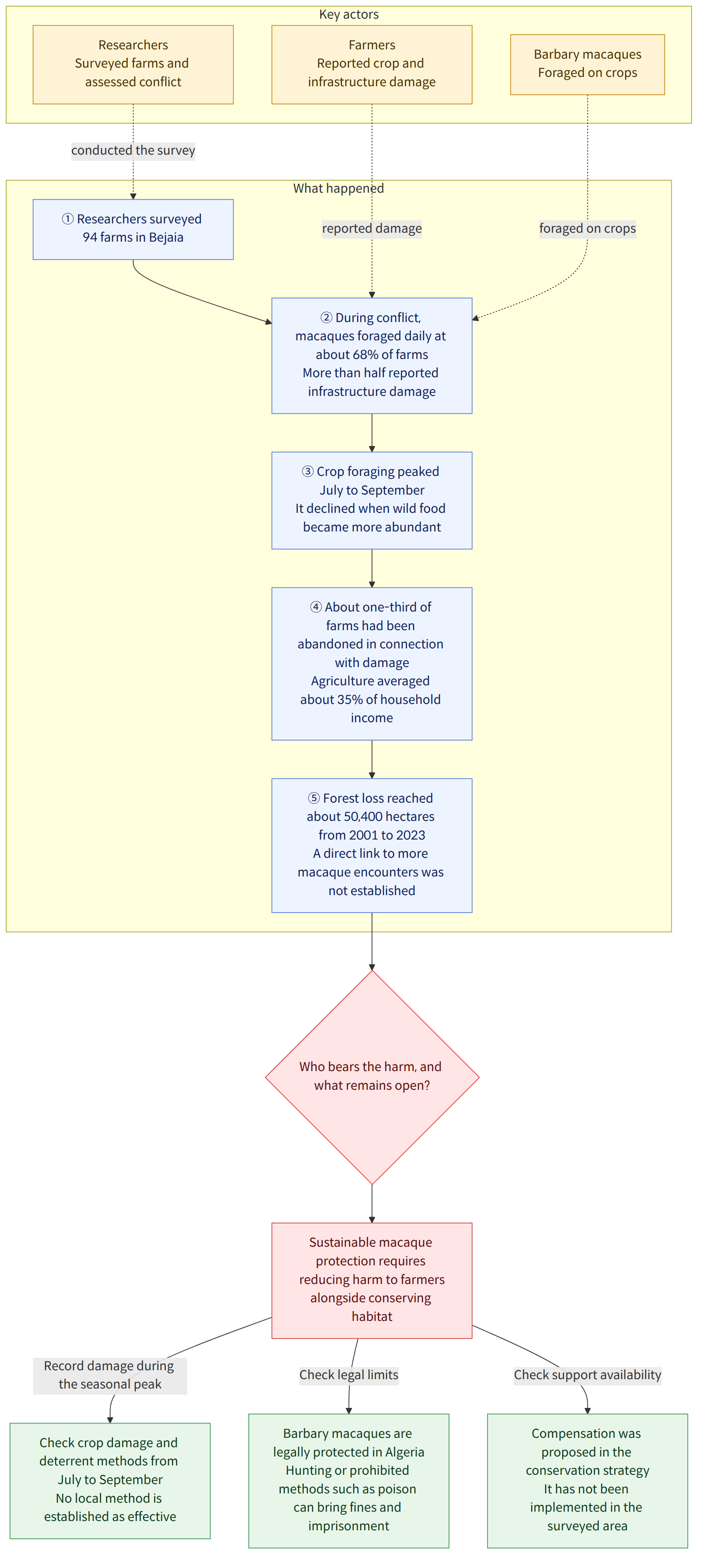
A survey examining conflict between Barbary macaques and farmers in Algeria’s northern Bejaia Province found that about one-third of the surveyed farms had been abandoned because of crop damage associated with macaques. Agriculture accounted for an average of about 35% of surveyed households’ income, and was the only source of income for some households. Protecting the Barbary macaque, an endangered species that is legally protected in Algeria, is not just a matter of wildlife conservation: it also requires addressing the livelihoods of farmers bearing the damage and the issue of habitat.
Background and context
Researchers surveyed 94 farms in Bejaia Province, looking at crop damage and the deterrent methods used by farmers. During periods when conflict occurred, macaques foraged for crops daily at about 68% of the surveyed farms, and more than half of the farmers said that infrastructure such as roofing materials and drip-irrigation systems had also been damaged.
The damage was concentrated on particular crops and at particular times of year. Figs were damaged at nearly all the surveyed farms, while apples, pears, grapes and nuts were also identified as frequently affected crops. Crop foraging by macaques peaked from July to September, when local figs ripen, and declined from late autumn through winter, when acorns—a major wild food source—become more abundant in oak forests.
The time of day and farm size were also relevant. Crop foraging was especially common at dawn and dusk, when human activity was low, and occurred more often at farms with larger cultivated areas. By contrast, none of the survey respondents said they were concerned about macaques physically attacking people or transmitting disease. The conflict documented in this survey centered on crops, infrastructure and the resulting harm to livelihoods, rather than attacks on people.
Bejaia Province lost about 50,400 hectares of forest between 2001 and 2023. This was about 40% of its baseline forest area, and forest loss was greatest in 2023. Agricultural land showed no signs of expansion between 2014 and 2021. However, the researchers said the study alone could not establish that forest loss had caused the increase in encounters with macaques reported by farmers.
What this means
For farmers, it is important that the damage recurs seasonally and can affect their livelihoods. Since agriculture accounts for an average of about 35% of household income—and is the only source of income for some households—crop losses can threaten their income base, rather than being a mere inconvenience. The finding that about one-third of the farms had been abandoned in connection with the damage shows that leaving the conflict unaddressed could make it difficult to continue farming.
The methods farmers used most often were guard dogs, traditional fences and slingshots. However, using more deterrent methods was not associated with a lower frequency of crop foraging. This suggests that simply advising individual farmers to use existing methods more often may not be enough to reduce damage. The researchers proposed that macaques may change their behavior in response to obstacles and learn how to get around them.
From a conservation perspective, it is difficult to focus management efforts on farms alone. The survey found that crop foraging declined when wild food became more abundant, and, considered alongside the forest-loss figures, this gives reason to address both reducing harm to farmers and conserving macaque habitat. However, a causal link showing that forest loss directly increased encounters with macaques has not been established.
For example, a fig farmer could use the finding that damage may concentrate from July to September to record damage and the deterrent methods used during that period and consider how to respond. This is a hypothetical application of the survey findings; it has not been established that any particular method actually reduces damage locally.
Relevant policies and support information
The Barbary macaque is legally protected in Algeria. According to the source, hunting macaques or using prohibited methods such as poison can result in fines and imprisonment; specific penalties were not provided. It is therefore important not to use prohibited methods without authorization, even if crops have been damaged.
Compensation for damage has been proposed in Algeria’s Barbary macaque conservation strategy, but the source says the measure has not been implemented in the surveyed area. No specific plan to introduce compensation or subsidies in Bejaia Province has been confirmed. The researchers suggested that compensation or subsidies could ease the financial burden on farmers and reduce incentives to kill the animals, but this is not a description of a support program currently in operation.
Almost all the surveyed farmers had never received training in managing human-wildlife conflict. The source proposes testing whether electric fences and motion detectors are effective locally, and also mentions planting citrus, which macaques are less likely to prefer, in buffer zones. This does not mean that the local effectiveness of these methods has already been confirmed.
What is known and what remains uncertain
What is known
- Researchers surveyed 94 farms in Bejaia Province about crop damage and deterrent methods.
- About one-third of the surveyed farms had been abandoned because of crop damage associated with macaques.
- Fig damage was reported at nearly all the surveyed farms, and foraging peaked from July to September.
- No association was found between using more deterrent methods and a lower frequency of damage.
- Bejaia Province lost about 50,400 hectares of forest between 2001 and 2023, but the study alone could not establish a causal link between forest loss and an increase in encounters.
What remains uncertain
- The exact timing of the survey and how farms were selected were not provided.
- It has not been established whether electric fences or motion detectors actually reduce damage under local conditions.
- No specific plan to provide compensation or subsidies to farmers in Bejaia Province has been disclosed.
What readers can check
- Farmers experiencing crop damage can record which crops were affected, when the damage occurred, any damage to infrastructure, and which deterrent methods they used, to identify seasonal patterns. In particular, distinguishing situations during the July-to-September period when fig damage is concentrated from those at dawn and dusk would align with the survey findings.
- When choosing a response to damage, readers should not assume that electric fences or motion detectors are already proven methods; they should check whether their effectiveness has been confirmed under local conditions. The source says only that these devices need to be tested locally.
- Compensation or subsidies were proposed in the conservation strategy, but the source says they had not been implemented in the surveyed area. Before counting on support, it is therefore worth checking whether it is actually available in the relevant area and whether an application process has been established.