
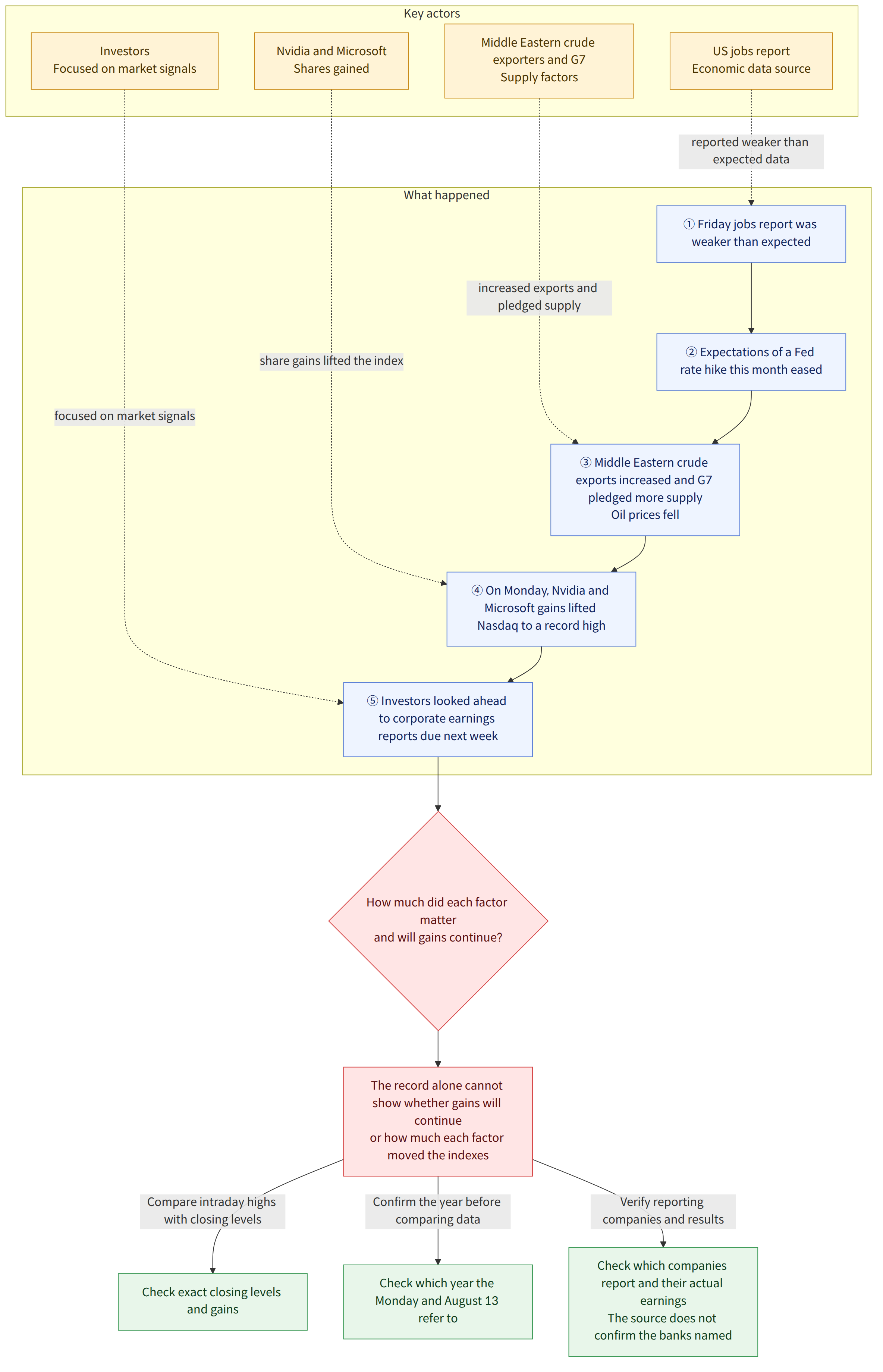
The Nasdaq hit a record high on Monday. Nvidia and Microsoft gains lifted the index as investors focused on lower oil prices and upcoming corporate earnings reports. The Nasdaq posted an intraday record high for a second consecutive day after Friday’s weaker-than-expected jobs report.
Background and context
Friday’s jobs report lowered expectations that the Federal Reserve would raise its benchmark interest rate at its policy meeting this month. Changing expectations of a rate hike can affect the stock market. However, based only on the information provided in the report, it is not possible to tell how much investors changed their interest-rate outlook or how much that change was reflected in the indexes.
The S&P 500 also rose, but remained about 0.5% below its intraday record high set on August 13. Nvidia gained 1.6%, Microsoft rose 1.5%, Meta Platforms advanced 2.1%, and Tesla climbed 2.5%. Oil prices fell after Middle Eastern crude exports increased and the Group of Seven (G7) pledged to increase supply.
Art Hogan, chief market strategist at B. Riley Wealth, said investors were looking for positive developments and focusing on lower energy prices, with economic data releases sparse and earnings reports about a week away. The original report says third-quarter earnings season begins next week, but the following sentence cuts off at “large US ban,” so it is not possible to confirm which companies are due to report.
What this news means
This market activity shows that stock indexes may move in response to more than one factor. However, this information alone cannot show whether the gains will continue or calculate how much each factor affected the indexes.
For technology investors, it is notable that gains in Nvidia and Microsoft coincided with the Nasdaq’s record high. A market strategist said investors viewed lower energy prices as a positive development. With earnings reports approaching, however, companies’ actual results remain an unknown.
For example, someone who has invested in Nasdaq-listed technology stocks could look at individual companies’ earnings reports and the market’s responses to interest rates and oil prices, rather than assume from this index record alone that their holdings have performed well or that their share prices will continue to rise. This is a way to assess the reported factors, not a confirmed future outcome.
What is confirmed and what remains unknown
Confirmed facts
- The Nasdaq hit a record high on Monday and posted intraday record highs for two consecutive days, including Friday.
- Friday’s jobs report lowered expectations that the Federal Reserve would raise its benchmark interest rate at its policy meeting this month.
- The S&P 500 rose and was about 0.5% below its intraday record high of August 13.
- Shares of Nvidia, Microsoft, Meta Platforms, and Tesla all rose.
- Oil prices fell after Middle Eastern crude exports increased and the G7 pledged to increase supply.
What remains unknown
- The exact closing levels and gains for the Nasdaq and S&P 500 were not provided.
- The year of the Monday and August 13 referenced in the article is not confirmed.
- The original report cuts off, so it is not possible to confirm which major U.S. banks are due to report earnings next week.
- The report alone cannot establish how the earnings announcements will actually affect the market.
What readers should check
- To compare index movements, distinguish intraday highs from closing levels and consult sources that provide exact closing levels and gains.
- Since the year is not given, first confirm which year the Monday and August 13 refer to when comparing this report with other market data.
- If you are interested in companies due to report earnings, check which companies are reporting and what their actual results are. The original text begins to refer to major U.S. banks but does not provide their names.