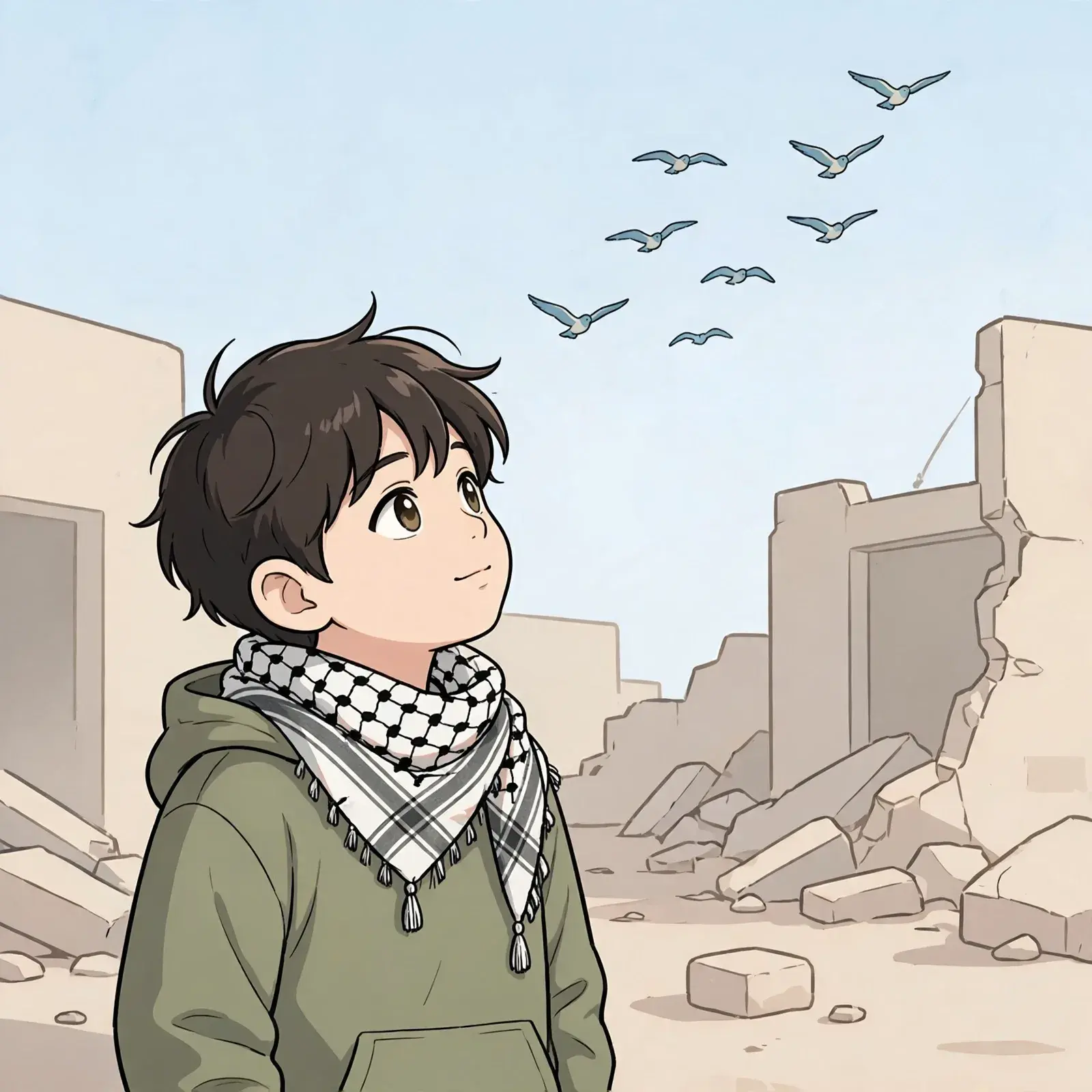
Gaza, Answered Again and Again
Where have so many children lost limbs in conflict? Where have so many United Nations personnel been killed? Where has most of the vegetation reportedly been destroyed in less than a year, and where did enormous flocks of migratory birds once gather on their journeys between continents? The answer given to each question in the book Voices of Gaza is the same: Gaza.
The questions place the scale of the devastation alongside the everyday life that existed before it. They also challenge readers to look beyond images of destroyed buildings and consider the people, animals, farmland, schools, and ecosystems affected by the war. The collection’s message is that Gaza is not only a place where people have been killed and displaced; it is also a home and a living landscape under profound strain.
Published in Korean translation in 2026, Voices of Gaza brings together work by 23 writers, doctors, teachers, human-rights activists, scholars, and journalists. Contributors include graphic novelist Joe Sacco, known for documenting Palestinian experiences, as well as Palestinian poet Mosab Abu Toha. Rather than offering a single account, the book assembles different forms of testimony to make the crisis more visible from multiple angles.
“So that countless victims do not disappear into oblivion.” >The collection presents writing as a way to preserve individual lives and experiences when the scale of the tragedy risks reducing them to statistics.
Testimony as a Record Against Erasure
The book argues that Palestinians have used writing to document what is happening to their communities and to challenge accounts that leave their experiences unheard. Testimony cannot stop an airstrike or restore a destroyed home, but it can preserve names, memories, and descriptions of events that might otherwise be forgotten. In that sense, reading becomes an act of attention: a decision to stay with people’s accounts rather than move on as though the crisis were distant or complete.
This record includes more than descriptions of physical injury. It addresses the destruction of homes and public infrastructure (the systems and buildings people rely on, such as schools, roads, water networks, and hospitals), as well as the damage to education and the natural environment. The collection’s breadth reflects a basic reality of war: when a community’s schools, farms, water, and health services are devastated, the consequences continue long after a particular attack ends.
The book also asks readers to consider the imbalance in who gets heard. Its contributors describe Palestinians writing and publishing as a means of making their lives visible to people outside Gaza. Their appeal is not simply to learn about a past event, but to keep following developments while displacement, destruction, and the loss of life continue.
Accounts of Humiliation and Cruelty
Mary Turfa, a journalist and surgeon in the United States whose family is part of the Palestinian diaspora (a population living outside its ancestral homeland), writes about what she describes as entrenched anti-Palestinian hatred among Israeli soldiers. Her account discusses images and videos circulated online in which soldiers reportedly posed in Palestinian homes, mocked the ruins, or treated objects belonging to residents as props. The book presents these acts not as harmless jokes, but as forms of humiliation directed at people whose homes and communities have been taken over or destroyed.
Turfa also challenges the idea that such material should automatically be dismissed as the behavior of a few individuals suffering from trauma. She points to the circulation of war imagery in social media and messaging spaces, including content that ridicules dead or starving Palestinians. Her concern is that public amusement at suffering may reveal a wider culture of dehumanization (treating people as less than fully human), rather than a handful of isolated incidents.
“More chilling than the cruel images themselves is the way they openly express delight in cruelty.” >Turfa’s observation shifts attention from the images alone to the reactions they invite and the attitudes they may normalize.
The book’s accounts are a call to examine how online platforms can turn images of war into entertainment or propaganda. A short clip shared for laughs can travel far beyond the people who recorded it, while the person shown may have no control over how the image is used. The collection asks readers to treat such material as evidence of how violence is represented, not as a spectacle detached from the lives behind it.
The War’s Environmental Toll
Nina Lakhani’s essay, titled “Palestinian Ecocide,” focuses on the environmental damage described in the book. Ecocide is a term used for extensive destruction of ecosystems; it is not a universally defined crime in international law. The essay reports that by around June 2024, 83% of Gaza’s vegetation and 70% of its agricultural land had been destroyed.
The collection also cites an estimate of 42 million tonnes of rubble from damaged or destroyed buildings. The debris is described as mixed with hazardous waste and human remains, creating risks to the air, soil, and groundwater. When toxic materials enter soil or water, the effects can reach beyond the immediate area—for example, contaminated water can affect households, crops, and animals that depend on the same supply.
The consequences may persist even after the fighting subsides. Clearing rubble safely can take years, especially when buildings contain dangerous materials or unexploded weapons. Damaged fields may also require restoration before people can grow food again, meaning environmental destruction can deepen food insecurity and make it harder for displaced families to return.
The essay further argues that the emissions produced by military activity contribute to the climate crisis. It cites an estimate that emissions from the first 120 days of airstrikes and ground operations in 2023 exceeded the annual carbon footprints of 21 climate-vulnerable countries. Such comparisons depend on how emissions are counted, but they underline a wider point: war has environmental costs that do not stop at national borders.
A Landscape, Its Wildlife, and the Possibility of Return
Gaza lies within a migratory corridor used by birds traveling between Africa, Asia, and Europe. The book describes the region as a major route where huge numbers of birds once passed through, and says that 250 bird species became threatened after the 2023 invasion. Habitat loss, polluted land, disrupted agriculture, and damaged wetlands can all reduce food and shelter for wildlife.
The collection also questions how organizations and institutions respond to environmental harm during war. It criticizes what it sees as selective concern for animal welfare and the environment, arguing that attention can be directed toward one issue while damage in Gaza receives less notice. The wider question is whether environmental protection can be meaningful if the people who live among those ecosystems are denied safety, food, and the chance to return home.
The book connects the destruction of land to the future of Palestinian communities. It quotes Israeli military commander YogeV Bar SheShet as saying that anyone who returned would find the land devastated, without homes or agricultural ground. The collection presents this statement as evidence of how the destruction of a place can also damage people’s hope of rebuilding a life there.
That prospect has implications beyond physical reconstruction. A home is not only a building: it can hold family history, community ties, and the practical means to earn a living. When homes, farms, schools, and local services are destroyed together, returning becomes more difficult even for people who remain determined to do so.
Boycott Campaigns and International Pressure
Omar Barghouti, a Palestinian human-rights activist associated with the Boycott, Divestment and Sanctions movement, describes efforts to increase pressure on Israel. The movement, usually called BDS, encourages boycotts, the withdrawal of investments, and sanctions (official measures intended to exert political or economic pressure). Its supporters see these tools as a way to press for Palestinian rights; critics dispute the campaign’s methods and political aims.
The book points to examples of local and institutional action. It says Alameda, California, became the first U.S. city to prohibit investments in Israeli arms companies and fossil-fuel interests, and that Norway’s trade-union federation pressed the country’s pension fund to withdraw roughly $500 million in Israeli government bonds. It also reports that Intel halted construction of a planned new facility in Israel and that venture investment in Israeli companies fell 75% after the war began in 2023.
These examples show how public pressure can move from demonstrations into decisions by city governments, unions, pension funds, and businesses. They do not by themselves establish why any one company or institution changed course, and the figures describe developments cited by the book. Still, they illustrate the growing debate over whether economic ties should continue unchanged during a war that has produced extensive civilian suffering and destruction.
Holding on to Life and Memory
The final appeal of Voices of Gaza is not only to document loss, but also to notice how people continue to care for one another. The contributors describe residents sharing food with stray cats and donkeys, doctors treating patients despite danger, children learning amid rubble, and journalists returning to report after the killing of colleagues. These acts do not lessen the scale of the suffering; they show the persistence of ordinary responsibilities under extraordinary pressure.
The book closes its moral argument with words associated with Mahmoud Darwish, one of Palestine’s most beloved poets: “We love life whenever we can.” In the collection, that sentiment is not a denial of grief or a promise that hope will be enough. It is a statement that life, care, and memory endure even when the conditions needed to protect them have been shattered.
The book also links today’s crisis to the Nakba, an Arabic word meaning “catastrophe” that refers to the mass displacement of Palestinians around the creation of Israel in 1948. For many Palestinians, the Nakba remains a living history shaped by displacement, loss, and the enduring demand for a homeland. By placing contemporary testimony within that longer memory, the collection asks readers to understand the current destruction not as an isolated episode, but as part of a history whose consequences remain unresolved.
The book’s final request is direct: when Palestinians write, keep reading; when they write again, read again. >To listen, remember, and stand in solidarity is not a substitute for political action, but the collection argues that forgetting makes it easier for suffering to go unseen.
Why the Stories Matter Beyond Gaza
The experiences gathered in Voices of Gaza concern Palestinians first and foremost, but the book argues that their implications reach further. The destruction of ecosystems, the spread of toxic debris, the collapse of essential services, and the normalization of cruelty all raise questions about the responsibilities of governments, institutions, and audiences around the world. A reader thousands of miles away may not be able to change events directly, but can still examine what is being reported, seek out testimony, and resist treating civilian suffering as background noise.
The collection offers no simple formula for ending the war or repairing what has been lost. Its contribution is to make the human and environmental dimensions of the crisis harder to ignore, while preserving the voices of people who continue to describe their own lives. Its central demand is that attention should not fade while the violence and its effects remain: read, remember, and keep listening until the destruction ends.