The exhibition “From Dots to the World: 100 Years of Korean Braille,” marking the 100th anniversary of Korean Braille, has opened at the National Museum of World Writing Systems (국립세계문자박물관) in Incheon. Artist Eom Jeong-sun’s work “Elephant Without a Trunk 7” opens the exhibition. Rather than viewing the work only with their eyes, visitors experience the exhibition through touch and encounter the message, “A world where everyone can read together.”
Background and context
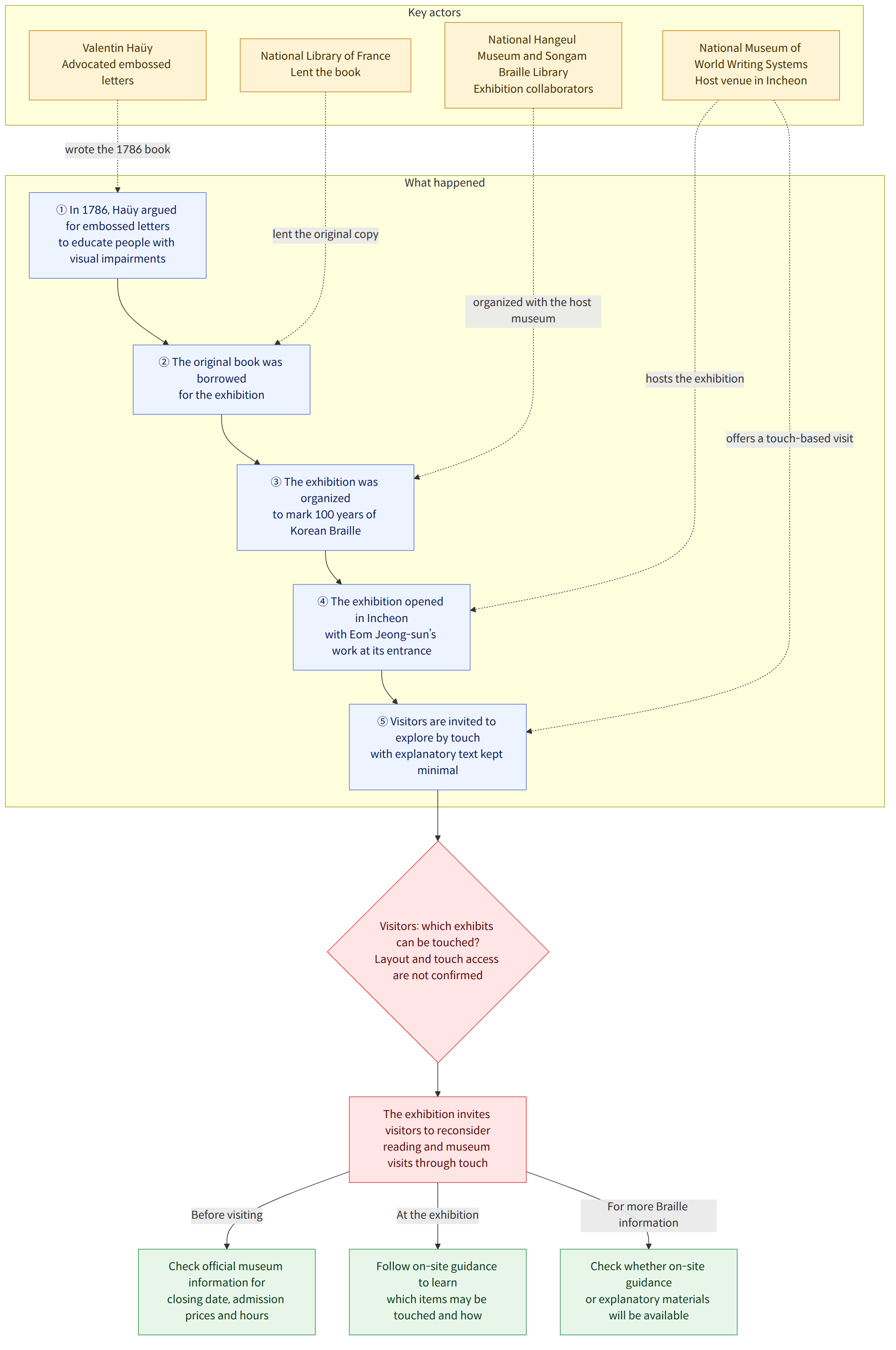
The exhibition was organized in collaboration with the National Hangeul Museum (국립한글박물관) and the Songam Braille Library (송암점자도서관). It aims both to mark the centenary of the Korean Braille system and to raise awareness of Braille. The exhibition questions the convention of treating a museum visit as simply looking at artifacts and makes the experience of touching part of the visit.
Curator Koo Dan-bi said at a press preview on Tuesday that explanatory text had been kept to a minimum so visitors could experience the exhibition through touch. This approach is also connected to the exhibition’s central message: “A world where everyone can read together.”
The exhibition traces the origins of Braille’s history to France. In his 1786 book “An Essay on the Education of the Blind,” Valentin Haüy argued for educating people with visual impairments using embossed letters—that is, characters raised on a surface so they could be read by touch. The original copy of the book was borrowed from the National Library of France for the exhibition.
What this news means
The exhibition does more than introduce Braille as a writing system for people with visual impairments; it also invites visitors to consider the act of reading and the way they experience museums. For visitors accustomed to viewing text and exhibits with their eyes, touch may be an unfamiliar approach. By minimizing explanations and inviting visitors to experience the exhibition by hand, it may prompt them to consider whether the standards for a museum visit are based solely on sight.
The exhibition is significant in showing visitors that there is more than one way to engage with an exhibition. As an event marking 100 years of Braille, it may also help broaden interest in what kind of writing system Braille is. However, the information provided does not establish how the exhibition is arranged or how much of it visitors can touch directly.
For example, for visitors who usually view museum exhibits only with their eyes, experiencing the exhibition by hand may offer another way to understand the works and their message. This does not mean that every exhibit can be touched. Visitors should check the on-site guidance to distinguish which exhibits may be touched and how to experience them.
Confirmed facts and what is not yet known
Confirmed facts
- The exhibition “From Dots to the World: 100 Years of Korean Braille” has opened at the National Museum of World Writing Systems in Incheon.
- Eom Jeong-sun’s “Elephant Without a Trunk 7” opens the exhibition.
- The exhibition is designed to be experienced through touch, with minimal explanatory text, and its central message is “A world where everyone can read together.”
- It was organized jointly with the National Hangeul Museum and the Songam Braille Library, with the aims of marking the 100th anniversary of Korean Braille and raising awareness of Braille.
- The original copy of Valentin Haüy’s 1786 book was borrowed from the National Library of France for the exhibition.
What is not yet known
- The information provided does not say how long the exhibition will run, or give admission prices or visiting hours.
- The exhibition’s detailed layout and the range of exhibits visitors can touch directly have also not been confirmed.
What readers should check
- Before visiting, check the museum’s official information for the exhibition’s closing date, admission prices and visiting hours.
- Do not assume that every work can be touched just because touch is central to the exhibition. Follow the on-site guidance to find out which items may be touched and how.
- If you want to learn more about Braille at the exhibition, check in advance whether on-site guidance or explanatory materials will be available.