
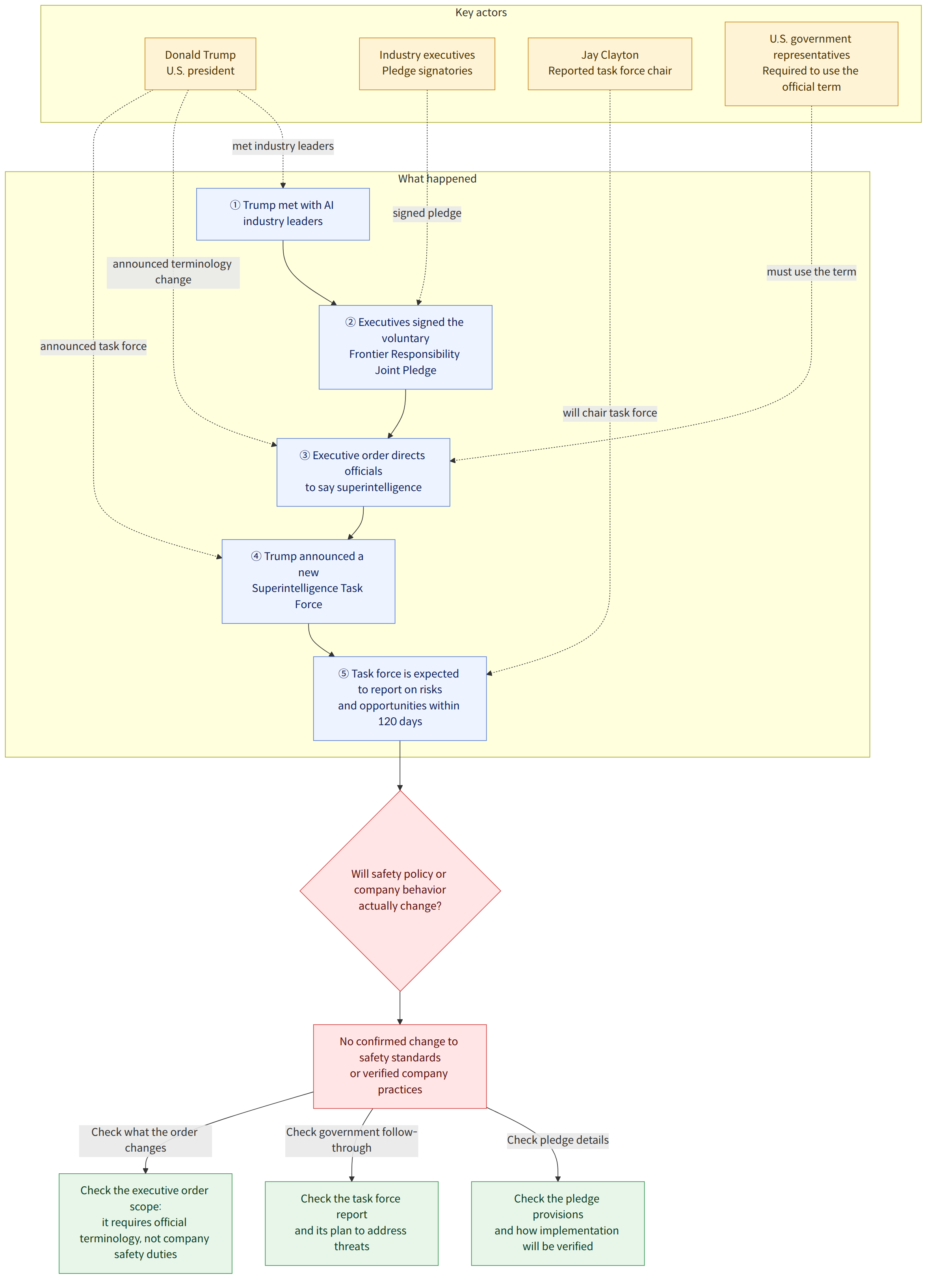
After meeting with leading figures in the artificial intelligence industry, U.S. President Donald Trump announced that the U.S. government would use the term “superintelligence” instead of “artificial intelligence.” Industry executives signed the Frontier Responsibility Joint Pledge (프런티어 책임 공동 약속), but the pledge was reported to be voluntary and not legally binding. President Trump described it as “morally binding.”
Over the weekend, President Trump also announced the launch of a “new Superintelligence Task Force.” The move therefore includes not only a change in terminology and an industry declaration, but also plans for a government response. However, it remains unclear how much these measures will actually change AI safety policy and companies’ behavior.
Background and context
Anthony Ha explained that, under a presidential executive order (행정명령), official representatives of the U.S. government must say “superintelligence,” not “artificial intelligence.” This was presented as an official change in terminology included in the executive order, rather than a simple recommendation about wording. But changing the terminology and changing policies to reduce the risks of the technology are separate matters.
At the meeting, industry executives signed the Frontier Responsibility Joint Pledge. Sean O'Kane noted that the pledge was voluntary and not legally binding, and said that the signed document also misspelled “United States.” He cited these points as reasons to be skeptical about how much the pledge would actually mean.
The new Superintelligence Task Force announced by President Trump is reportedly to be led by Director of National Intelligence Jay Clayton. According to a separate report, Clayton will serve as chair, with Federal Trade Commission (연방거래위원회) Chair Andrew Ferguson, Under Secretary of War for Research and Engineering Emil Michael, and Director of the Office of Personnel Management (인사관리처) Scott Cooper serving as vice chairs. The organization is reportedly expected to produce a report on AI risks and opportunities within 120 days and develop a plan to address threats enabled by superintelligence, while avoiding excessive regulation that could stifle innovation and competition.
What this news means
Some have interpreted the meeting as rebranding—a freshening up of a name and image. Kirsten Korosec said the message she took from it was that “AI is scary and could take jobs, but superintelligence isn’t.” This was the message she read into the meeting, not confirmation that the risks or employment effects have actually changed.
Korosec said the meeting was attended by Mark Zuckerberg, Jeff Bezos, Elon Musk, and Anthropic CEO Dario Amodei. Amodei was invited to a 10 p.m. dinner and, a few days later, also attended a lunch with industry figures. The meetings show that a point of contact has been established between the government and Anthropic, but they do not establish that tensions have eased.
O'Kane said the Department of Defense (국방부) still views Anthropic negatively and claims it poses a national security risk, while Emil Michael criticizes Anthropic on X. Ha explained that within the White House (백악관), some officials support using Anthropic’s technology and others oppose it; the Treasury secretary is favorable toward it, while the Department of Defense is dissatisfied. In other words, there is no basis to conclude from the meeting alone that disagreements within the government or the conditions for using the technology have been resolved.
The pledge is not legally binding, and it has not been confirmed whether requiring the use of the term “superintelligence” has changed safety standards or companies’ obligations.
For example, even if a company signed the pledge, it would be difficult to determine from the signature alone whether safety measures had been implemented if specific provisions and a way to verify implementation had not been established. For that reason, what readers should focus on is not the new terminology itself, but the pledge’s contents, whether it is implemented, and the report the Superintelligence Task Force will produce.
Relevant policies and support information
The measures presented were reported to consist not of mandatory safety regulations for companies, but of a voluntary joint pledge and plans for government reporting and response. The presidential executive order was described as requiring official U.S. government representatives to use the term “superintelligence.” The available information does not confirm the joint pledge’s specific provisions or how implementation will be verified.
According to reports, the new Superintelligence Task Force is expected to produce a report on AI risks and opportunities within 120 days. The information presented so far does not show the extent of the organization’s authority and responsibilities, or what actions may follow from the report.
What is confirmed and what remains unknown
Confirmed
- President Trump announced an executive order requiring the government to use the term “superintelligence” instead of “artificial intelligence.”
- Industry executives signed the Frontier Responsibility Joint Pledge, which was reported to be voluntary and not legally binding.
- President Trump described it as “morally binding.”
- President Trump announced a new Superintelligence Task Force, which is reportedly expected to produce a report on AI risks and opportunities within 120 days.
Still unknown
- Which companies and executives signed the joint pledge, and what is the complete list?
- What are the pledge’s specific provisions, and how will compliance be verified?
- What authority and responsibilities will the Superintelligence Task Force have?
- Will the change in terminology and the joint pledge actually change AI safety policy or companies’ behavior?
What readers should watch for
- It will be worth watching whether the full text of the joint pledge and its signatories are made public and, if so, whether it includes actual obligations and procedures for verifying implementation.
- Readers can check whether the report mentioned in coverage is released within 120 days and what it says about responding to risks and regulation.
- It is worth watching whether the Superintelligence Task Force’s authority and responsibilities are clarified, particularly whether responsibility for using the technology and responding to safety concerns is clearly assigned.
References
- Other coverage consulted: techcrunch.com