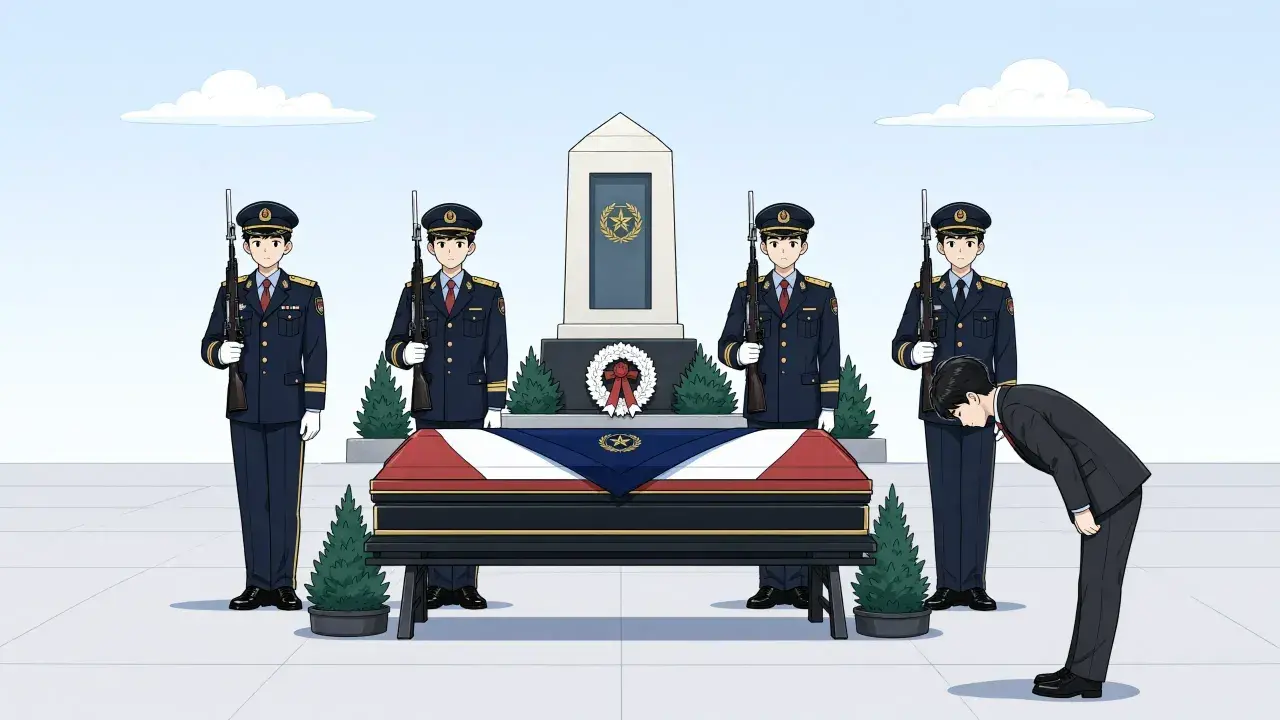
The remains of independence activist Lee Han-ho (1895–1960), who died overseas, were returned to his homeland and laid to rest on November 15, 2022. At a repatriation ceremony held at Terminal 1 of Incheon International Airport (인천국제공항), his great-great-granddaughter Hwang So-young read aloud a letter she had written to him. As she reached the end of the letter, her voice trembled slightly. Lee Han-ho’s remains were then carried to the ceremony venue by the Ministry of National Defense Honor Guard (국방부 의장대).
Lee Han-ho’s remains were repatriated 107 years after he left his homeland.
Background and context
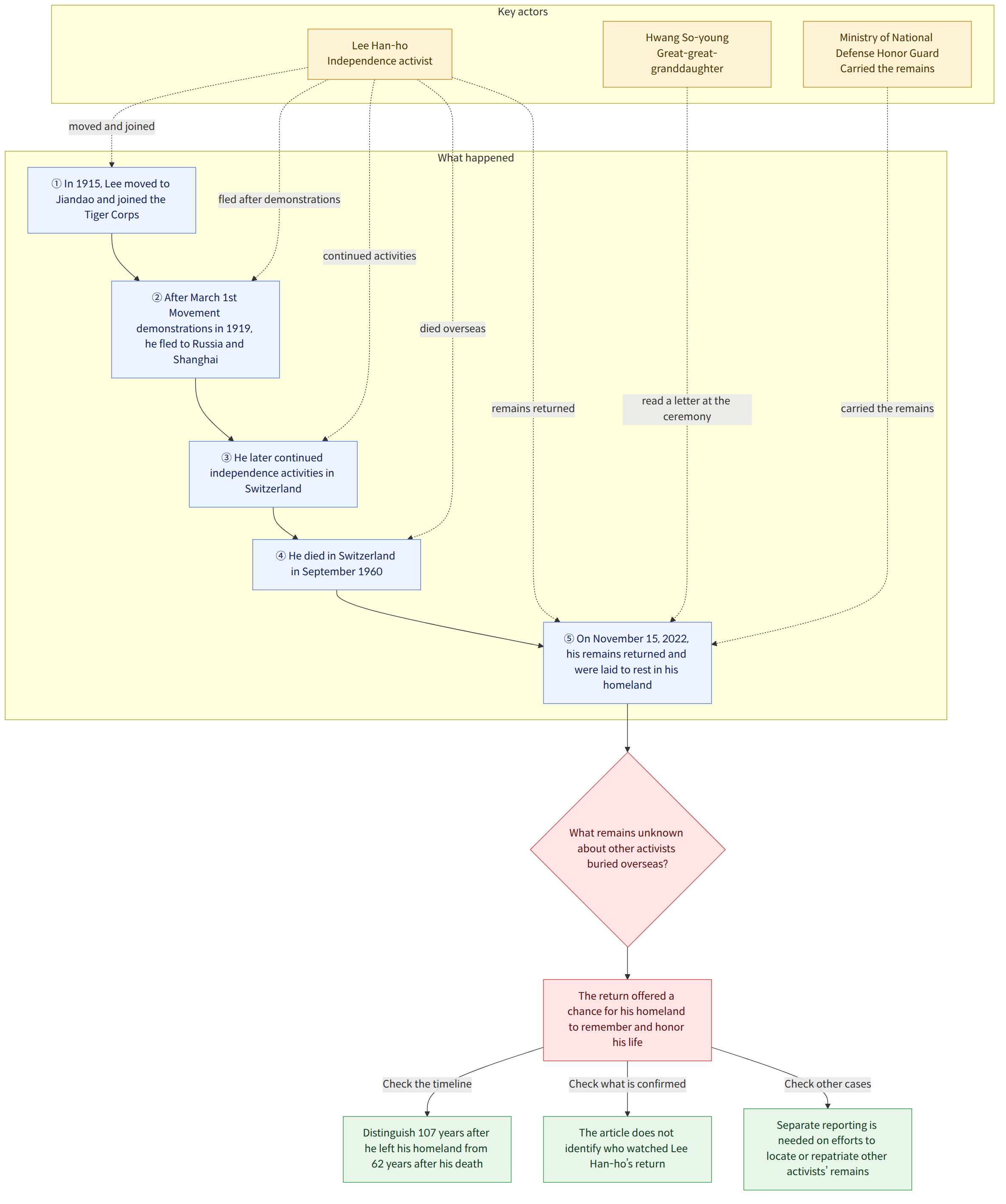
In 1915, Lee Han-ho moved to the Jiandao region of China and joined the Tiger Corps (맹호단), an anti-Japanese independence group. After taking part in demonstrations during the March 1st Movement (3·1운동) in 1919, he fled to Russia and Shanghai, China, to escape the Japanese police. He later moved to Switzerland and continued his independence activities. He died in Switzerland in September 1960.
This route shows that the independence movement did not take place in just one region. Lee Han-ho’s life took him through Jiandao, Russia, Shanghai and Switzerland, and it took a long time after his death for his remains to return to his homeland. According to the article, his return and burial took place 107 years after he left his homeland and 62 years after his death.
What this news means
The repatriation of remains is not merely a procedure for moving a deceased person’s remains; it can also offer an opportunity for the person’s homeland to remember and honor anew the life of an independence activist who worked and died overseas. In particular, the regions where Lee Han-ho continued his independence activities, as well as the time it took for him to return, underscore that remembering the history of the independence movement also means looking at lives that crossed borders.
For example, when readers encounter the story of an independence activist who died overseas, they can look not only at the person’s activities and life but also at where the remains were laid to rest and whether they were returned. However, one person’s repatriation does not tell us the status of efforts to repatriate the remains of other independence activists buried overseas.
Confirmed facts and what remains unknown
Confirmed facts
- The ceremony repatriating Lee Han-ho’s remains was held at Terminal 1 of Incheon International Airport on November 15, 2022.
- His great-great-granddaughter Hwang So-young read aloud a letter she had written to Lee Han-ho at the ceremony, and her voice trembled slightly near the end.
- Lee Han-ho moved to the Jiandao region of China in 1915 and joined the Tiger Corps.
- After taking part in demonstrations during the March 1st Movement in 1919, he fled to Russia and Shanghai, and later continued his independence activities in Switzerland.
- Lee Han-ho died in Switzerland in September 1960, and his remains were laid to rest in his homeland on November 15, 2022.
What remains unknown
- The article does not establish who watched Lee Han-ho’s return. The original text cuts off before the sentence about that person is complete.
- The article does not explain how efforts to locate the graves of other independence activists buried overseas are proceeding.
What readers should check
- When citing Lee Han-ho’s timeline, distinguish between “107 years after he left his homeland” and “62 years after his death,” which are periods measured from different starting points.
- Readers can note that Hwang So-young’s reading of the letter and the transport of the remains are confirmed events, but the original text does not identify the person who watched the return.
- Anyone seeking information about efforts to identify the graves or repatriate the remains of other independence activists will need to consult separate reporting, as this article does not cover those matters.