
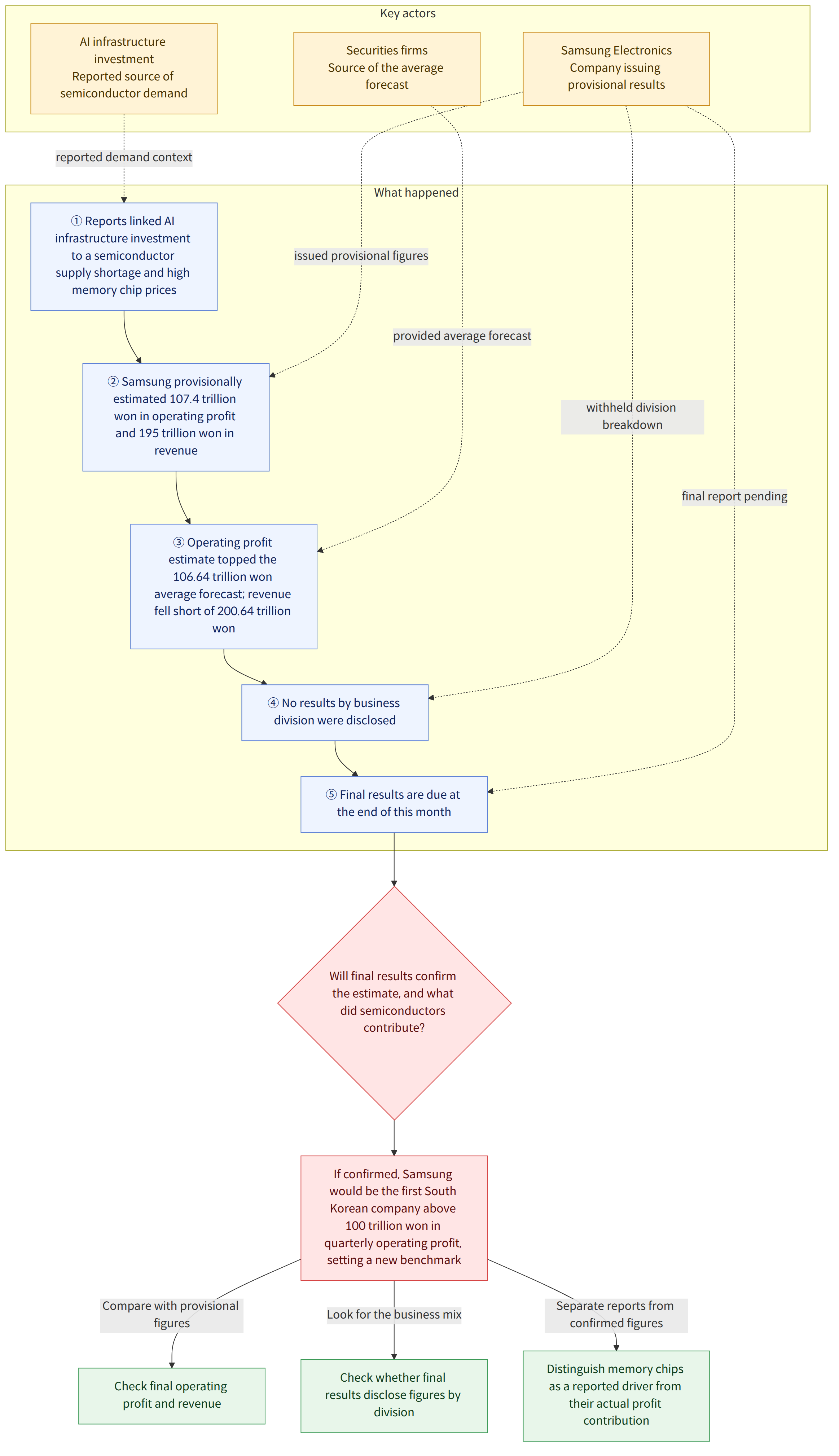
Samsung Electronics provisionally estimated third-quarter operating profit at 107.4 trillion won and revenue at 195 trillion won. If the operating profit estimate holds in the final results due at the end of this month, the company will become the first South Korean company to exceed 100 trillion won in quarterly operating profit. Based on the provisional figures, operating profit was up 782.5% and revenue 126.6% from the same period a year earlier.
Background and context
Operating profit refers to the profit a company earns from its core business. Samsung Electronics’ operating profit estimate exceeded the average forecast of 106.64 trillion won by securities firms, but its revenue estimate of 195 trillion won fell slightly short of the 200.64 trillion won forecast. The announcement therefore showed a stronger performance against market expectations in profit than in revenue.
The source report said there had been concerns that the won’s sharp appreciation against the U.S. dollar compared with the previous quarter could weigh on profitability, but results exceeded expectations. The fact that operating profit came in above the average forecast despite concerns about potentially unfavorable exchange-rate conditions is noteworthy. However, the provisional results disclosed so far do not make it possible to determine how much profit each business division generated.
Reports identified memory chips as a key driver of the results. Another report pointed to increased investment in artificial intelligence (AI) infrastructure, which has intensified the semiconductor supply shortage and kept memory chip prices high. This provides a basis for interpreting the results in relation to the semiconductor market, but Samsung Electronics did not disclose figures by business division in its provisional results.
What this news means
If Samsung Electronics’ quarterly operating profit exceeds 100 trillion won, it could be seen as a new benchmark for gauging the scale of profitability among South Korean companies. The market may be interested not only in the overall profit figure, but also in how that profit was generated across businesses, including semiconductors. Without figures by division, assessments that semiconductors were a key driver should be distinguished from the actual amount they contributed.
For example, investors seeking to gauge Samsung Electronics’ earnings trend based on the semiconductor market cannot use these provisional figures alone to estimate the semiconductor division’s profit or the performance of other businesses. Any detailed figures released with the final results could offer a clearer picture of the business mix behind the overall record. This distinction matters both to investors following Samsung Electronics’ results and to readers interested in the profitability trends of South Korean companies.
Points reported differently by different outlets
Reports agreed on the won-denominated estimates for operating profit and revenue, but gave different dollar conversions for operating profit: $80.28 billion and $79.8 billion. One report also cited the average forecast by securities firms of 106.64 trillion won, while another said the results exceeded its cited market consensus by 1.6%.
What is confirmed and what remains unknown
Confirmed facts
- Samsung Electronics provisionally estimated third-quarter operating profit at 107.4 trillion won and revenue at 195 trillion won.
- The operating profit estimate exceeded the average forecast by securities firms of 106.64 trillion won, while the revenue estimate fell slightly short of the 200.64 trillion won forecast.
- If the estimates are confirmed, operating profit will have increased 782.5% and revenue 126.6% year on year.
- Samsung Electronics did not disclose estimated results by business division in its provisional results announcement.
What remains unknown
- It is not yet known how much the final results due at the end of this month will differ from the provisional estimates.
- The reports provided do not specify operating profit or revenue for each business division.
- The provisional announcement alone does not reveal the exact amount the semiconductor business contributed to overall profit.
What readers should check
- Check whether operating profit and revenue differ from the provisional estimates in the final results announcement due at the end of this month.
- See whether results by business division are disclosed; this can help distinguish the assessment that memory chips were the main driver from the actual figures.
- When comparing earnings forecasts, it is useful to check not only the won-denominated operating profit estimate but also the market consensus used by each report.
References
- Other coverage consulted: en.yna.co.kr
- Other coverage consulted: m.koreaherald.com