Even when the Seoul Metropolitan Government (서울시) provides its own welfare services to people whom the Ministry of Health and Welfare (보건복지부) has identified based on signs of hardship, such as having their electricity or water cut off, and referred to local governments, the support may not appear in the ministry’s records. That is because Seoul and the ministry manage services in separate information systems, and records of Seoul-style support are not automatically reflected in the ministry’s figures. This does not mean that no support was provided; rather, it means the government’s records alone may not make it possible to verify whether support was provided.
Background and context
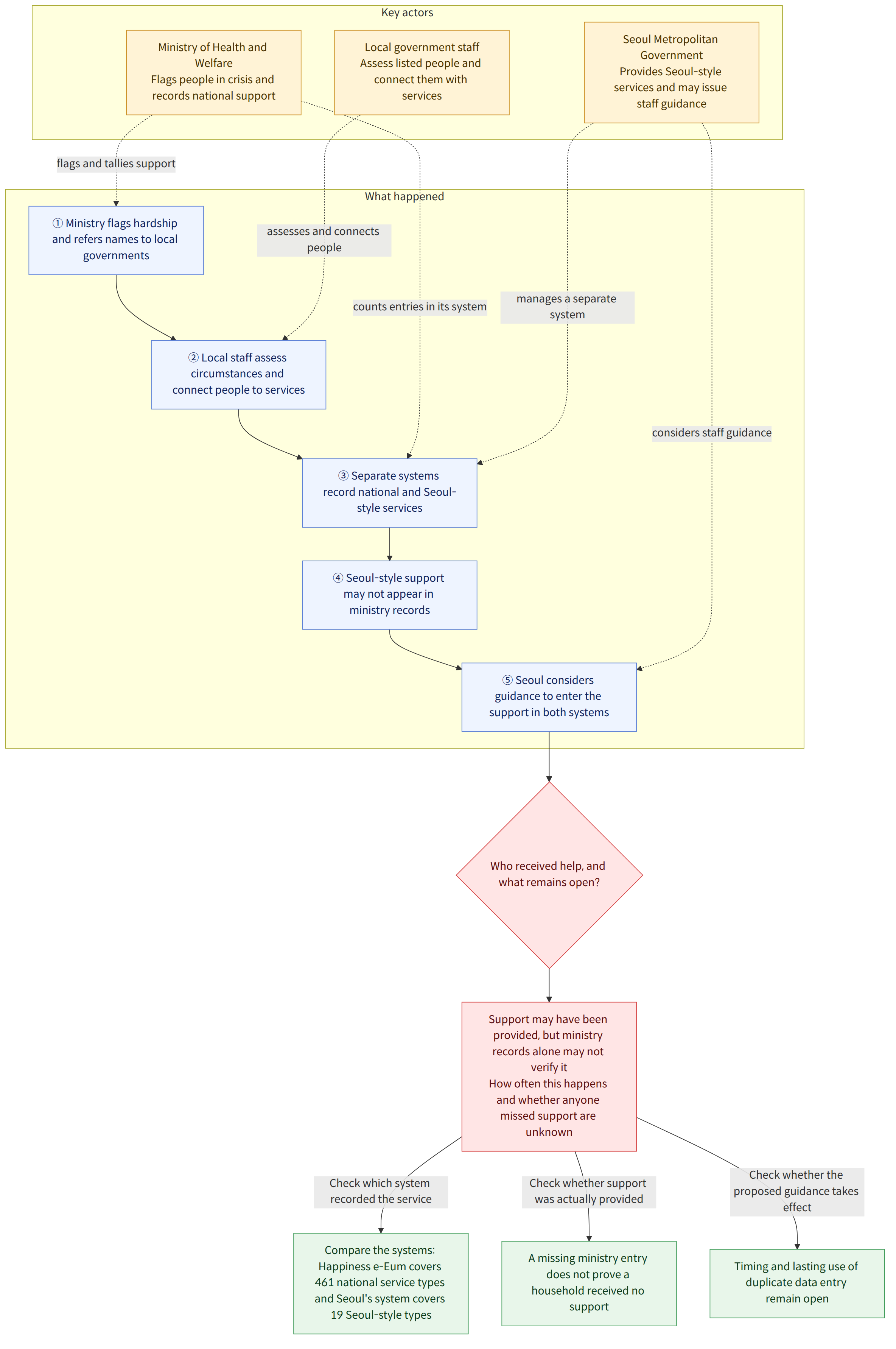
The ministry classifies people flagged for signs of hardship, such as having their electricity or water cut off, as “people suspected of being in crisis” and sends their names to local governments. Local government staff assess their living circumstances and connect them with the welfare services they need. The ministry tallies support entered in Happiness e-Eum (행복이음) as official results, which serve as evidence for checking whether people on the lists actually received support.
The problem is that the systems used to manage service records are separate. The ministry’s Happiness e-Eum system manages 461 types of national welfare services, while the Seoul Living Welfare Information System (서울시 생활복지정보시스템) manages 19 types of Seoul-style services. When a national service is arranged through Happiness e-Eum, it is counted in the ministry’s records. But Seoul-style services recorded in the city’s system are not automatically reflected in the ministry’s figures for identifying and supporting people in crisis.
Therefore, if Seoul’s emergency welfare services or Care SOS (돌봄SOS) are handled only through the city’s system, the support may not be entered in the ministry’s records even if it was actually provided. Seoul does not separately count how many people identified by the ministry received only Seoul-style services, so it is also unable to determine how many people may be missing from the records.
What this means
Support for households in crisis does not end with identifying people in need. Records must show what support was arranged so that the responsible agencies can distinguish between people who have already received help and those who need additional support. The key issue here is that separate information systems can create a gap in which frontline staff provide support, but it cannot be verified in the central government’s records.
The fact that support is not recorded in the ministry’s figures does not, by itself, prove that a household did not actually receive support. However, missing records can make it harder to check whether support was provided and decide on follow-up measures.
For example, if a person identified as being at risk receives only a Seoul-style service, that information may be recorded in the city’s system but not appear in the ministry’s records. In that case, anyone reviewing the figures may not be able to verify immediately whether support was actually provided. However, the source does not establish how often this has happened or whether anyone was actually left without support because their records were missing.
A Seoul Metropolitan Government official said that directly linking the two systems would be difficult and that the city would consider issuing guidance instructing frontline staff to enter information about Seoul-style support in the ministry’s records as well. Since this would involve entering the same support information separately rather than integrating the systems immediately, the timing of implementation and whether the additional data entry becomes established practice remain to be seen. Lee In-young, a lawmaker with the Democratic Party of Korea (더불어민주당), said the ministry should call on Seoul to improve its management of support records and establish a system for sharing information.
What is confirmed and what remains unknown
Confirmed facts
- The ministry classifies people flagged for signs of hardship as people suspected of being in crisis and sends their names to local governments.
- Local government staff assess the circumstances of those listed and connect them with the welfare services they need.
- Happiness e-Eum manages 461 types of national services, while the Seoul Living Welfare Information System manages 19 types of Seoul-style services.
- Records of support through Seoul-style services may not be automatically reflected in the ministry’s figures, and Seoul has not separately counted the number of people omitted from those records.
- Seoul said it would consider issuing guidance for frontline staff on entering information in the ministry’s records as well, but it did not provide an implementation date.
What remains unknown
- How many people who received Seoul-style services were actually omitted from the ministry’s records.
- When the guidance on additional data entry will take effect.
- Whether any cases of actual support being missed occurred because support information was not reflected in the ministry’s records.
What readers can check
- If you need to verify whether you received a Seoul-style welfare service, you can ask the local government official handling your case which system the information was recorded in.
- Officials reviewing support for households in crisis should check whether there is a procedure to ensure that support recorded in Seoul’s system is also entered in the ministry’s records.
- The timing of Seoul’s proposed guidance has not yet been confirmed. Readers should check whether it has been implemented and whether procedures for frontline staff to enter the information have been established.