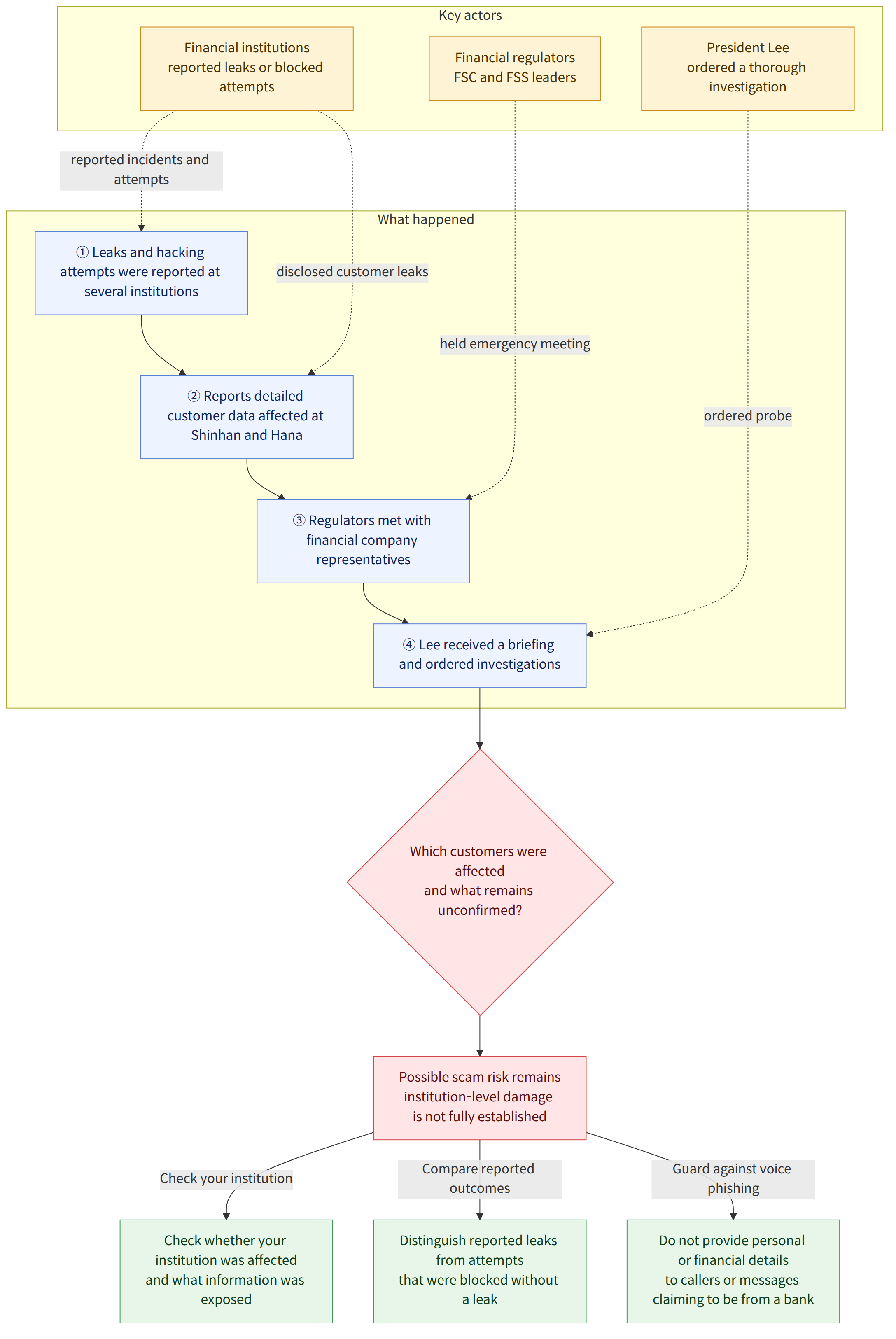
President Lee Jae Myung called for a thorough investigation into a series of personal data leaks at financial institutions. In a report published on October 4, 2026, Yonhap News Agency (연합뉴스) said Lee had received a briefing on data leaks and responses at financial and public institutions, and had instructed authorities to treat the matter seriously and focus on investigations and measures to address it.
The key point is not a single incident at one particular bank, but that information leaks and hacking attempts have continued at several places, including financial institutions. However, reports mention different institutions and affected data, so it should not be assumed that the same types and amounts of information were leaked at every financial institution.
Background and context
According to a follow-up report by Yonhap News Agency, Shinhan Bank disclosed on Thursday that the personal information of about 25,000 customers had been leaked. The leaked information reportedly included names, phone numbers and annual incomes. Personal information belonging to 89 customers was reportedly leaked at Hana Bank.
The same report said Woori Bank (우리은행) and NH NongHyup Bank (NH농협은행) were also targets of similar hacking attempts, but blocked unauthorized access and did not suffer any personal data leaks. The chair of the Financial Services Commission (금융위원회) and the governor of the Financial Supervisory Service (금융감독원) held an emergency meeting with representatives of the affected financial companies to discuss the matter.
The Financial Services Commission chair said several security breaches had been identified over a short period not only at major commercial banks, but also at savings banks and specialized credit finance companies. The chair also said that, so far, no sensitive information that could be used for unauthorized payments appeared to have been leaked, but called for a high level of vigilance, warning that the leaked information could be used in scams such as voice phishing.
The Financial Services Commission chair warned that leaked information could be exploited in voice phishing and other scams. This is a risk to keep in mind separately from the explanation that, so far, no sensitive information used for unauthorized payments has been identified.
What this news means
For users of financial services, what matters is not only that “a leak occurred,” but whether the institution they use experienced an incident and what information was affected. The Financial Services Commission chair’s warning shows that even when basic information such as names or contact details is exposed, there may be concerns about impersonation calls or scams using that information. However, the reports alone do not establish that any particular user has actually been defrauded.
For example, if someone receives a call or message pretending to be from a financial institution, it is safer not to immediately provide personal or financial information requested by the other party, keeping in mind the voice-phishing risk mentioned in the reports. This does not mean that harm to a particular person has been confirmed; it is a general precaution against the reported possibility of misuse.
Points that differ between reports
Reports differ in their accounts of which institutions experienced incidents and the scope of the damage. One report said incidents had been reported in succession at Shinhan Bank, KB Kookmin Bank (KB국민은행), Hana Bank and BNK Busan Bank (BNK부산은행), and described the leaked information as including names, phone numbers, annual incomes, loan limits and some resident registration numbers. By contrast, a follow-up report specifically cited leaks affecting about 25,000 Shinhan Bank customers and 89 Hana Bank customers, and said Woori Bank and NH NongHyup Bank had blocked hacking attempts and suffered no leaks. The accounts in the two reports do not allow all leaked data at each institution to be definitively established or the differing descriptions to be combined into a single list of affected information.
Reports also differed in how strongly they described the use of artificial intelligence (AI). One said AI-based cyberattacks are increasingly targeting financial institutions, while a follow-up report said the Financial Services Commission chair had not ruled out the possibility that AI tools were used in the hacking.
What is confirmed and what remains unknown
What is confirmed
- President Lee received a briefing on personal data leaks at financial and public institutions and their responses, and ordered thorough investigations and measures to address the problem.
- Reports mentioned information leaks affecting about 25,000 Shinhan Bank customers and 89 Hana Bank customers.
- Woori Bank and NH NongHyup Bank reportedly experienced hacking attempts but blocked them, with no personal data leaks.
- The Financial Services Commission chair warned that the information could be used in scams such as voice phishing and did not rule out the possibility that AI tools were used.
What remains unknown
- The final types and total volume of information actually leaked at each financial institution
- Who is conducting the investigation into each incident, the results of those investigations and the specific measures that will follow
- How customers whose personal information was leaked were notified
What readers should check
- Check official notices from the financial institution you use to see whether it experienced an incident and whether your information was affected.
- If the institution has issued a notice, review what kinds of information were leaked and what steps it recommends.
- If you receive a communication from someone posing as a financial institution, do not immediately provide the requested information; verify whether it is genuine through an official channel.
References
- Other coverage consulted: koreatimes.co.kr
- Other coverage consulted: en.yna.co.kr