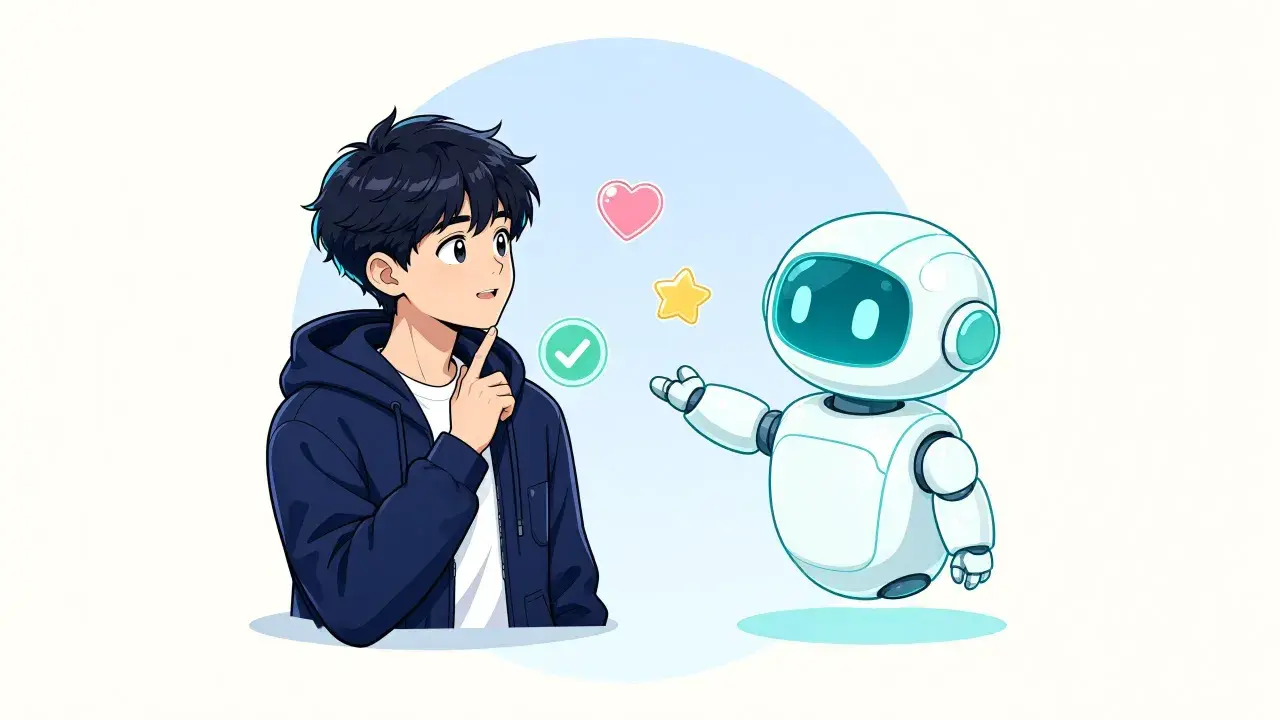
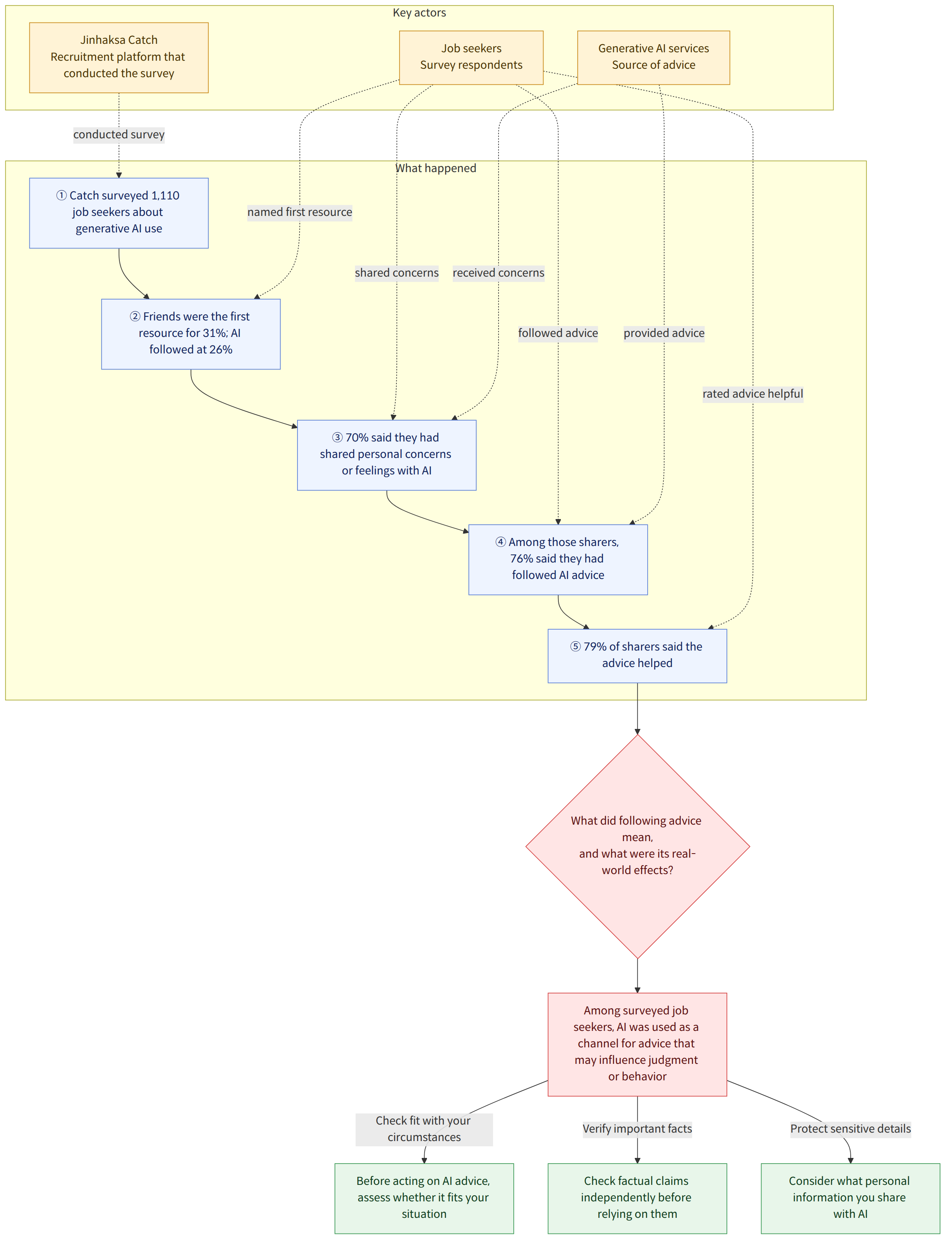
A survey of job seekers found that generative artificial intelligence (AI) has become a place to share personal concerns and seek advice. AI was named by 26% of respondents as the first place they turned when they had a problem, second only to friends (31%). Seventy percent of respondents said they had shared personal concerns or feelings with an AI service.
Background and context
The recruitment platform Jinhaksa Catch (진학사 캐치) surveyed 1,110 job seekers about their use of generative AI. Based on the findings, a report said generative AI is being used by job seekers, particularly Generation Z, as a channel for seeking personal advice.
Friends were named by 31% of respondents as the first people or resource they turned to when a problem arose. Generative AI followed at 26%, then family at 18% and romantic partners at 13%. The findings show that AI did not rank ahead of friends, but that more respondents said they turned to it before family or romantic partners.
Fifty-eight percent of respondents said they used generative AI several times a day. However, the survey results alone do not show whether this frequent use was mainly for job-search tasks or personal advice.
What this news means
One notable finding is that respondents who had shared concerns with AI also said they had put its advice to use. Among those who had shared concerns, 76% said they had actually followed AI’s advice, and 79% said it had been helpful. This suggests that, at least among the job seekers who took part in the survey, AI may be used not just as a tool for finding information but as a channel for advice that can influence judgment or behavior.
The reasons people turn to AI relate not only to the content of its answers but also to how it can be accessed. Respondents’ main reasons were that it provides objective solutions (27%), does not judge them (22%) and is available 24 hours a day (20%). One interpretation is that people may be more likely to use AI because they feel there is less effort or fewer time constraints involved in seeking help. This is an interpretation based on respondents’ stated reasons, however; it does not mean the survey tested the accuracy of AI advice.
For example, a job seeker might use AI suggestions about interview preparation or career concerns as a starting point for organizing their thoughts. But before making a real decision, they may want to consider whether the suggestions fit their circumstances and whether they have independently verified important facts. The finding that respondents had followed AI advice points to its practical use, while also suggesting that it can be important to assess advice before accepting it.
What is confirmed and what is still unknown
What is confirmed
- Jinhaksa Catch surveyed 1,110 job seekers about their use of generative AI.
- The reported ranking of the first place respondents turned when a problem arose was friends (31%), generative AI (26%), family (18%) and romantic partners (13%).
- Fifty-eight percent of respondents said they used generative AI several times a day, and 70% said they had shared personal concerns or feelings with AI.
- Among respondents who had shared concerns with AI, 76% said they had actually followed its advice, and 79% said it had been helpful.
- The main reasons for turning to AI were that it provides objective solutions (27%), does not judge users (22%) and is available 24 hours a day (20%).
What is still unknown
- The report did not specify when or how the survey was conducted.
- The composition of the survey group, including respondents’ ages and genders, is also unknown.
- It is not known what kinds of concerns or actions respondents meant when they said they had followed AI advice, or how the advice affected real-world outcomes.
What readers can check
- Before applying AI advice to an important decision, readers can check whether it fits their specific circumstances.
- For information that requires factual accuracy, it is safer to verify it separately rather than draw conclusions based only on an AI response.
- Readers can consider what information they share when discussing personal concerns and think carefully before entering sensitive details.