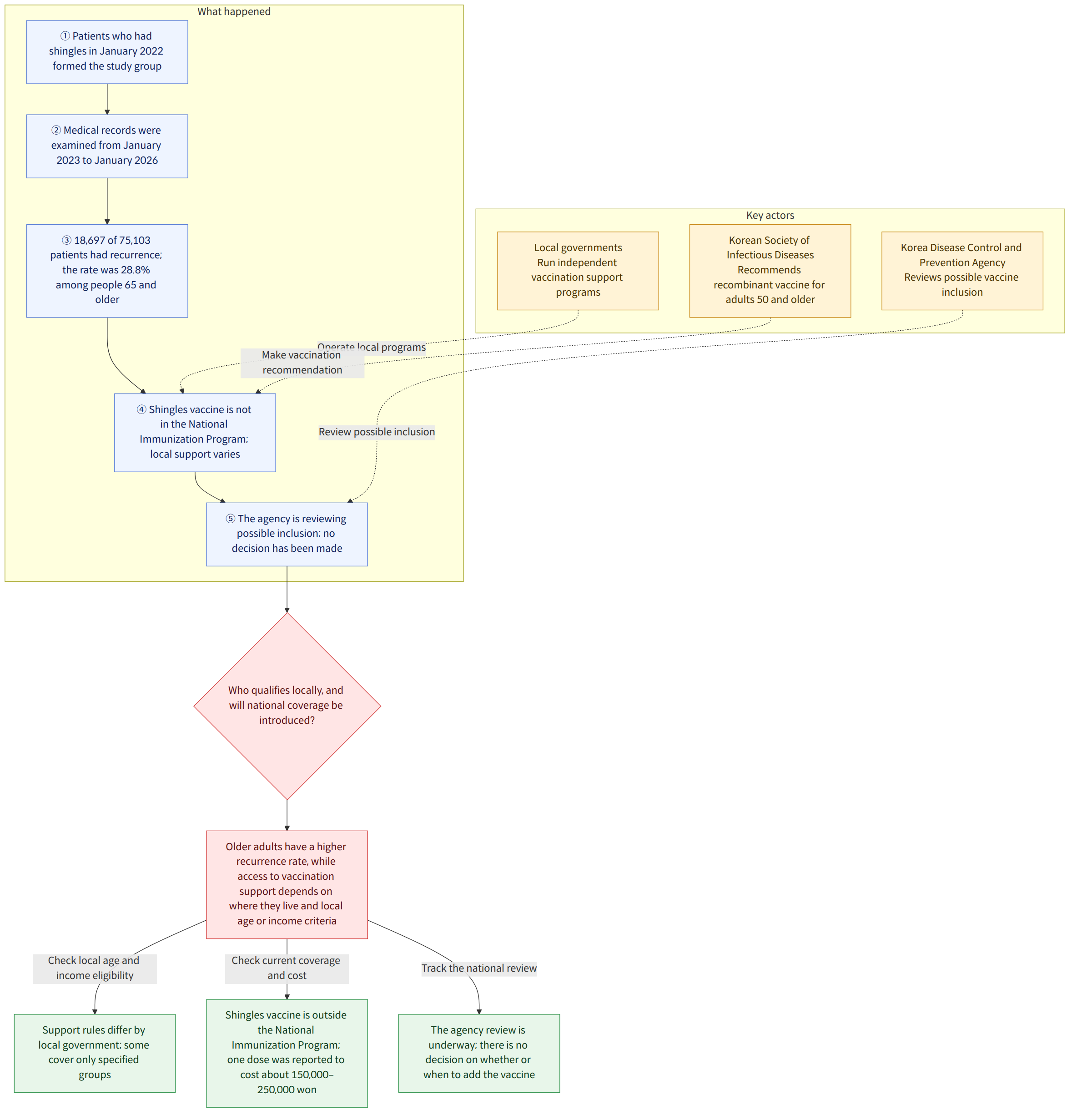
Of the 75,103 shingles patients in January 2022, 18,697 (24.9%) received medical care again between January 2023 and January 2026. Among people aged 65 and older, 7,351 of 25,500 patients had a recurrence, for a recurrence rate of 28.8%. That was 3.9 percentage points higher than the overall recurrence rate. Meanwhile, vaccination support depends on locally operated programs, and whether a person qualifies varies according to their place of residence, age, and income criteria.
Background and context
Shingles is a disease caused when the varicella-zoster virus, which has been dormant in the body’s nerve ganglia (clusters of nerve cells), becomes active again as immunity declines. This analysis examined subsequent medical records for patients in January 2022. The recurrence rate cited here is therefore the share of that patient group who received medical care again during the specified observation period.
The recurrence rate was 8.37% among people aged 29 or younger. It rose steadily from the 30s onward, reaching a peak of 29.78% among those aged 75–79. The recurrence rate among people aged 65 and older was also higher than the overall rate, at 28.8%. Professor Lee Gu-sang of Seoul St. Mary's Hospital (서울성모병원) explained that shingles and postherpetic neuralgia (nerve pain that can continue after shingles) can cause severe pain and reduce quality of life to the point of making daily activities difficult.
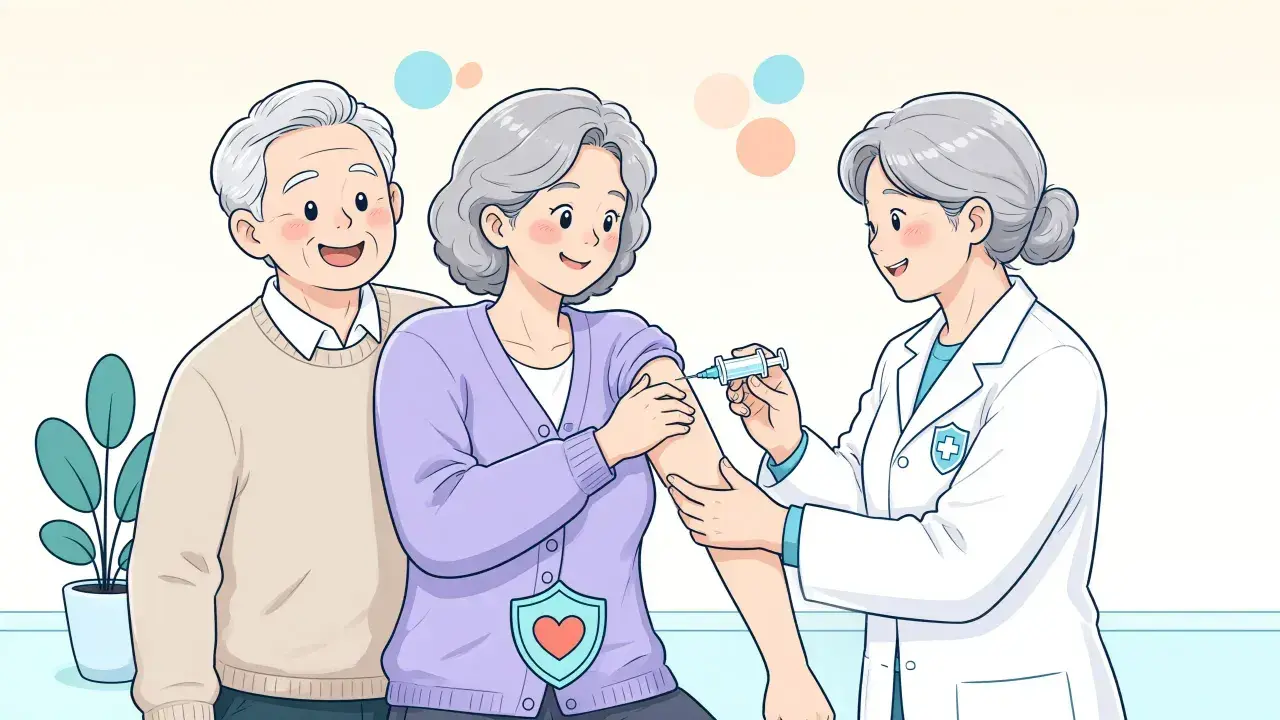
Professor Lee said the Korean Society of Infectious Diseases (대한감염학회) recommends that adults aged 50 and older receive a recombinant shingles vaccine. However, a vaccination recommendation and a government program that covers the cost are separate matters. Shingles vaccination is not included in the National Immunization Program (국가예방접종사업), so whether support is available currently depends on programs run independently by local governments.
What this news means
The higher recurrence rate among older adults shows that health burdens can remain even after a person has had shingles once. In particular, complications such as postherpetic neuralgia can cause pain and make daily life difficult, linking the scope and accessibility of vaccination support to efforts to reduce the disease burden among older adults.
However, vaccination support is not available under the same conditions everywhere in the country. Of the 230 local governments included in the analysis, 175 (76.1%) operated their own support programs, while 55 (23.9%) had no separate program. Among the local governments that operated programs, age and income criteria differed, so people of the same age may or may not qualify for support depending on where they live.
For example, if two people aged 65 and older live in different local governments, one area might support all residents in that age group, while another might support only certain people, such as recipients of basic livelihood security or members of near-poor households. This does not refer to examples from specific local governments; it is an illustration based on the different types of support identified.
Relevant policies and support information
Shingles vaccination is not included in the National Immunization Program, and whether support is available depends on whether a local government operates its own program. In this year's analysis, 121 (69.1%) of the 175 local governments with programs targeted people aged 65 and older. Twenty-three (13.1%) targeted people aged 50 and older, and 19 (10.9%) targeted people aged 60 and older.
The scope of eligibility also varies. Of the local governments operating programs, 94 (53.7%) supported only certain groups, such as recipients of basic livelihood security or members of near-poor households, while 81 (46.3%) supported everyone in the specified age group and older. One dose of the shingles vaccine was reported to cost about 150,000–250,000 won. However, this data does not show exactly who each local government supports or how much it provides.
Assembly member Kim Yoon said the government should actively consider introducing shingles vaccination into the National Immunization Program to reduce the disease burden among older adults and address regional disparities in support. An official from the Korea Disease Control and Prevention Agency (질병관리청) said the agency is comprehensively reviewing whether to introduce several candidate vaccines, including the shingles vaccine, taking into account factors such as disease burden and fiscal conditions. This means that a review is underway; it does not mean that a decision has been made on whether or when to introduce the vaccine.
What is confirmed and what remains unknown
Confirmed facts
- Of the 75,103 shingles patients in January 2022, 18,697 (24.9%) received medical care again between January 2023 and January 2026.
- The recurrence rate among patients aged 65 and older was 28.8%, 3.9 percentage points higher than the overall rate.
- Of the 230 local governments, 175 operated their own support programs, while 55 had no separate program.
- Among local governments with programs, 94 supported only certain groups, while 81 supported everyone in the specified age group and older.
What remains unknown
- Who exactly is eligible for support in each local government, and how much support is provided for vaccination.
- When a decision will be made on whether to add the vaccine to the National Immunization Program, and whether it will actually be introduced.
- Whether recurrences occurred after the observation period and whether the same recurrence rate would be seen in other patient groups.
What readers can check
- If you are considering vaccination, first check with your local government to find out whether it has its own shingles vaccination support program and whether its age and income criteria apply to you.