
A major share sale to raise personal funds
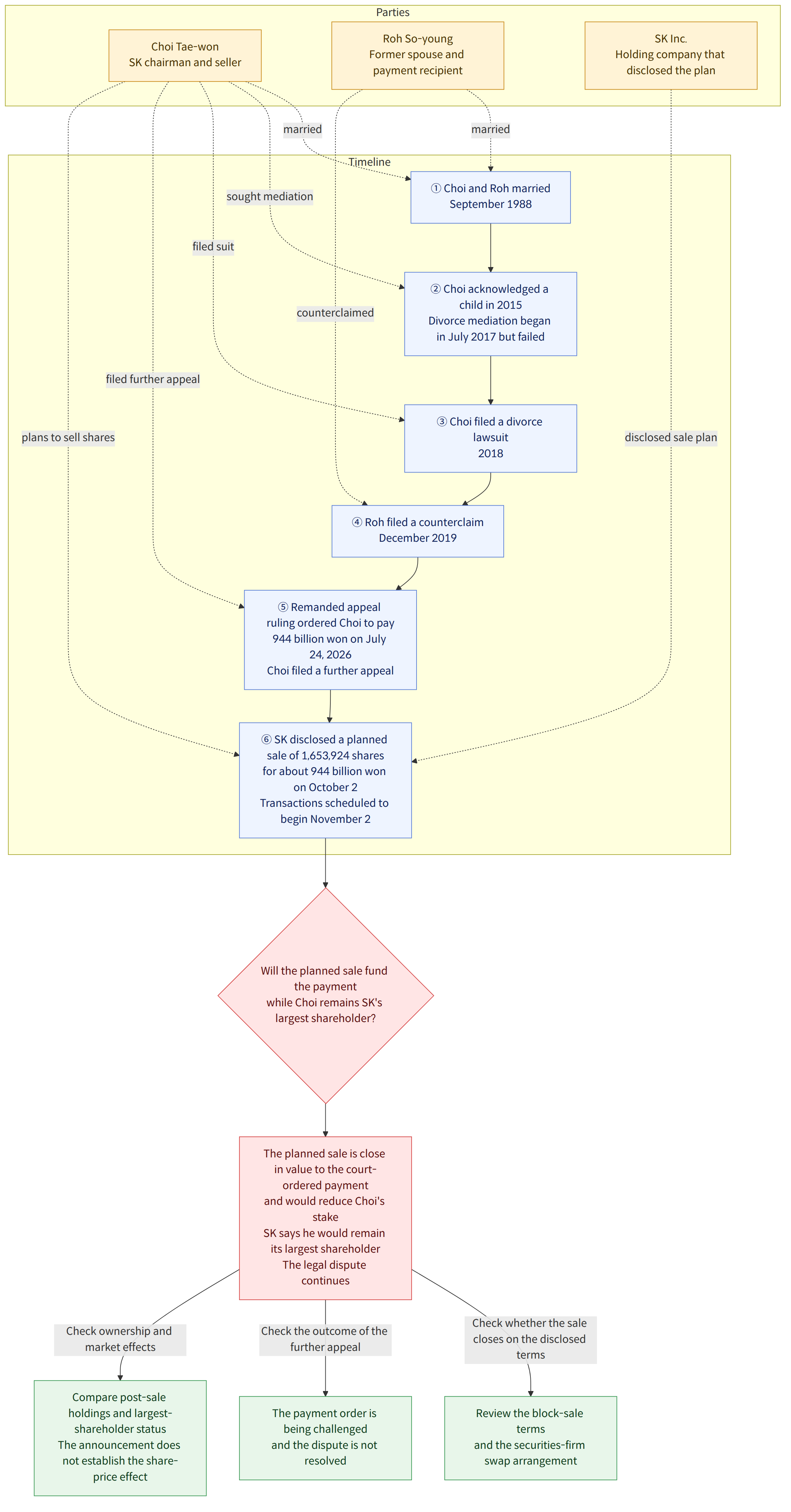
SK Group chairman Choi Tae-won plans to sell 1,653,924 shares in SK Inc., the group’s holding company, for an expected 943.999 billion won, or about 944 billion won. The shares represent 2.3% of the company. SK disclosed the planned sale on October 2, saying its stated purpose was to raise personal funds by selling shares Choi owns.
The planned amount is almost exactly the 944 billion won that a court ordered Choi to pay to Roh So-young as part of the couple’s divorce-related property division. The close match makes the purpose of the planned sale clear, although the stock transaction and the legal dispute remain separate matters.
Choi’s planned share sale is intended to raise personal funds for a payment arising from the divorce property division.
How the shares are to be sold
The transactions are scheduled to begin on November 2, about a month after the disclosure. They are structured in two parts, with the shares to be sold outside regular trading hours in large blocks. Such transactions can help limit the immediate effect of a very large sale on a company’s share price compared with placing all the shares on the open market at once.
- 681,431 shares, about 41% of the total, are covered by a contract with a securities firm at 587,000 won per share.
- 972,493 shares, about 59%, are to be sold to a strategic investor at 559,387 won per share.
- SK did not identify the securities firm or the strategic investor.
The securities-firm contract uses a total return swap (an agreement in which the parties settle gains or losses based on changes in a share’s price). The contract is scheduled to run for three years. Because the arrangement ties the final result to movements in the stock price, it is not simply the same as an ordinary immediate sale of shares for cash.
Why use block trades?
A large sale placed directly into normal market trading could add substantial selling pressure in a short period. By arranging trades outside the regular session and dividing them between counterparties, the seller can manage how the shares enter the market. SK said the chosen method was intended to reduce the impact on share trading.
Choi would remain SK Inc.’s largest shareholder
If the planned sale is completed, Choi’s direct holdings in SK Inc. would fall from 12,975,472 shares to 11,321,548 shares. His ownership would decline from 17.8% to 15.5%. Including shares held by related parties, the combined stake would decrease from 25.2% to 22.9%.
SK said the reduction would not change Choi’s position as the company’s largest shareholder or weaken the stable basis for its management. A largest shareholder is the investor with the biggest individual stake; that status does not necessarily mean the shareholder owns more than half of the company.
SK said Choi would remain its largest shareholder after the planned transactions and that the company’s stable management foundation would not change.
For investors, the distinction between a smaller stake and a change in control matters. The disclosed figures point to a lower ownership percentage, while SK’s statement is that Choi would continue to hold the largest individual shareholding. The announcement does not, by itself, establish how the stock price will move or how the market will assess the transactions.
The divorce case behind the payment
Choi and Roh married in September 1988. Choi publicly acknowledged the existence of a child born outside the marriage in 2015. He applied for divorce mediation in July 2017, but the mediation did not produce an agreement. Choi filed a divorce lawsuit in 2018, and Roh filed a counterclaim in December 2019.
On July 24, 2026, a court ruling in the case’s remanded appeal ordered Choi to pay Roh 944 billion won in cash as property division, among other terms. Choi challenged the ruling by filing a further appeal. The planned share sale therefore comes as the legal process continues; the announcement describes a way to raise funds, not a statement that the dispute has been fully resolved.
What “property division” means
In a divorce, property division is the process of determining how assets are to be allocated between spouses. It is different from simply splitting every asset in half: courts consider the applicable law and the circumstances presented in the case. Here, the reported order concerns a specified cash payment, and Choi’s proposed sale is one way to obtain personal funds on a similar scale.
What the transaction could mean
The planned sale links a personal legal obligation with ownership of a major listed company. Choi would sell a portion of his shares, while SK says the change would not dislodge him as its largest shareholder. That leaves two separate questions for observers: whether the transactions proceed on the announced terms, and how the continuing legal appeal affects the timing or final status of the payment.
The sale is also notable for its size. Selling more than 1.6 million shares in a single plan is different from an ordinary small investor trading a few shares, so the use of block transactions and a multi-year swap contract is central to understanding how the deal is structured. The identities of the counterparties have not been disclosed, and the planned transaction’s completion remains ahead.
For now, the key figures are 944 billion won in planned proceeds, a reduction in Choi’s direct stake from 17.8% to 15.5%, and SK’s assurance that he would remain the company’s largest shareholder. The next significant milestones are the scheduled start of trading on November 2 and developments in the ongoing appeal.