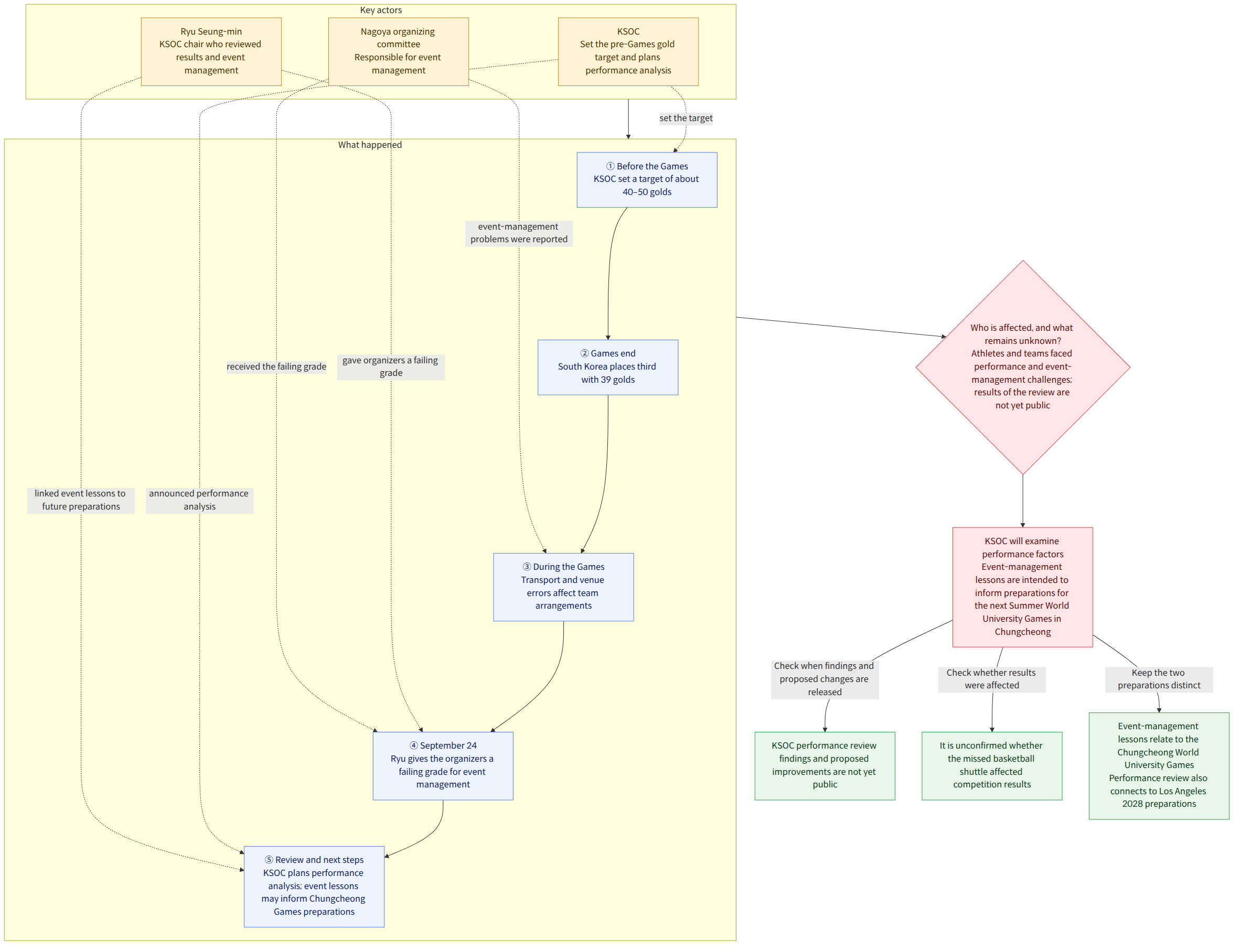
South Korea finished third overall with 39 gold medals at the 2026 Aichi-Nagoya Asian Games. It was the country’s third consecutive finish in the same position, but the total fell short of the target set before the Games by the Korean Sport & Olympic Committee (한국스포츠·올림픽위원회; KSOC). According to the original report, the target was about 40–50 gold medals. China finished first with 169 golds, followed by host Japan with 83, a record for the country at the Asian Games.
Background and context
KSOC Chair Ryu Seung-min acknowledged that results in some sports fell short of expectations and said the country would use the Games to review its performance and preparation. KSOC plans to analyze the results in detail and examine factors affecting athletes’ performance, including the training system and sports science. Ryu noted that teams from Central Asia and Southeast Asia, as well as China and Japan, are also making rapid progress.
There was also comment that poor results in archery and taekwondo, sports in which South Korea has traditionally expected medals, affected the medal race. By contrast, Ryu cited the achievements of team sports such as basketball, baseball and soccer, and also pointed to the emergence of new champions in modern pentathlon, skateboarding and teqball, a new Asian Games sport. His point was that the success and significance of the country’s preparations cannot be judged by medal counts alone.
The challenges left by these Games were not limited to athletic performance. The South Korean men’s basketball team canceled its shooting practice after the shuttle bus that was supposed to take the team to its training venue failed to arrive on the morning before the final against Japan. The South Korean and Qatari men’s soccer teams were directed to a baseball stadium instead of the venue for their opening group-stage match, arriving at the soccer stadium about 30 minutes later than scheduled.
Other reported incidents included the North Korean national anthem being played before a men’s field hockey match and South Korea being introduced as “the Republic of China” at a medal ceremony. On September 24, Ryu gave the organizing committee a failing grade because of problems with event management. At this press conference, however, he did not comment further, saying in effect that there was no reason to say more as the Games were drawing to a close.
What this news means
Competition results and event management are separate issues, but they both shape the conditions in which a delegation actually competes. The performance analysis announced by KSOC could go beyond simply counting gold medals and examine factors that affect results, such as the training system and sports science. However, the findings and proposed improvements have not yet been made public, so it is not possible to say what changes will follow based on the results of these Games alone.
The event-management problems show why it is important for athletes to have an environment in which they can focus on preparing for competition. For example, if a team cannot get transportation to its pre-competition training venue on time, it may have to cancel a scheduled practice or adjust its schedule. This is a hypothetical explanation of a situation of the same kind as the reported case of the shuttle failing to arrive; it has not been confirmed whether the incident affected the competition results.
South Korean delegation head Lee Sang-hyun said that his experiences at the 2023 Asian Games and the 2024 Olympics had not prepared him for what happened in Nagoya. He said athletes need training to better prepare for unexpected situations during competitions. This suggests that, apart from the task of improving event management, athletes also need to be prepared to respond to situations they did not anticipate.
Ryu described these Asian Games as an important part of preparations for the 2028 Los Angeles Olympics. The plans to analyze performance and listen more to athletes and coaches are connected to preparations for the national team ahead of the Olympics. Separately, he said that lessons from reviewing event management would be important for preparations for next summer’s Summer World University Games in the central Chungcheong region. The comments about the two events should be considered separately: event-management problems were not directly presented as an issue for preparations for the Los Angeles Olympics.
What is confirmed and what remains unknown
Confirmed facts
- South Korea finished third with 39 gold medals, placing third overall for the third consecutive time. According to reports, its pre-Games target was about 40–50 gold medals.
- China won 169 gold medals and Japan won 83.
- KSOC said it would analyze the results in detail and examine the training system, sports science and other factors.
- Reports covered incidents during the Games involving a shuttle that failed to arrive, the soccer teams being directed to the wrong venue, and errors involving the playing of an anthem and the introduction of a delegation.
- Ryu cited event management at these Games as a source of lessons for preparations for the Summer World University Games.
What remains unknown
- What will KSOC’s detailed analysis find, and what plans will it make to improve training and sports science?
- What caused the event-management problems, and what steps will be taken to prevent them from happening again?
- It has not been confirmed how or when training to prepare athletes for unexpected situations will be arranged.
What readers should watch for
- Readers can look at how KSOC’s forthcoming detailed analysis evaluates individual sports, including archery and taekwondo, and what it proposes to improve the training system and sports science.
- It will be worth checking what procedures or measures are adopted in preparations for the Summer World University Games to address the event-management problems at these Asian Games.
- Readers can also watch to see whether training to help athletes prepare for unexpected situations is put in place and whether athletes’ and coaches’ views are incorporated into preparations.
References
- Other coverage consulted: koreatimes.co.kr
- Other coverage consulted: en.yna.co.kr