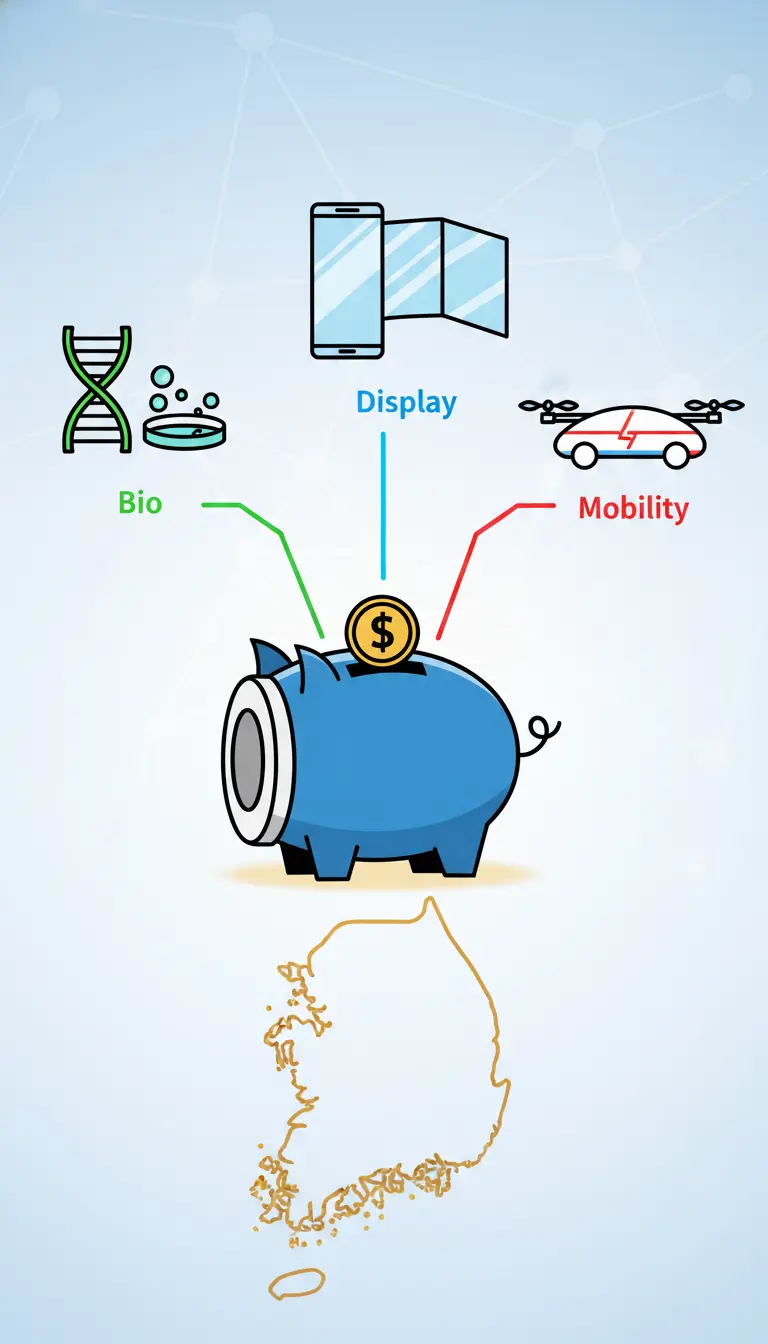
Fueling the Future: A 150 Trillion Won Vision
The South Korean government has officially identified Bio, Display, and Mobility as the primary targets for the second phase of its massive Public Growth Fund. This 150 trillion won (approx. $101 billion) initiative was launched to bolster seven core sectors over the next five years.
Previously, the fund committed 6.6 trillion won to four major projects, such as offshore wind farms and AI chip manufacturing facilities. This next step signifies a significant expansion of the government's role in driving industrial growth through large-scale capital injection.
A 10 Trillion Won Boost for Strategic Sectors
The Financial Services Commission (FSC) announced that the second investment batch will total approximately 10 trillion won. This funding aims to accelerate innovation in technologies we encounter every day, ensuring domestic industries stay ahead of the curve.
- Bio: Developing treatments for incurable diseases and expanding digital healthcare services.
- Display: Securing leadership in next-generation screens that are clearer and more flexible than current technology.
- Mobility: This refers to "innovations in transportation," such as self-driving cars and urban air mobility like flying taxis.
"The projects funded in this second batch will have a significant ripple effect across the entire industrial sector while revitalizing regional economies," stated Lee Eog-weon, Chairman of the FSC.
Public-Private Synergy for Global Leadership
To finance these ambitious projects, the government is utilizing a 35 trillion won public-private partnership fund alongside a 15 trillion won direct investment fund. The goal is to deploy more than 30 trillion won within this year alone to maintain a competitive edge in global technology markets.
Planned investments for this year already include 6 trillion won for AI, 4.2 trillion won for semiconductors, and 3.1 trillion won for future mobility. This systematic financial support is expected to provide essential capital to high-growth industries and solve funding challenges in the private sector.