
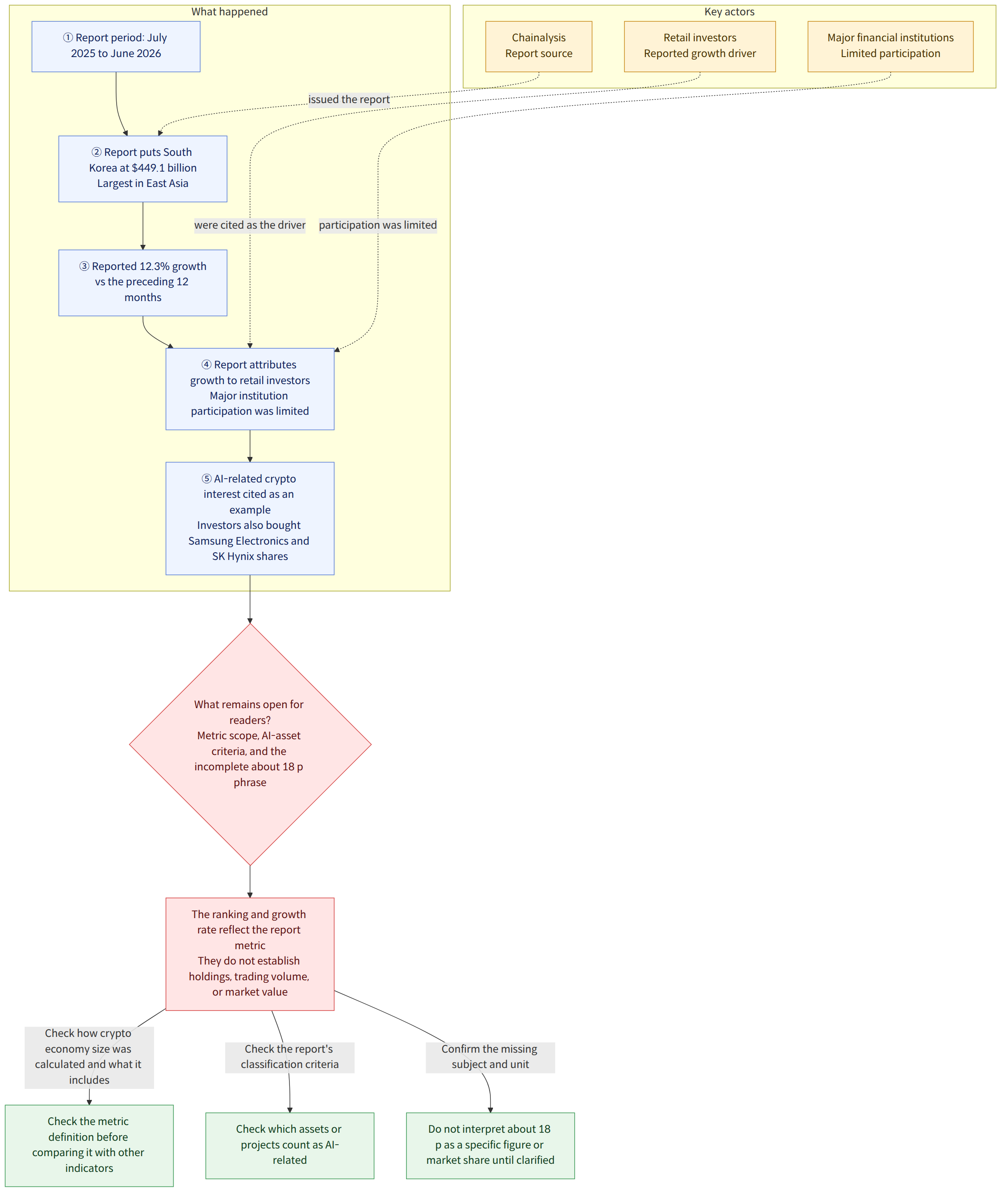
South Korea’s digital-asset economy reached $449.1 billion from July 2025 to June 2026, the largest in East Asia, according to a Chainalysis report. That was 12.3% growth compared with the preceding 12-month period. The report said growth was driven by retail investors, with limited participation by major financial institutions, and cited interest in AI-related cryptocurrencies as one example of the trend.
Background and context
The report put South Korea’s crypto economy at $449.1 billion, the largest among the markets listed. Japan followed at $228.3 billion, Hong Kong at $192.2 billion, China at $176.3 billion, and Taiwan at $140.4 billion. The article presented these figures as the crypto-economy sizes of the respective markets.
However, the original text does not explain what the term “economy size” comprises or how it was calculated. These figures alone therefore cannot be taken as representing any one measure, such as South Korean investors’ holdings, trading volume, or market value. The rankings and growth rate should be understood as results based on the metric presented in the report.
The Chainalysis report is titled “East Asia Crypto Adoption Report: South Korea's AI Trade Comes to Crypto.” It identified AI-related cryptocurrencies as one clear sign of South Korea’s retail-investor enthusiasm. According to the article, amid a stock-market rally fueled by AI, South Korean investors bought shares in Samsung Electronics and SK Hynix while also putting money into digital assets linked to AI-focused projects and infrastructure.
What this news means
One notable point in the report is that it presents the market’s growth alongside the direction of investor interest. The growth rate indicates that South Korea’s crypto economy expanded, but the article links that growth to retail-investor activity rather than participation by major financial institutions. AI-related assets were presented as one example of those individual investors’ interests.
The fact that interest in stocks and digital assets was reported at the same time does not establish that the two markets moved for the same reasons or based on the same investment decisions. However, the fact that interest in AI extended beyond stocks to digital assets linked to related projects and infrastructure may suggest that investors are engaging with the AI theme through multiple types of assets.
For example, if an investor considers both shares in an AI-related company and digital assets linked to an AI project, the fact that both assets share the AI theme does not mean their risks or values can be considered the same based on the article alone. In particular, the article does not specify which cryptocurrencies or projects were classified as AI-related assets.
Confirmed facts and what remains unknown
Confirmed facts
- According to the Chainalysis report, South Korea’s crypto economy totaled $449.1 billion from July 2025 to June 2026.
- The figure was reported as 12.3% growth compared with the preceding 12-month period.
- South Korea’s figure was larger than those reported for Japan, Hong Kong, China, and Taiwan.
- The article said growth was driven by retail investors and described AI-related cryptocurrencies as a sign of their interest.
What remains unknown
- The original text does not say how the report calculated the size of the crypto economy or what it included.
- It is also unclear which assets or projects were classified as AI-related cryptocurrencies.
- The article’s final sentence cuts off at “as of June 2026, AI-related cryptocurrencies account for about 18 p.” It is therefore unknown what the “about 18 p” refers to, what the unit is, or what the rest of the sentence says.
What readers should check
- Before comparing this figure with other market indicators, readers should first check how “crypto economy size” was calculated and what it includes.
- Anyone examining AI-related digital assets should check the criteria the report actually used to classify the asset or project.
- Until the subject and unit of the incomplete phrase “about 18 p” are confirmed, it should not be interpreted as a specific figure or market share.