The Dual Face of South Korea's Labor Market
South Korea's labor market is currently exhibiting a profound structural divergence (a situation where different parts of an economy move in opposite directions). While the headline numbers suggest a robust recovery, a closer look reveals a widening gap between different age groups and industrial sectors.
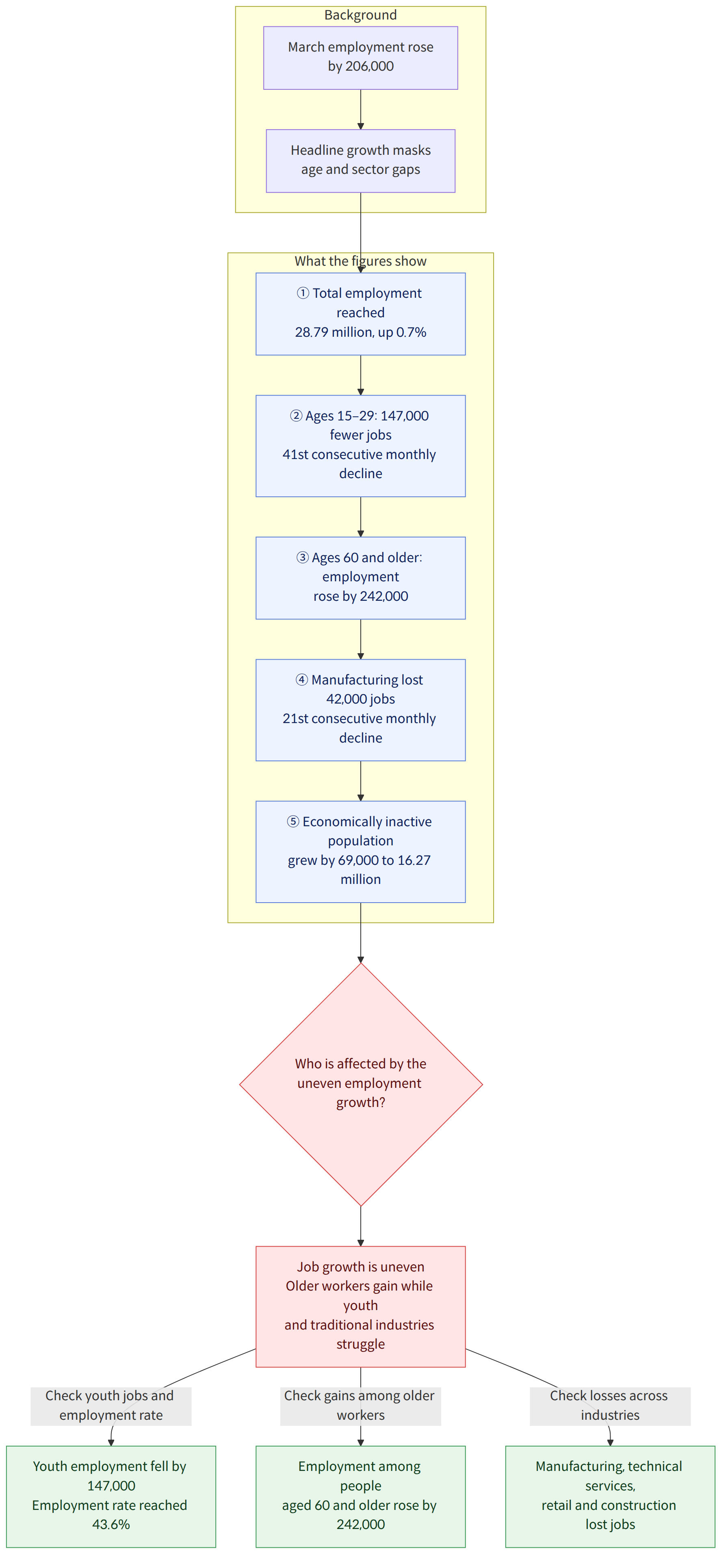
In March, the total number of employed individuals in South Korea rose by 0.7 percent compared to the previous year, reaching a total of 28.79 million. This marks the second consecutive month where job growth has exceeded the significant threshold of 200,000 new positions.
The Growing Crisis for the Younger Generation
Despite the overall increase in jobs, the outlook for South Korea's youth is increasingly grim. The number of employed people aged 15 to 29 plummeted by 147,000 in March alone. This represents the 41st consecutive month of year-on-year decline for this demographic.
"The downward trend in youth employment reflects a fundamental shift in hiring practices, where companies increasingly prioritize experienced workers over entry-level candidates through rolling recruitment (a continuous hiring process rather than a single seasonal hiring period)."
This trend is not just about the number of jobs, but also the employment rate (the percentage of the working-age population that is actually employed). For the 23rd straight month, this rate has slipped, falling to 43.6 percent in March.
Why are young people losing jobs?
Several factors are contributing to this youth employment drought:
- Sectoral Shifts: Significant losses were noted in the information and communications, manufacturing, and lodging/food service sectors.
- Experience Gap: Employers are moving away from training new graduates and are instead seeking 'ready-to-work' professionals.
- Automation: The rapid integration of technology is reducing the need for junior-level administrative and technical roles.
The Silver Economy: Seniors Driving the Numbers
While the youth struggle, the elderly population is stepping in to fill the labor gap. The number of employed individuals aged 60 and older surged by 242,000, effectively offsetting much of the losses seen in younger demographics.
This phenomenon is often referred to as the 'Silver Economy' (an economic term describing the consumption and labor patterns of the aging population). As South Korea faces one of the fastest-aging populations in the world, older citizens are remaining in the workforce longer to support themselves and contribute to the economy.
Industrial Disruption: Manufacturing and the AI Effect
The traditional pillars of the South Korean economy are facing unprecedented challenges. The manufacturing sector, long considered the backbone of the nation's industrial strength, shed 42,000 jobs, marking its 21st consecutive month of decline.
The Impact of Technology and Structural Changes
Modernity is reshaping the job landscape through two primary forces: Automation and Artificial Intelligence (AI).
- The AI Displacement: The professional, scientific, and technical services sector lost 61,000 jobs. This is largely attributed to the rapid spread of Artificial Intelligence (AI) (computer systems capable of performing tasks that normally require human intelligence), which is increasingly automating complex analytical tasks.
- The Retail Revolution: The wholesale and retail sector saw its first decline in a year, losing 18,000 jobs. This is a direct result of the massive expansion in e-commerce (buying and selling goods online) and the rise of automated kiosks and unmanned stores.
- Construction Slump: The construction industry continues to struggle, posting its 23rd straight month of losses with 16,000 fewer jobs.
"The decline in manufacturing, construction, retail, and accommodation serves as a critical warning sign, as these sectors are the primary indicators of domestic demand (the total demand for goods and services within a country)."
A Growing Trend of Economic Inactivity
Perhaps most concerning is the rise in the economically inactive population (people who are neither working nor actively looking for work). This group grew by 69,000 people, reaching a total of 16.27 million.
Within this group, there is a notable increase in individuals who are not working simply because they wish to rest. The number of people reporting they are 'just resting' rose by 31,000 to a total of 2.55 million.
Future Outlook
As South Korea navigates this transition, the government faces a complex challenge. The economy is growing in terms of sheer numbers, but the quality and distribution of jobs are shifting. The mismatch between the skills of the youth and the demands of an AI-driven, experience-heavy job market suggests that structural reforms in education and industry may be necessary to prevent long-term social instability.