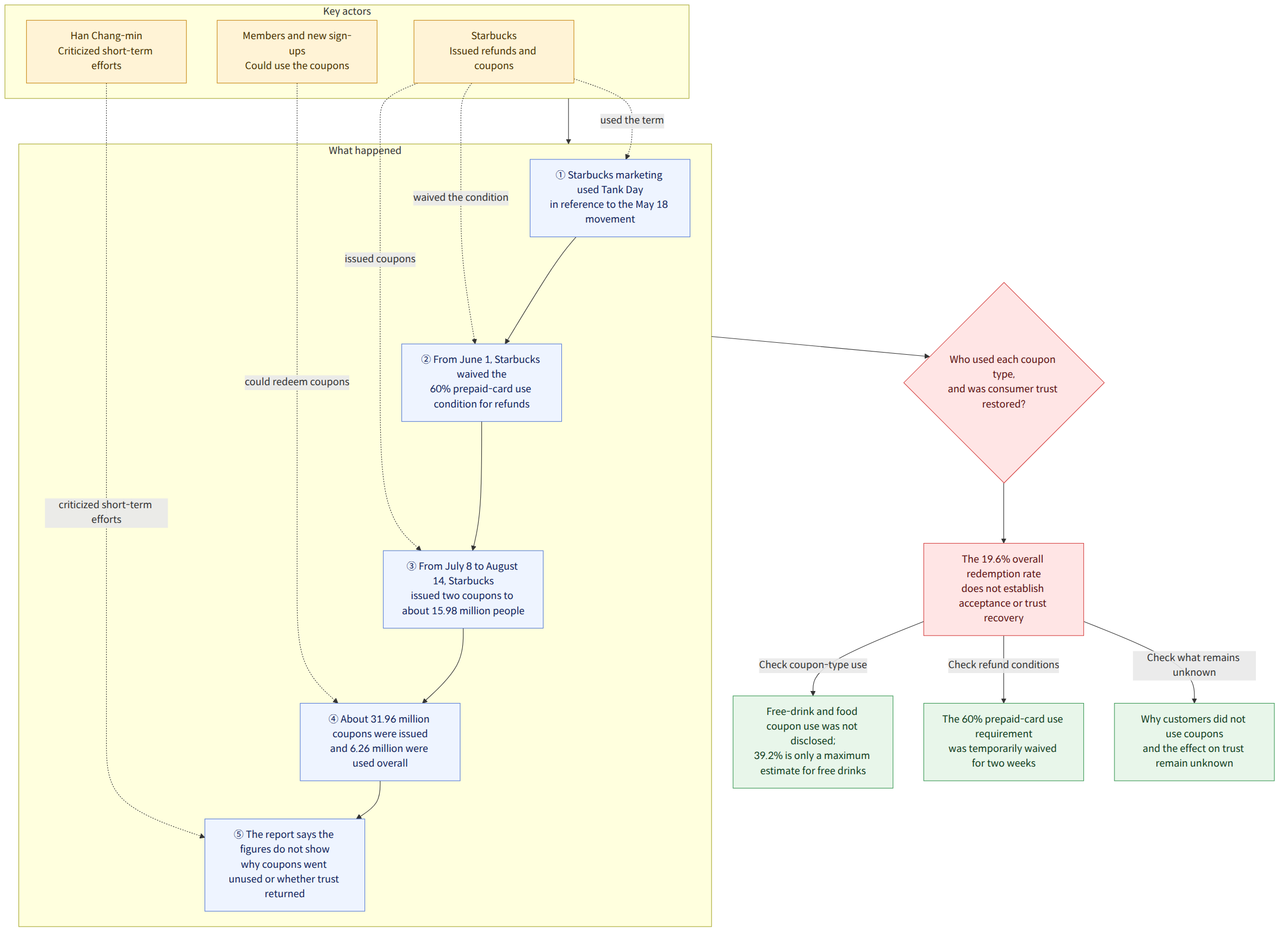
After Starbucks sparked controversy over disparaging the May 18 Democratization Movement (5·18민주화운동) by using the term “Tank Day” in its marketing last May, it issued about 31.96 million coupons to roughly 15.98 million members and new sign-ups. About 6.26 million coupons were actually used, for a redemption rate of about 19.6% of all coupons issued. Starbucks provided both free-drink and food discount coupons, but the number used of each type has not been disclosed.
Background and context
The coupons were issued from July 8 to August 14, 2026. Each user received one free-drink coupon and one 30% discount coupon for food. Reports said this was the first time Starbucks had issued free-drink coupons to all members without conditions.
The free-drink coupon could be used for one Americano, café latte or vanilla latte. However, only the total number of coupons used was made public, so it is not possible to tell which type was used more. Therefore, the overall coupon redemption rate of 19.6% should not be interpreted as the redemption rate for free-drink coupons alone, nor should it be assumed that the free-drink coupon redemption rate was 19.6%.
Based on the reported figures, if all 6.26 million coupons used were assumed to be free-drink coupons, the redemption rate would be a maximum of about 39.2% of the 15.98 million free-drink coupons issued. This is still not the actual redemption rate by coupon type, but an upper-bound calculation that assigns all coupons used to the free-drink category. The actual redemption rate for free-drink coupons could be lower.
Before issuing the coupons, Starbucks temporarily waived for two weeks, starting June 1, 2026, the condition that customers had to use at least 60% of a reloadable prepaid card balance to be eligible for a refund, and issued full refunds. During this period, refunds totaled about 76 billion won across 2.56 million transactions, with an average refund of about 30,000 won per transaction. The transaction count also included cases in which one customer received refunds for multiple prepaid cards.
What this means
Coupons offer a way to see whether customers actually choose to use a measure introduced after a controversy. However, a low redemption rate does not by itself explain the cause of the controversy or the reactions of all consumers. The reported figures cannot show why people did not use the coupons or what effect the coupons had on restoring trust.
Even so, the fact that about 31.96 million coupons were issued but only about 6.26 million were used shows that the scale of a benefit and consumer acceptance of it are not the same thing. Even when a coupon offers a free drink, it will not be used if a customer does not visit a store or does not want the benefit. That is why holding a large-scale promotion does not, by itself, show that trust has been restored.
For example, someone who decided to avoid Starbucks after the controversy might receive a free coupon but still choose not to visit a store, leaving the coupon unused. This illustrates a possibility consistent with the experience of one customer reported in the news; it does not mean that everyone who received an unused coupon declined it for that reason.
Representative Han Chang-min of the Social Democratic Party (사회민주당) said that event-based, short-term efforts to contain the fallout would not be enough to restore consumer trust. This was the representative’s criticism; the figures in the report alone do not establish the extent of any regulatory gaps or whether the refunds were handled appropriately.
What is confirmed and what remains unknown
Confirmed facts
- From July 8 to August 14, 2026, Starbucks issued about 15.98 million people one coupon of each of two types.
- About 31.96 million coupons were issued and about 6.26 million were used, for an overall redemption rate of about 19.6%.
- The number used of each coupon type has not been disclosed. The maximum 39.2% redemption rate for free-drink coupons is calculated on the assumption that all coupons used were free-drink coupons.
- For two weeks starting June 1, 2026, Starbucks temporarily waived the requirement that customers use at least 60% of their prepaid card balance and issued full refunds, totaling about 76 billion won.
- There were 2.56 million refund transactions, with an average refund of about 30,000 won per transaction, but the transaction count included cases in which one customer received refunds for multiple cards.
What remains unknown
- How many free-drink coupons and food discount coupons were actually used, respectively?
- After excluding duplicate refunds, how many unique customers were represented by the 2.56 million refund transactions?
- Why did customers not use the coupons, and what effect did the measures have on consumer trust?
- The reported figures alone make it difficult to determine whether the follow-up refunds were properly carried out or where, specifically, gaps in the management and oversight of prepaid payment instruments may lie.
What readers should look for
- When considering the coupon redemption rate, check whether it is calculated against all coupons issued or separately for free-drink and discount coupons. This report did not disclose usage by type.
- The number of refund transactions may differ from the number of unique customers. Because one person may have received refunds for multiple cards, transaction counts and customer counts should be distinguished.
- When assessing a company’s response after an incident, readers can consider not only the number of benefits issued but also the actual usage results and whether consumer protection, management and oversight issues are addressed. Representative Han Chang-min said he would examine the issue during the National Assembly audit (국정감사).