
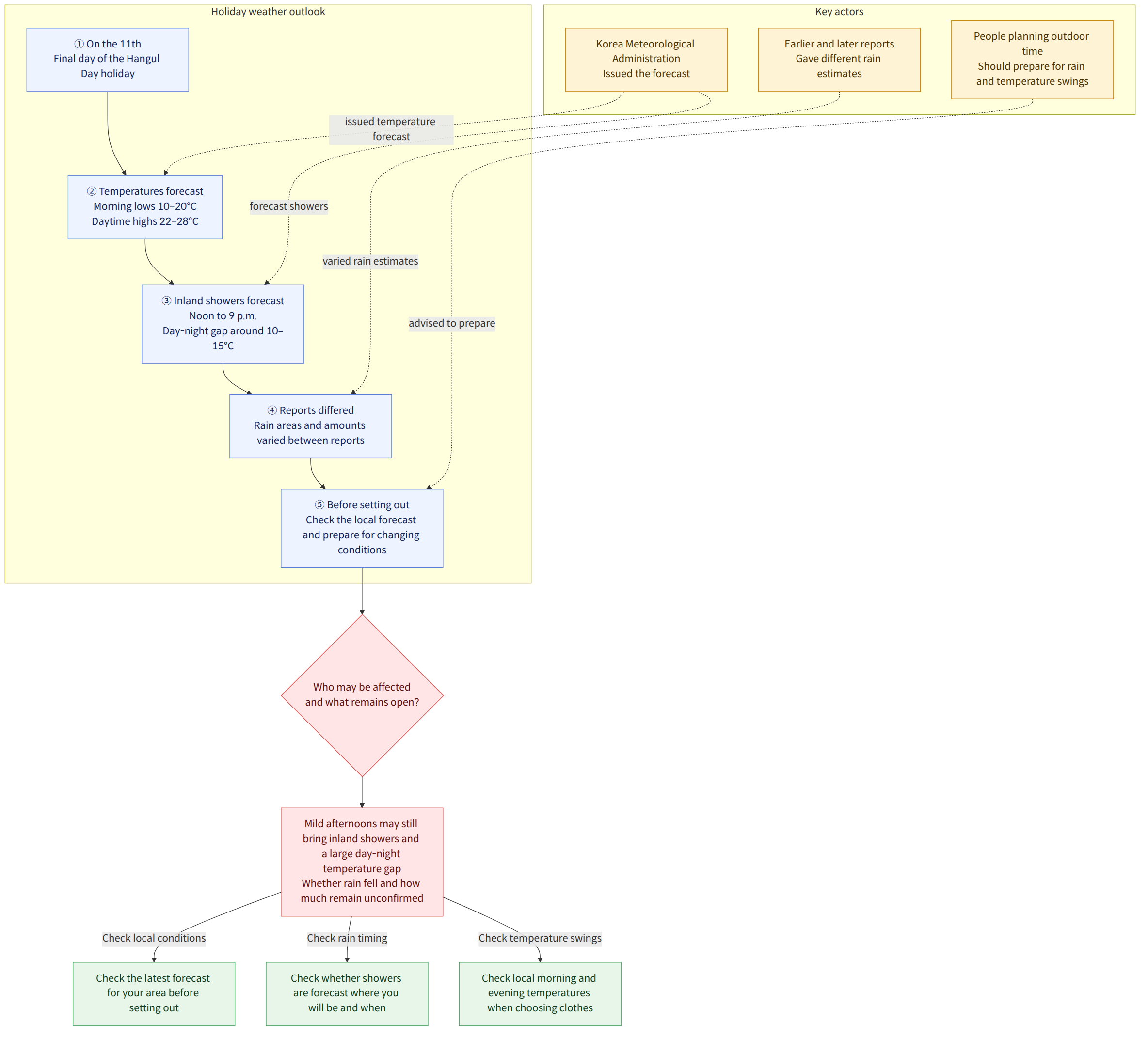
On the 11th, the final day of the Hangul Day holiday (한글날), daytime highs are expected to reach 28°C, but showers are forecast in parts of inland areas. The Korea Meteorological Administration (기상청) forecast morning lows of 10–20°C and daytime highs of 22–28°C, and said the day-night temperature difference would be large, at around 10–15°C, particularly in inland areas nationwide. Although it will be mild during the day, the weather will call for preparation for mornings and evenings and for periods of rain.
Background and context
By region, morning lows are forecast to be lowest in Chuncheon, at 11°C, and highest in Busan, at 20°C. Seoul, Suwon, Cheongju and Gwangju will be at 15°C; Incheon, Jeonju and Daegu at 16°C; Daejeon at 13°C; Gangneung at 15°C; and Ulsan at 17°C.
Daytime highs are forecast to reach 28°C in Daegu and 27°C in Cheongju, Daejeon, Jeonju and Gwangju. Seoul, Incheon, Suwon, Busan, Ulsan and Jeju are expected to reach 26°C, Chuncheon 25°C and Gangneung 23°C. Since both morning and daytime temperatures vary by region, consulting the forecast for your specific area is more useful for choosing what to wear than relying only on the nationwide high and low ranges.
Showers are forecast in parts of inland areas nationwide between noon and 9 p.m. on the 11th. Expected rainfall is 5–20 mm in inland areas of southern Gyeonggi Province; inland and mountainous areas of southern Gangwon Province; inland areas of Daejeon, Sejong and South Chungcheong Province; and North Chungcheong Province. Rainfall of 5–10 mm is expected in North Jeolla Province, eastern South Jeolla Province, inland areas and northeastern mountain areas of Daegu and North Gyeongsang Province, and western inland areas of South Gyeongsang Province. Jeju is forecast to receive 5–40 mm of rain over two days starting on the 11th.
What this news means
Based on daytime temperatures alone, it may seem like a day to go out in light clothing, but the large day-night temperature difference inland and afternoon showers should also be taken into account. In particular, if you will be outdoors inland during the hours when rain is expected, it is best to check the latest forecast for your area before setting out, since showers are forecast in “parts” of the areas concerned.
For example, if you plan to spend time outdoors inland on the afternoon of the 11th, you could bring an umbrella and also prepare a light outer layer for the morning and evening. This is an example of preparation based on the forecast; the actual locations and timing of rainfall may vary.
Differences between the reports
Both reports gave a temperature range of morning lows of 10–20°C and daytime highs of 22–28°C for the 11th, but they differed in the areas forecast to receive precipitation and the expected rainfall amounts. The earlier report gave 5–20 mm for Daegu, North Gyeongsang Province and inland areas of South Gyeongsang Province; 5–10 mm for southern Gangwon Province, Gwangju, South Jeolla Province and inland areas of North Jeolla Province; and about 5 mm for southeastern inland areas of South Chungcheong Province, North Chungcheong Province, Ulleungdo and Dokdo.
The later report said showers would occur in parts of inland areas between noon and 9 p.m. and gave 5–20 mm for inland areas of southern Gyeonggi Province; inland and mountainous areas of southern Gangwon Province; Daejeon, Sejong, inland areas of South Chungcheong Province; and North Chungcheong Province. It gave 5–10 mm for North Jeolla Province, eastern South Jeolla Province, inland areas and northeastern mountain areas of Daegu and North Gyeongsang Province, and western inland areas of South Gyeongsang Province. The forecasts may have changed depending on when the reports were issued, but the materials do not establish whether rain actually fell or how much fell in each area.
Confirmed facts and what remains unknown
Confirmed facts
- Morning lows of 10–20°C and daytime highs of 22–28°C were forecast for the 11th.
- The day-night temperature difference was expected to be around 10–15°C, particularly in inland areas.
- Showers were forecast in parts of inland areas between noon and 9 p.m.
- Jeju was expected to receive 5–40 mm of rain over two days starting on the 11th, and fine dust levels nationwide were forecast to be “good” or “moderate.”
What remains unknown
- The actual rainfall amounts by area on the 11th and whether showers occurred have not been confirmed.
- These materials do not include specific health precautions issued by the Korea Meteorological Administration regarding the large day-night temperature difference.
What readers should check
- Before going out, check the latest precipitation forecast and the expected timing of showers in the area where you will be.
- If you will be outdoors inland in the afternoon, bring an umbrella and consider taking a light outer layer for the morning and evening.
- If you will be staying on or traveling to Jeju, check the separate forecast for rain over the two days starting on the 11th.
References
- Other coverage consulted: hani.co.kr