A Human Story: The Cost of a Missing Number
Min-su Kim, a young office worker, thought he had found his dream home—a charming, renovated detached house in a quiet corner of Seoul. The property sat on a large plot owned by Mr. Park, who also owned a larger multi-unit villa on the same land.
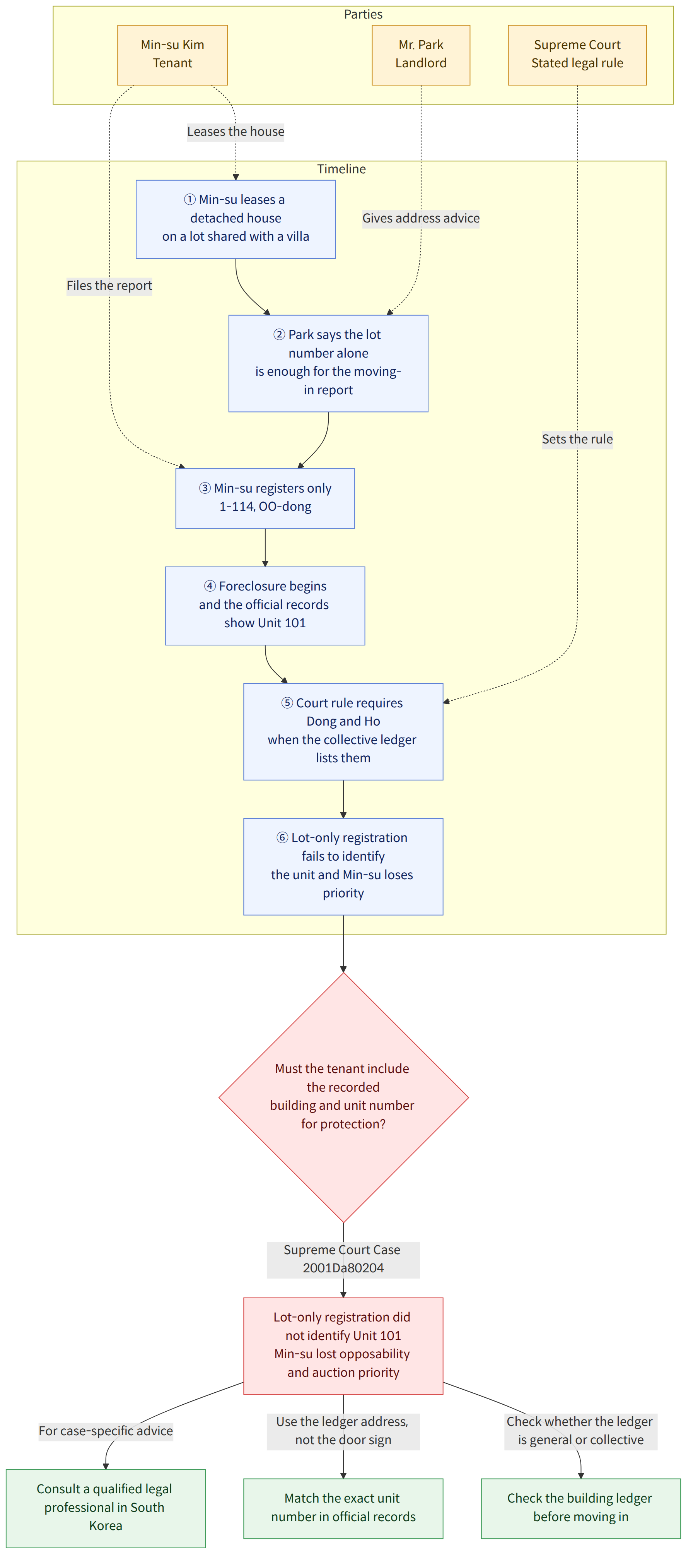
When signing the lease, Mr. Park reassured Min-su: "Since this is a detached house and I own the whole plot, you just need to report the lot number '1-114' for your moving-in report. No need to worry about building names or unit numbers." Trusting the landlord, Min-su registered his address simply as '1-114, OO-dong.'
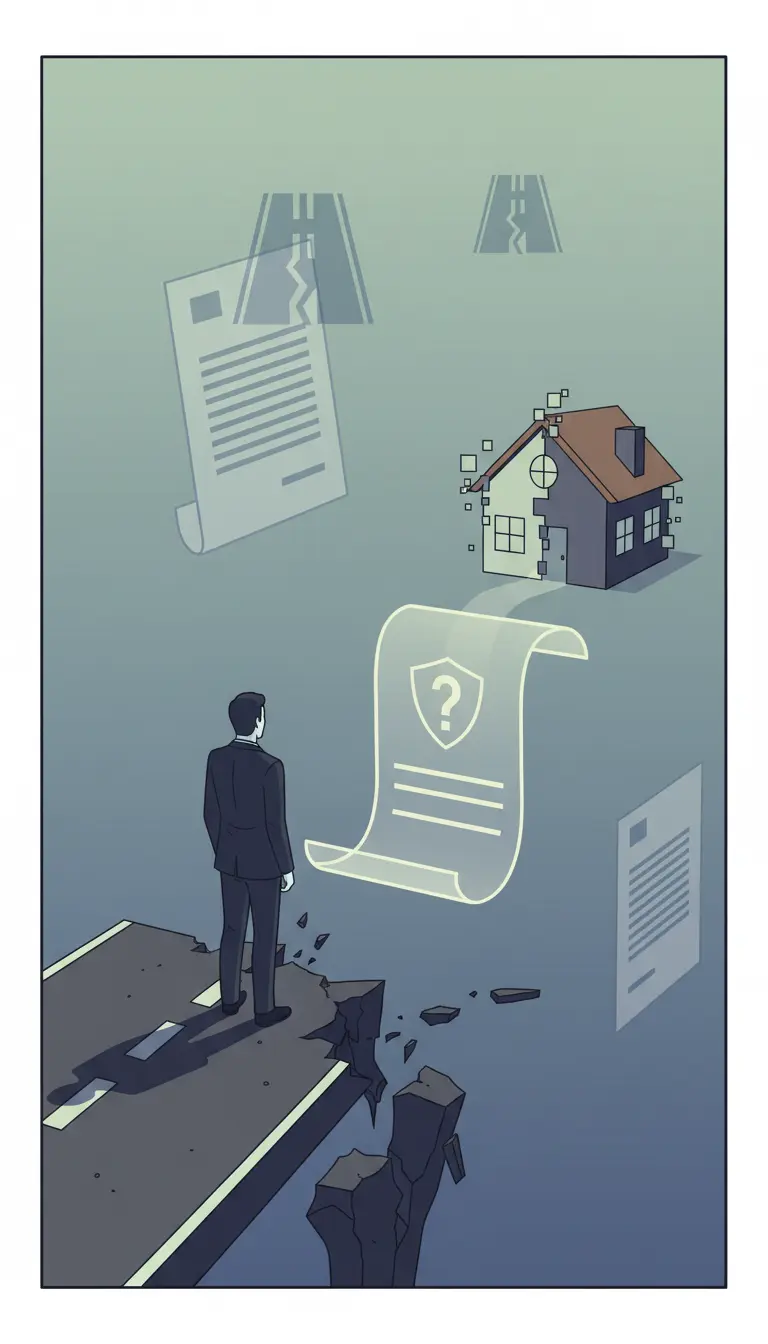
Two years later, the property went into foreclosure. To his horror, Min-su learned that his legal right to stay and reclaim his deposit—known as 'opposability'—was invalid. The reason? His resident registration was deemed incomplete because he had omitted the specific unit number listed in the official government records.
The Legal Question
The core issue is whether a tenant of a detached house, located on a lot shared with multi-unit buildings, must include a specific building and unit number (Dong and Ho) in their resident registration to be legally protected under the Housing Lease Protection Act.
What Korean Law Says
In Korea, 'opposability' (the right to maintain a lease against third parties like new owners) requires two things: moving into the house and filing a 'moving-in report' (Jeonip Singo). This registration serves as public notice to others that someone is living there under a lease.
Key Legal Principles:1. Detached/Multi-family Houses (Dandok/Dagagu): Generally, only the lot number (Jibeon) is required because the entire building has one owner.2. Multi-unit Villas/Apartments (Dasedae): Since each unit is owned separately, the lot number PLUS the specific building (Dong) and unit (Ho) must be registered.
However, a complication arises when a detached house is registered under a 'Collective Building Ledger' (Jiphap Geonchukmul Daejang), assigning it a specific identity like "Unit 101 of Building 102," even if it looks like a single standalone house.
How Korean Courts Approach This
The Supreme Court of Korea takes a strict stance on the accuracy of public records. In cases where a single plot contains both detached and multi-unit houses under the same ownership, the court looks at the official ledgers.
According to a landmark ruling (Supreme Court Case 2001Da80204), if a detached house is registered in the Collective Building Ledger with a specific Dong and Ho, the tenant must include those details in their moving-in report. If the tenant only writes the lot number, the registration is considered an "invalid method of public notice," and the tenant loses their legal protection.
Applying the Law to the Case
In Min-su’s case, his house wasn't just a simple detached dwelling in the eyes of the law. Because it shared a lot with a villa and was registered under a Collective Building Ledger, it was officially designated as 'Unit 101.'
- The registry and the building ledger both listed the address with a specific unit number.
- By only writing the lot number '1-114,' Min-su failed to provide a notice that matched the official records.
- To a third party—such as a bank providing a loan or a buyer at an auction—Min-su’s registration didn't clearly point to the specific unit he occupied.
Because of this discrepancy, the law treats Min-su’s registration as if it never happened regarding the specific unit he was living in.
Conclusion: What Happened, and What Should You Do?
Because of that one missing line—'Unit 101'—Min-su Kim lost his priority status in the foreclosure auction. His deposit, representing years of savings, was at risk because he followed the landlord's informal advice instead of the official ledger.
To avoid this "address trap," follow these practical tips:
- Always check the 'Building Ledger' (Geonchukmul Daejang): Before moving in, do not just look at the building's exterior. Request the ledger and check if it is a 'General' (일반) or 'Collective' (집합) ledger. If it is 'Collective,' you MUST write the unit number exactly as it appears.
- Match the records, not the door sign: Sometimes the number on the physical door (e.g., '101') is different from the number in the government ledger (e.g., 'B01'). Always use the ledger's version for your moving-in report.
This column provides general legal information. For specific cases, always consult with a qualified legal professional in South Korea.