
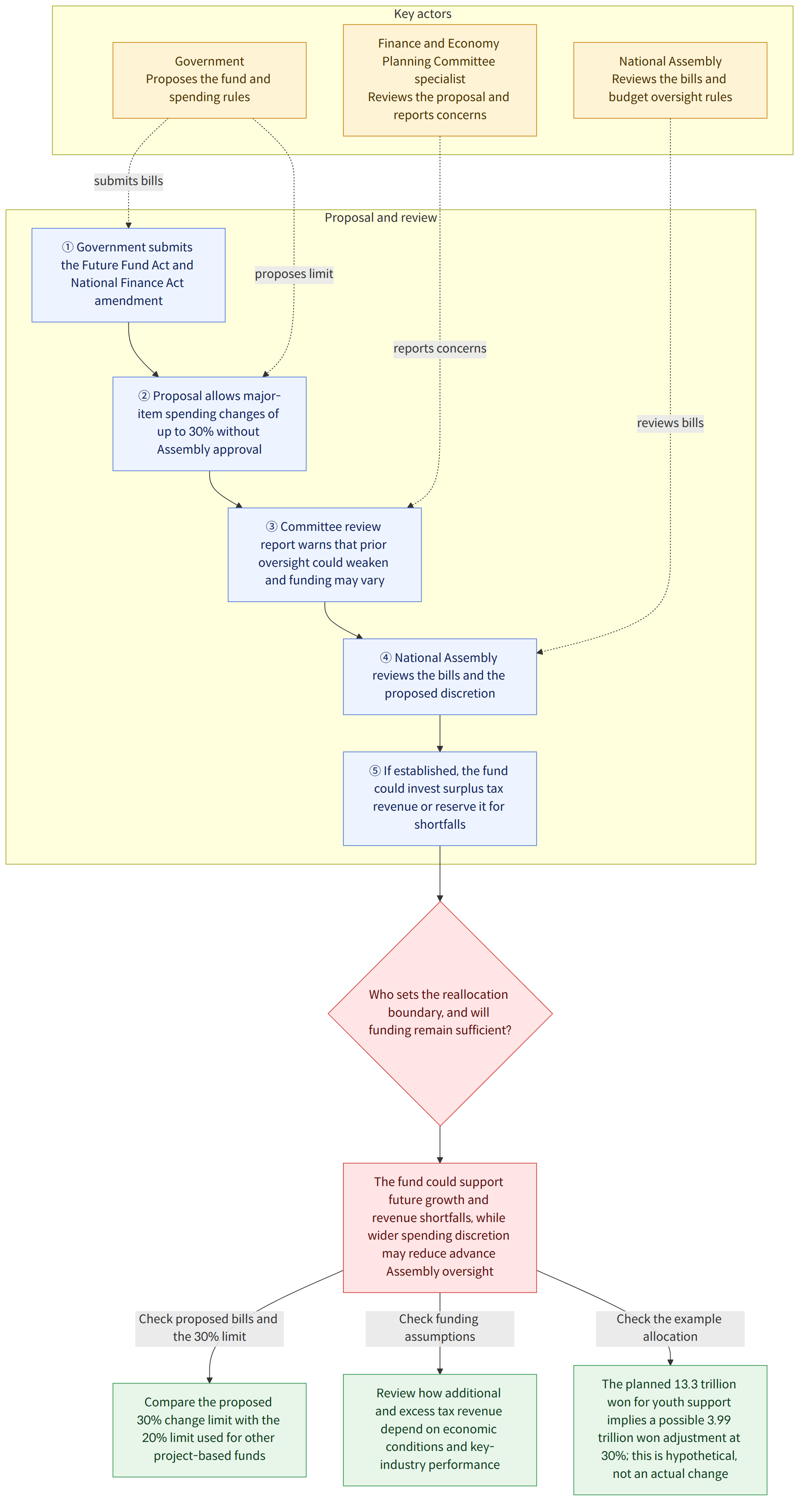
A review report prepared and submitted by a specialist on the National Assembly’s Finance and Economy Planning Committee (재정경제기획위원회) found that establishing the fund under the government’s proposal could weaken the Assembly’s prior review and oversight of the budget and fund management plans. In particular, the government’s proposed limit allowing major spending items to be changed by up to 30% without National Assembly approval is a point of contention.
Background and context
The Future Fund is a new fund designed to invest tax revenue that exceeds existing trends or projections in areas such as young people and growth engines to boost potential growth, or to set the revenue aside for later use when tax revenues fall short. The government has submitted to the National Assembly for review a bill to enact the Future Fund Act (미래기금법), which provides the legal basis for the fund, and a bill to amend the National Finance Act (국가재정법), which sets out special provisions needed to operate it.
The debate over the fund’s discretion centers on how flexibly spending plans can be changed. Under the government’s proposal, spending on each major item in the Future Fund could be changed by up to 30% without National Assembly approval. The Finance and Economy Planning Committee said that as the government gains greater flexibility in managing public finances, the scope for the Assembly to review and oversee spending plans in advance could correspondingly shrink.
As an example of the amounts involved, the government said in its proposed Future Fund management plan that it would allocate 13.3 trillion won to the Youth Comprehensive Support Program (청년종합지원 프로그램). Applying the 30% limit to this amount means the government could increase or decrease spending by 3.99 trillion won at its discretion. The committee said that compared with setting the limit at 20%, as is done for other project-based funds, the amount that could be changed independently for each program could increase by 800 billion to 1.4 trillion won.
Here, an independent change means that the government adjusts spending on a planned item without separate prior approval from the National Assembly. The issue, therefore, is not simply how much is allocated to the fund. It also concerns how much deviation is allowed between the plan first approved by the Assembly and actual spending, and where that boundary should be set.
On the funding side, “additional tax revenue” and “excess tax revenue” are central concepts. The article described additional tax revenue as the portion of 2027 national tax revenue that exceeds the trend line for domestic tax revenue growth over the past 10 years. Excess tax revenue was described as an increase in revenue that, following a revised estimate, exceeds the existing domestic tax revenue budget. The review report noted that both sources could vary depending on economic conditions and the performance of key industries.
What this news means
If the fund is established, it would allow tax revenue above expectations to be used for investment in future growth and to prepare for future revenue shortfalls. At the same time, a wider scope for changing spending would give the government more latitude to adjust budgets for individual programs. This means it may be necessary to examine how much of the plan set in advance by the National Assembly is maintained during implementation.
For example, if the planned allocation for the Youth Comprehensive Support Program is set at 13.3 trillion won and the government considers adjustments for other needs, the 30% limit in its proposal could allow substantial changes without National Assembly approval. This is a hypothetical example; it does not mean that spending on the program has actually been changed. The planned amount and the adjustment limit need to be considered together because a limit stated as a percentage can translate into a large sum for a specific program.
The stability of the fund’s resources is linked to how much its commitments depend on economic conditions. The report’s concern is that the fund’s resources could decline if additional tax revenue does not continue at a sufficient level. Since the fund is designed to be used when tax revenues fall short, assessing its medium- and long-term sustainability in light of the possibility of inadequate funding may become important. However, the evidence available does not make it possible to determine actual tax revenue trends or the fund’s future size.
What is confirmed and what remains unknown
Confirmed facts
- The government has submitted the Future Fund Act and the bill to amend the National Finance Act to the National Assembly for review.
- The government’s proposal allows spending on major items in the Future Fund to be changed by up to 30% without National Assembly approval.
- The planned allocation for the Youth Comprehensive Support Program is 13.3 trillion won, and the amount that could be changed under the 30% limit is 3.99 trillion won.
- The Finance and Economy Planning Committee said that funding could fluctuate with tax revenues and the performance of industries, and that medium- and long-term sustainability needs to be assessed.
What remains unknown
- It is not yet known what conclusions the National Assembly’s review will reach on the Future Fund Act or the bill to amend the National Finance Act.
- It is not yet known whether the 30% limit on spending changes in the government’s proposal will be adjusted during the review process.
- This report alone does not make it possible to assess how long additional tax revenue will continue to flow in or how the fund’s resources will change as a result.
What readers should look for
- It will be important to check whether the spending-change limit is retained during the National Assembly’s review or adjusted in comparison with other project-based funds.
- Looking at how the final bill defines the items and scope of changes permitted without National Assembly approval can help clarify how oversight will change in practice.
- It is also worth checking how the final version addresses the fund’s revenue criteria and the assessment of its medium- and long-term sustainability.