Friends of Person A, a young adult preparing to live independently who died in June 2023, were not allowed to take charge of the funeral because they were not family. They pleaded with crematorium staff and were allowed to offer prayers only; the remains were returned in a paper bag. The article reported that, more than three years later, the remains are still kept in one corner of a columbarium. Although the law has changed to allow people who are not family members to take charge of a funeral, barriers involving the paperwork and costs needed to begin funeral arrangements, as well as public support, remain.
Background and context
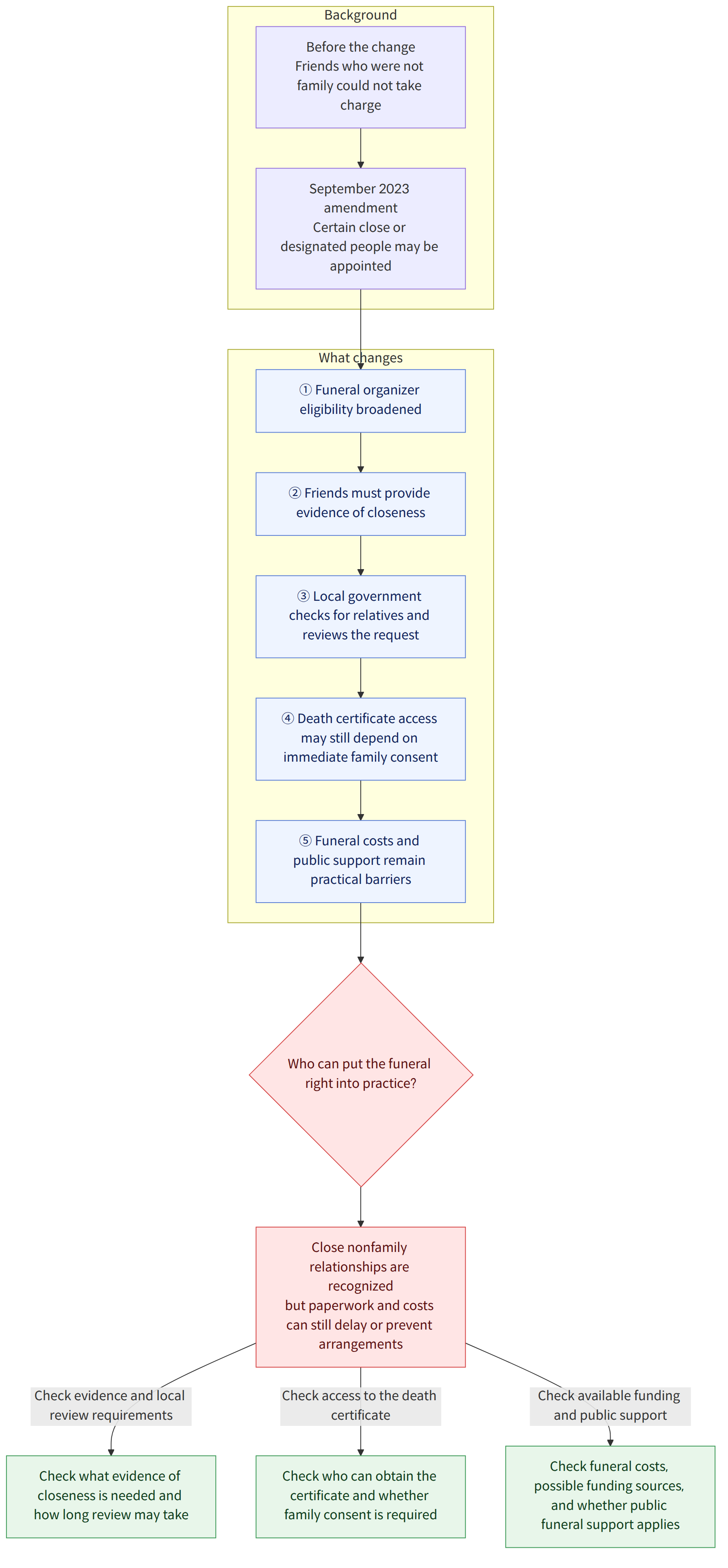
An amendment to the Funeral Services Act (장사법), which took effect in September 2023, allows a person who had a long-standing and continuing relationship with the deceased, or someone designated by the deceased in a will or otherwise, to be appointed to take charge of the funeral. Requiring local governments to hold public funerals for unclaimed deceased people was another part of the amendment. In other words, it opened the way for someone close to the deceased to take charge of the funeral even if they were not legally family.
However, a friend seeking appointment as funeral organizer must submit evidence of their closeness to the deceased, such as text messages, photographs or a will. The local government must also check for relatives and conduct an internal review, a process that the article reported can take anywhere from several days to more than a week. When procedures begin immediately after a death, a lengthy review can make it difficult even for someone close to the deceased to proceed with the funeral right away.
The issuance of a death certificate has also been identified as a barrier, separate from appointment as funeral organizer. According to the article, under the current Medical Act (의료법), the priority right to obtain the certificate belongs to the deceased’s immediate family. It reported that siblings, as well as friends and acquaintances, may need the consent of immediate family members such as the deceased’s children to obtain it. Park Jin-ok, executive director of Nanum and Nanum (나눔과나눔), said that even estranged children have priority in obtaining the certificate, and that there have been cases in which siblings could not get the documents in time and their brother’s or sister’s funeral was held as an unclaimed funeral.
Even when the range of people who can take charge of a funeral has been broadened, a friend’s right to do so may not lead to an actual funeral if death certificate issuance and administrative procedures are not aligned.
What this means
The issue cannot be explained simply by asking whether the deceased had family. Even if someone was emotionally close to the deceased, differences in legal family status and the order for issuing documents may mean that person has to wait for a local government review before taking charge of the funeral. The funeral organizer system has begun to recognize a broader range of relationships, but whether the procedures required immediately after death have been brought into line with that change is a separate question.
The financial burden may also fall on the friend. Social worker Kim Chi-hwan said it cost about 2.5 million won to hold a funeral as its organizer, and that he covered the cost with condolence money. If there are no condolence contributions or other sources of funding, someone who wants to take charge of a funeral may hesitate because of the cost. This suggests that guaranteeing the right to organize a funeral alone may not be enough.
It is also not straightforward to use the deceased’s assets to pay for funeral costs. The Funeral Services Act allows local governments to cover the costs of a public funeral for an unclaimed deceased person using that person’s assets, but the article reported that such cases are extremely rare. An official at the Ministry of Health and Welfare (보건복지부) said that handling the assets is a matter governed by the Civil Act (민법), so local governments cannot dispose of them at their discretion, and that the ministry does not hold related data. Therefore, it is important to distinguish between the fact that the law allows for this possibility and whether assets can actually be identified and used to pay funeral costs in practice.
For example, if a friend who had a longstanding relationship with the deceased wants to take charge of the funeral, they may need to prepare evidence of their closeness and go through a local government review, while also dealing with the death certificate and finding a way to cover the costs. This is a hypothetical illustration; the actual requirements and process should be confirmed on a case-by-case basis.
The size and use of public funeral budgets also remain challenges. The number of unclaimed deceased people in Seoul rose from 389 in 2018 to 1,496 last year. Over the same period, the Seoul Metropolitan Government (서울시) increased its public funeral budget from 521 million won to 935 million won. However, it was reported that last year the city drew on leftover funds from other programs and spent 1.21836 billion won on public funerals. Whether the budget increase alone can reliably meet actual demand for funerals needs to be examined.
According to data obtained from the Ministry of Health and Welfare by the office of Rep. Lee Su-jin of the Democratic Party of Korea (더불어민주당), of the 7,190 unclaimed deceased people nationwide last year, 1,293 did not receive a funeral, while the funeral status of 1,920 was classified as “no information.” Park Jin-ok, executive director of Nanum and Nanum, said that the current mandate for public funerals is closer to a declarative provision. The fact that there are cases in which it is not even confirmed whether a funeral took place points to a gap in verification between the mandate on paper and its actual implementation.
Related rules and support information
According to an in-house legal guide, heirs are determined by legal order and family relationships, not by personal closeness. The order is descendants, ascendants, siblings, and collateral relatives within the fourth degree; a spouse inherits jointly with descendants or ascendants. Therefore, being a close friend of the deceased does not by itself make someone an heir. However, this order of inheritance is not the same system as appointment of a funeral organizer under the Funeral Services Act or priority for obtaining a death certificate.
Whether the deceased’s assets can be used for funeral costs is connected to inheritance, but the information provided is not sufficient to determine the procedures by which a friend or local government may identify or use those assets. In particular, the guide cautions that renouncing an inheritance does not take effect merely upon filing a declaration; it takes effect when notice is given that the court has approved the petition. It also notes that disposing of inherited assets before that notice may be deemed acceptance of the inheritance without qualification.
What is confirmed and what remains unknown
Confirmed facts
- An amendment to the Funeral Services Act that took effect in September 2023 allows a person who had a long-standing and continuing relationship with the deceased, or someone designated by the deceased, to be appointed to take charge of the funeral.
- An application to take charge of a funeral requires evidence of closeness, and the article reported that local government checks and internal review can take anywhere from several days to more than a week.
- According to the article, immediate family members have priority in obtaining a death certificate, and siblings may also need the consent of immediate family members to obtain one.
- Of the 7,190 unclaimed deceased people nationwide last year, 1,293 did not receive a funeral, while the funeral status of 1,920 was classified as “no information.”
What remains unknown
- The article does not identify the specific provisions or exceptions in the Medical Act that establish priority for obtaining a death certificate.
- No specific bill or timeline for simplifying the process of appointing a funeral organizer or issuing a death certificate was provided.
- The article does not explain what records or procedures could be used to confirm the actual funeral outcomes for the 1,920 people whose funeral status was unknown.
What readers should check
- Anyone seeking to take charge of a funeral as a friend should check what evidence of their relationship with the deceased—such as text messages, photographs or a will—is needed, as well as the local government review process.
- Anyone who needs a death certificate should check with the medical institution about who can apply and whether consent from immediate family members is required. The article alone does not establish the specific exceptions under the law.
- Anyone seeking to use the deceased’s assets to pay funeral costs should first confirm who the heirs are and when the effects of disposing of assets or renouncing an inheritance take effect. They should also note that disposing of assets after filing to renounce an inheritance but before receiving notice that the petition has been approved may have adverse consequences.