In his book Trip Reports: Stories from an Australian Psychedelic Renaissance (NewSouth), Melbourne-based journalist Rich Haridy explores the properties of psychedelics such as LSD and magic mushrooms, their potential use in mental health treatment, and the course of related research in Australia. The questions the book raises go beyond whether psychedelics have therapeutic effects. It asks whether microdosing—the practice of taking very small amounts—is useful, whether the unpredictable experiences and potential healing effects of psychedelics can be separated, and whether they can also address social problems such as loneliness and isolation.
The potential described in this book does not mean that safety has been established. Alongside discussion of therapeutic effects, the article also describes deaths and serious physical symptoms.
Background and context
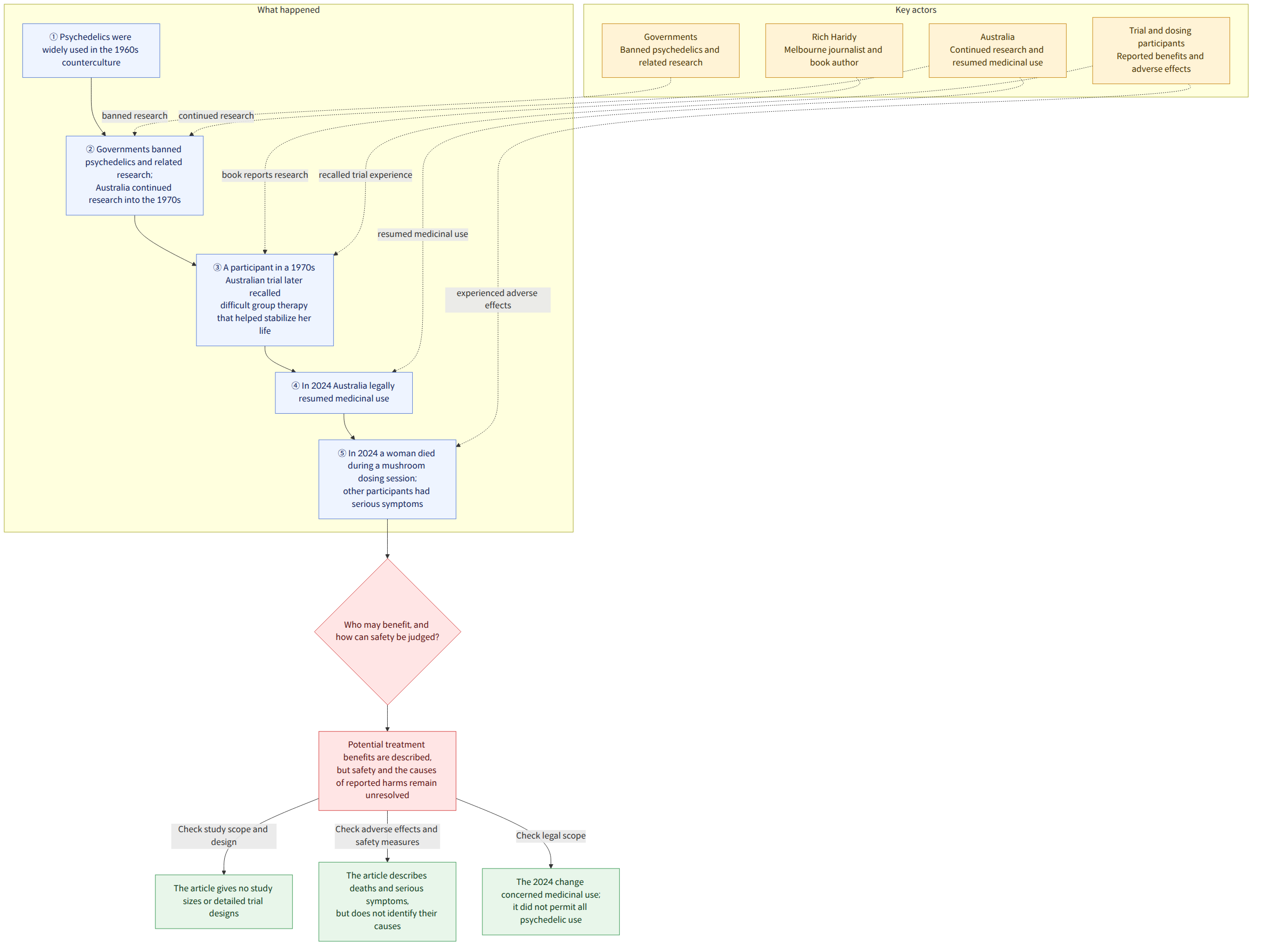
The article explains that psychedelics were widely used in the anti-war counterculture of the 1960s, and that governments around the world banned not only psychedelics but also related research. Haridy’s book says Australia was among the last countries to continue research into the 1970s, and that in 2024 it was among the first countries to legally resume the medicinal use of psychedelics. This refers to the resumption of medicinal use; it should not be taken to mean that all uses of psychedelics were permitted.
The book considers whether psychedelics could help with depression, anxiety and post-traumatic stress disorder (PTSD, a mental health condition that can develop after a traumatic event). It also emphasizes the context of treatment, not just the drug itself, when discussing therapeutic effects. A woman who took part in an Australian clinical trial in the 1970s said that exploring repressed childhood experiences in group therapy was difficult and painful, but that the treatment had been effective and had helped stabilize her life.
Haridy says studies involving terminally ill patients experiencing anxiety and fear about death also had positive results. The results he describes include not only reductions in anxiety and depression, but also less fear of death and demoralization, as well as improvements in spiritual well-being and quality of life. However, the article does not provide the size of the studies or details of their clinical trial designs, making it difficult to assess who experienced these results and under what conditions.
What this news means
The results described in the book show that psychedelics are being explored as a potential treatment for some mental health problems. The book also says researchers have found prosocial effects from MDMA, such as feelings of happiness, connection with others and empathy. It also describes people who took ayahuasca reporting that they had emerged from severe depression and felt better. But these accounts alone cannot establish that all patients will experience the same effects, or how long any effects last after treatment.
The risks are not abstract. The book recounts the death of a woman during a psychedelic mushroom dosing session in 2024, while other participants experienced paralysis, difficulty speaking or standing, and breathing problems. The article does not, however, identify the causes of the death or adverse effects. Significant negative effects are also mentioned in connection with ayahuasca. Participants who took DMT, a type of psychedelic, described experiencing another place inhabited by elves, insects and aliens. Some reportedly became convinced that the place was a concrete, real location or an extraterrestrial realm.
The central difficulty Haridy raises is that the very property of psychedelics that changes the mind creates both the possibility of healing and the risk of harm. If an experience is intense and unpredictable, even people hoping for a therapeutic effect cannot know in advance what they will experience. For example, someone considering treatment for depression should look beyond accounts of improvement in specific cases and also consider the scope of the research establishing therapeutic effects, as well as information about adverse effects and safety measures.
What is known and what remains unknown
What is known
- The book discusses the properties of psychedelics such as LSD and magic mushrooms and their potential for mental health treatment.
- Haridy says studies involving terminally ill patients found positive results, including reductions in anxiety and depression.
- The book describes prosocial effects of MDMA and positive experiences reported by people who took ayahuasca, while also mentioning negative effects of ayahuasca.
- The book recounts a death and serious symptoms among other participants during a psychedelic mushroom session in 2024.
- Participants’ descriptions of DMT experiences include strange beings and another place.
What remains unknown
- What was the size of the psychedelic therapy studies mentioned in the article, and what were the details of their clinical trial designs?
- How long do the therapeutic effects last after treatment ends?
- What caused the death and adverse effects among participants at the 2024 psychedelic mushroom session?
What readers should check
- When reading reports about therapeutic potential, check which patients and studies the reported results came from, and whether the study size and design are provided.
- If considering treatment, do not rely on positive accounts alone. Also look for information about unpredictable reactions, adverse effects and safety measures.
- Australia’s 2024 measure is described as a resumption of medicinal use. The article does not establish the specific scope of what was permitted or the procedures available to individuals, so do not interpret it as general authorization for use.