The frame that taught pictures to tell stories
People have used images to tell stories for thousands of years. Ancient Egyptian tomb paintings, for example, showed activities such as planting crops and storing a harvest in a sequence of scenes. The 11th-century Bayeux Tapestry similarly presents events from the Norman Conquest across a continuous stretch of embroidered cloth.
These works share an important feature: their scenes are not separated into clear, framed units. A viewer may need someone to explain the sequence, or may already need to know the story. The images show events, but they do not always make it easy to see where one moment ends and the next begins.
The comic panel changed that. By enclosing an image in a border and arranging it beside other framed images, creators could guide readers through a story in a deliberate order. A simple line around a picture could mark a change of place, signal the passage of time and tell readers what to look at next.
A panel does more than contain a picture: it helps decide what counts as a moment, what comes after it and how a reader moves through the story.
From one image to a sequence
In 1837, Swiss teacher Rodolphe Töpffer published The Adventures of Mr. Vieux Bois, a work that arranged one to six pictures on a page, often accompanied by short text. It helped establish a key principle of modern comics: a sequence of images can show not only what is happening, but also what happened first and what followed.
That difference made it possible to tell more complex stories visually. A single cartoon can capture a striking situation or make a joke, but a sequence can show a character making a choice, facing a consequence and reacting to what happens next. The reader becomes able to follow a narrative through pictures rather than relying on a separate explanation for every scene.
The format continued to develop as artists combined pictures with written dialogue. Speech balloons made it easier to show what characters were saying while keeping the words connected to the person speaking. By the late 19th century, this approach was becoming an increasingly familiar part of newspaper comics.
The story between the panels
A panel’s most important work may happen outside its border. Artists draw one moment, then leave the movement or event between that moment and the next one unshown. Readers use their imagination to fill in the gap.
Comic theorist Scott McCloud used the term “gutter” for the space between panels. The gutter is not simply blank space: it invites the reader to infer what happened. If one panel shows a character raising a hammer and the next shows a broken object, the reader understands the action in between without seeing every instant.
This process allows comics to communicate a great deal with relatively few images. It also gives readers an active role. They are not only looking at pictures; they are connecting them, estimating how much time has passed and imagining the movements the artist chose not to draw.
Comics and film control time differently
A film presents images in a fixed sequence and at a pace largely set by its director. A comic page, by contrast, remains visible. Readers can pause over one panel, return to an earlier image, move quickly through a familiar section or skip ahead.
That freedom makes comics distinct from other visual media. The creator chooses the order and composition of the panels, but the reader has more control over the time spent with each one. A quiet scene can be revisited; a dramatic reveal can be approached at the reader’s own pace.
- Panel borders separate moments and organize the page.
- Panel order signals the intended reading sequence.
- Gutters let readers imagine actions and changes that are not shown.
- Reader-controlled pacing allows people to linger, reread or move ahead.
How panels helped build a repeatable business
The panel sequence changed not only storytelling but also the way comics could be sold. A single cartoon could make an immediate impression, but an ongoing story gave readers a reason to return for the next installment.
Newspapers expanded their Sunday comic sections as publishers competed for readers. Serialized stories—stories released in installments over time—could encourage people to buy the next issue or return to the same publication. The comic became more than a one-time image: it could be a recurring product built around characters and continuing plots.
That model also made distribution more valuable. A story that appeared regularly could travel through newspapers and reach readers in many places. Later, collected editions and adaptations offered additional ways to keep a popular story in circulation.
The business logic is familiar in other media today. A television series can bring viewers back for the next episode, while a digital comic can encourage readers to return for the next update. In each case, the unfinished story creates anticipation and gives audiences a reason to come back.
Print pages shaped the art form
For more than a century, comics were largely designed around the physical page. The paper had a fixed size, so creators had to decide how many panels could fit, how large each image should be and how much blank space to leave between scenes.
The familiar North American comic-book format—about 6.625 inches wide and 10.25 inches tall—reflects how strongly printing conventions shaped the medium. The article traces the dimensions to a practical paper-folding format developed in the United States in 1933. Once that size became standard, artists and publishers learned to work within its limits.
Those limits were not only obstacles. The page turn created a special moment: when readers turned a page, the images on the previous one disappeared and a new set appeared. Creators could use that brief pause to build suspense or reveal a dramatic scene.
Japanese manga developed its own techniques around the page turn. One example is “mekuri,” a reveal timed to the act of turning the page. A crucial image placed near the end of a page can make readers eager to turn it, much as a cliffhanger encourages viewers to start the next episode.
A crisis in South Korea opened a new route
The next major change came from a country whose print-comics business was under severe pressure. In South Korea, a youth-protection law introduced in 1997 subjected comics to reviews of whether they were suitable for young readers. Bookstores began removing comics from their shelves, and the Asian financial crisis that followed added further strain.
As lending shops became an alternative to buying books, print sales and the market for comic magazines weakened. The number of Korean comic magazines, which had reached dozens in the mid-1990s, had fallen to fewer than ten by the late 2010s, according to the figures described in the article. Creators were losing the regular print spaces where they had traditionally published their work.
In the early 2000s, some of those creators moved to online portals. The portals needed material that could keep visitors on their sites, while comics could be offered to readers online without the constraints of printing and distribution. In October 2003, Kang Full’s Love Story began appearing on Daum’s online comics service, bringing a long-form narrative to the web.
The browser had no fixed page size. There was no sheet of paper to fold and no physical page to turn. That meant artists no longer had to arrange every scene to fit a predetermined print format.
Vertical scrolling changed the reader’s pace
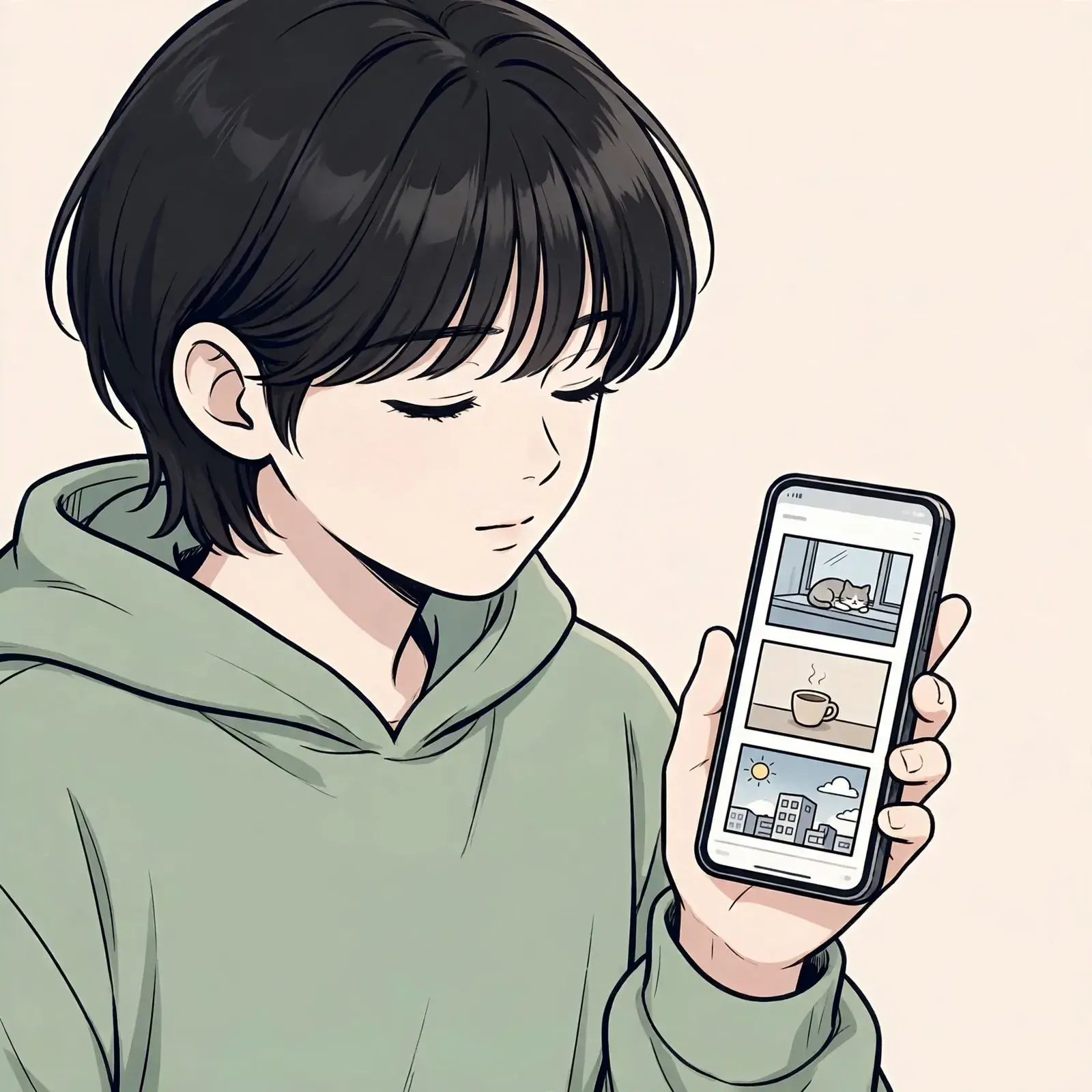
Webcomics eventually developed into the vertical-scroll format now associated with Korean webtoons. Instead of moving from one printed page to the next, readers move down a long digital canvas, commonly by swiping on a phone screen.
This changed the role of the space between panels. On paper, the gaps between images are limited by the page layout. In a scrolling comic, an artist can make the blank space much longer or shorter. A longer gap can delay the next image; tightly grouped panels can make events feel fast and immediate.
The creator can therefore influence the reader’s timing more directly than in a conventional printed comic. Readers still control how quickly they scroll, but the length of the screen and the placement of images can guide their pace.
A tall blank stretch can make a reader wait for what comes next. A sudden image after that pause can create a surprise that would be difficult to stage on a page where all the pictures are visible at once.
Horror comics make the effect especially clear. An artist can place a frightening image far below a stretch of empty screen. The reader may swipe several times before reaching it, building anticipation with every movement. The reveal is linked not just to the picture but to the physical act of scrolling.
Smartphones helped the format spread. Their tall screens suit a vertical sequence, and the thumb-driven swipe makes moving through a comic feel natural. A format that began as a response to a difficult publishing environment proved well matched to the devices readers increasingly used.
A new canvas, not just a new delivery system
Vertical scrolling is more than a way to put a printed comic on a screen. It changes how artists can use space, when a reader sees a scene and how a story builds suspense. The same story could be arranged differently for a printed book, where a whole page is visible, and for a phone, where the reader encounters one section at a time.
That difference matters for production as well as design. Creators and editors must consider how a story will feel on a narrow screen, where a pause or reveal can depend on the distance between images. Platforms also create a direct route for releasing episodes and reaching readers online.
The global shift from books to screens
Japan’s print-comics industry had long offered a successful model: serialize stories in magazines, collect them into books, then extend popular characters into animation and merchandise. With a strong publishing system already in place, there was little immediate reason for the industry to abandon the printed page.
But digital reading has grown. In 2025, electronic comics accounted for 76.1% of Japan’s manga market, according to the figures cited in the article. Sales of print manga magazines alone fell 12.7% in a year. In 2024, publisher Shueisha also launched the vertical-scroll app Jump Toon, a sign that established publishers were responding to the changing format.
These shifts do not mean that printed manga will disappear. Print books offer a different reading experience and remain part of the industry. But the figures point to a major change in where readers find comics and how publishers deliver them.
Korean-origin webtoon platforms have helped bring the vertical format to audiences around the world. Digital episodes can be read on phones, and popular stories can move into other formats, including animation and film. That creates opportunities for a story to reach new audiences, though each adaptation must work in the language of its own medium.
What the history of the panel tells us
The history of comics is, in part, a history of how images are arranged. Framed panels made it easier to establish order and time. The empty spaces between them invited readers to complete the action. Printed pages created a fixed canvas and gave artists the page turn as a tool for suspense.
Vertical scrolling changed that arrangement again. It loosened the page’s physical limits and let creators use distance on the screen as part of the story. Just as the panel transformed a sequence of pictures into a readable narrative, the scrolling canvas has changed how those panels can be experienced.
The striking part of this history is where the latest transformation began. South Korea’s webtoon format emerged not from a comics market with little to change, but from one where creators had lost many of their traditional publishing opportunities. With less of the old system to protect, they had greater reason to experiment.
That does not mean the shift was inevitable or that digital comics will replace every printed format. It does show how pressure can open space for new ideas—and how a change in the shape of a screen can reshape storytelling, publishing and the global content business.