Kim Hae-dong, a professor in the Department of Environmental Engineering at Keimyung University (계명대학교), wrote a column arguing that systems for responding to extreme heat in cities must be established quickly. The column reported that temperatures of 40–46°C had been recorded in Europe and the western part of North America since June this year, and that temperatures also exceeded 40°C across a wide area near South Korea’s southern coast, including a daytime high of 42.5°C in Yangsan, South Gyeongsang Province. The article’s photo caption described Yangsan’s 42.5°C as the highest temperature ever recorded in South Korea.
The column’s central argument goes beyond emphasizing the severity of extreme heat. It raises the concern that, although tools for identifying urban heat risks and protecting people already exist, there is no adequate system for connecting them to the work of local governments so they can be put to practical use.
Background and context
The column focuses on the urban heat island effect (the phenomenon in which buildings, roads and other features make cities hotter than surrounding areas). It noted that information about extreme heat on the World Meteorological Organization (세계기상기구) website emphasizes that urban temperatures can be 5–10°C higher than those in suburban areas. The column’s concern is that temperatures reported for a region as a whole may not adequately describe the heat residents face within a city.
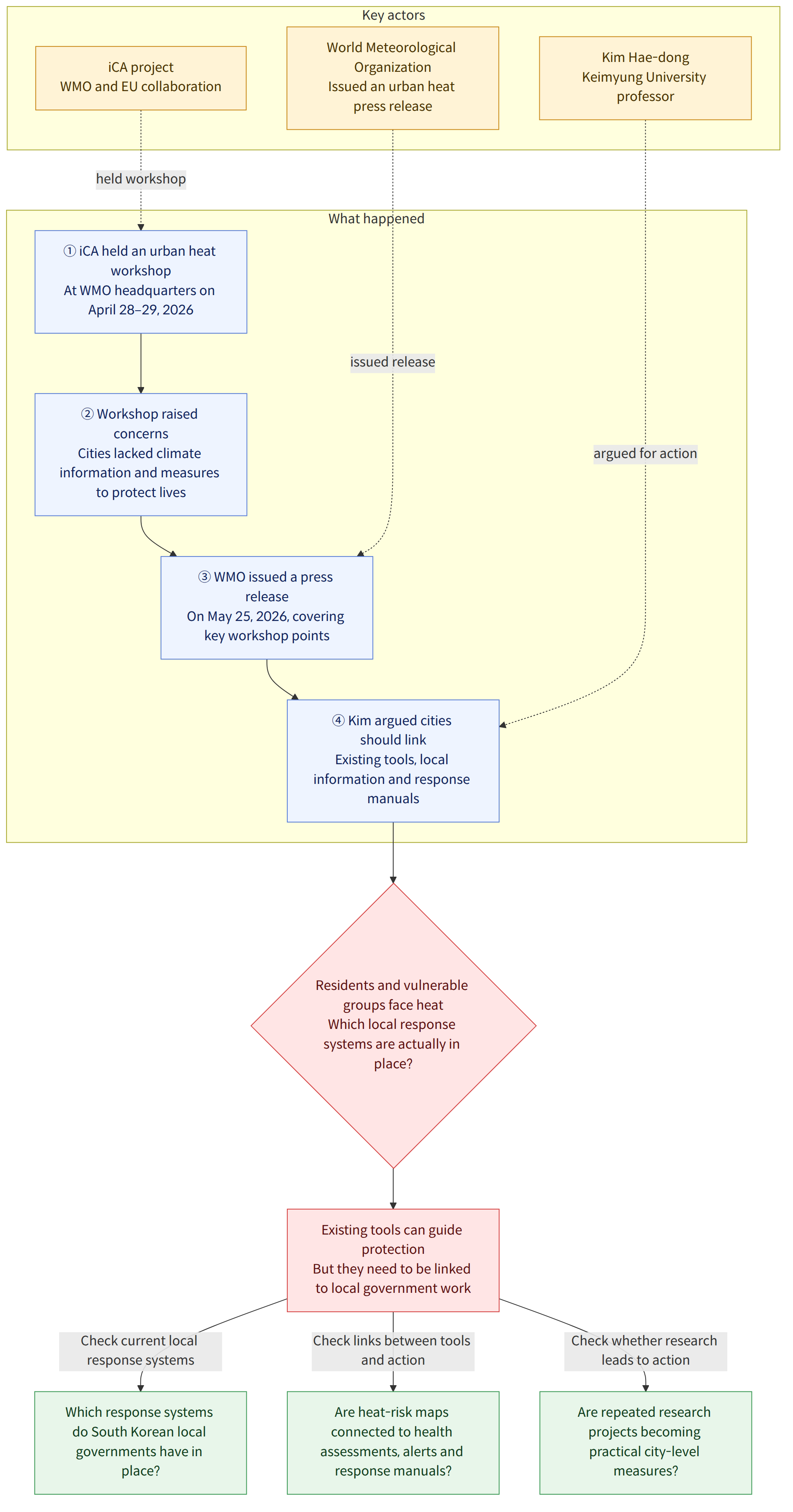
Professor Kim said the World Meteorological Organization (WMO) issued a press release on May 25, 2026, titled “What Is Needed to Protect Cities From Extreme Heat?” The press release, he said, covered key points from an urban heat response workshop held at WMO headquarters on April 28–29, 2026, by the iCA project (프로젝트 iCA), a collaboration involving WMO and the European Union, among others. According to the column, the workshop raised concerns that city governments did not have enough of the climate information needed to respond to extreme heat and were not properly equipped with measures to protect lives.
What this news means
The column explains that tools already exist, including heat-risk maps, health impact assessment models, urban planning techniques to reduce high temperatures in cities, and tools for evaluating the effects of investments. The focus of the response, then, could be not only on developing new tools but also on selecting those suited to local conditions, applying them in government operations, and expanding their use. Even if research findings accumulate, risk information may not lead to protection for residents unless the responsible authorities and manuals for issuing alerts and carrying out responses are linked.
Those affected are city residents exposed to extreme heat, and the column notes that vulnerable groups are particularly at risk. For example, if a heat-risk map in a city identifies areas at risk of high temperatures, it is possible to consider whether the local government can connect that information to health impact assessments, heat-health alerts, or response manuals and use it to protect residents. This describes a possible way to link these measures; the column did not specify which alerts are actually operating in which areas.
Professor Kim wrote that extreme heat research projects are being repeated in South Korea, while developed countries operate administrative response manuals tailored to city-specific heat information and heat-health alert systems. The point of this comparison is not to deny the need for research, but to ask whether research is leading to actionable government measures. However, the column alone does not make it possible to determine what response systems specific local governments in South Korea have in place or which cities should be prioritized.
What is known and what remains unclear
What is known
- The column reported that temperatures of 40–46°C had been recorded in Europe and the western part of North America since June this year.
- The column said that the daytime temperature in Yangsan, South Gyeongsang Province, reached 42.5°C and that temperatures also exceeded 40°C across a wide area near the southern coast. The article’s photo caption described Yangsan’s reading as the highest ever in South Korea’s temperature records.
- According to the column, WMO issued a press release on urban heat responses on May 25, 2026, and iCA held a workshop at WMO headquarters on April 28–29 of the same year.
- The column explained that tools for responding to extreme heat, including heat-risk maps and health impact assessment models, already exist.
- Professor Kim argued that research projects are being repeated in South Korea, while developed countries have examples of cities operating city-specific response manuals and heat-health alert systems.
What remains unclear
- What is the specific timeline for establishing city-specific heat-health alert systems in South Korea, and which agencies will be responsible?
- Have budgets for establishing city-specific response systems and priority areas for their rollout been determined?
- What heat-risk maps, health impact assessment tools, and administrative manuals are currently being used in each city?
What readers can check
- Readers can check whether their local government operates an extreme heat response manual or heat-health alert system and, if so, what information and criteria it uses.
- They can check whether local extreme heat response plans actually include measures to protect vulnerable groups and city-specific heat-risk information.
- They should also check whether the areas where new research or tools will be applied, the responsible parties, and implementation schedules have been made public. The column did not specify such schedules, responsible agencies, or budgets.