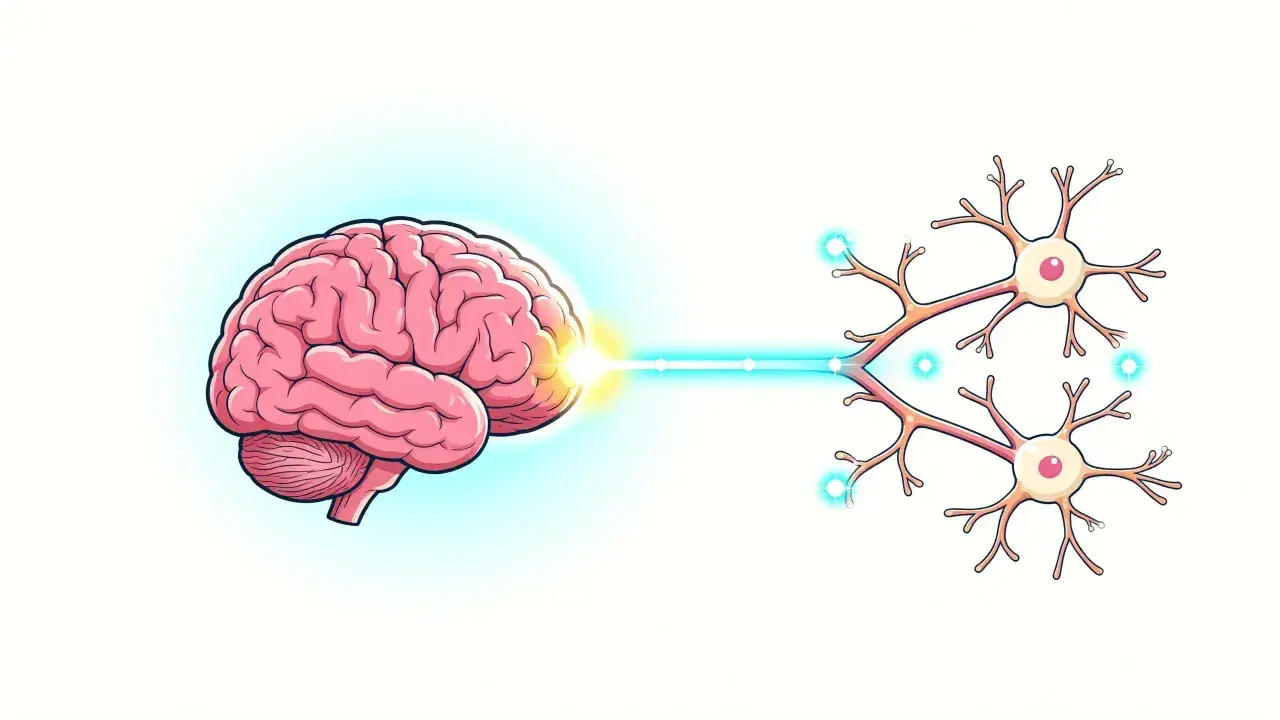
Karl Deisseroth, Peter Hegemann, and Georg Nagel, who led research into optogenetics—a field that uses light to control the activity of neurons—were named 2026 Nobel Prize in Physiology or Medicine laureates. Optogenetics involves expressing light-sensitive proteins in neurons and then shining light on them to activate or inhibit neural signals. Researchers can use it to control the activity of neurons on a millisecond timescale.
Background and context
The challenge of brain research lies in its scale and complexity. Even one cubic millimeter of brain tissue—about the size of a poppy seed—contains tens of thousands of neurons (nerve cells) and other supporting cells, which affect one another’s functions. To understand this complexity, neuroscience technologies have generally advanced in stages: visualizing the brain, measuring its functions, and then controlling its activity.
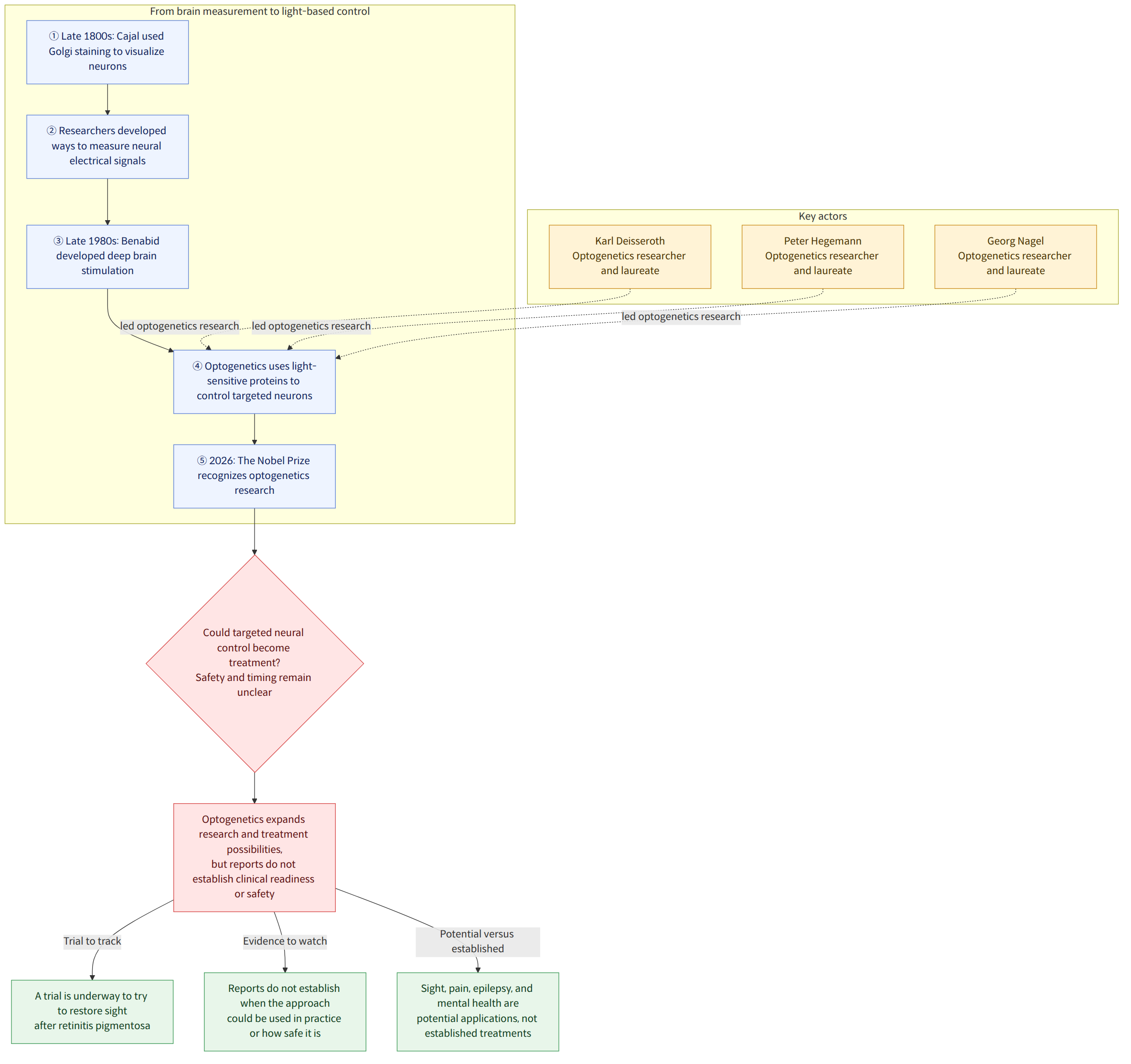
One of the early steps in visualization came from the observations of Santiago Ramón y Cajal, a Spanish neuroscientist and artist, in the late 1800s. He used a silver staining method developed by Camillo Golgi to make individual neurons in brain tissue visible, then examined them under a microscope and recorded them in drawings. Cajal and Golgi received the 1906 Nobel Prize in Physiology or Medicine for this work. Anterograde and retrograde tracing methods, developed in the 1970s, are used to map the many pathways between neurons.
Today, electron microscopy can produce images with atomic-level resolution, while expansion microscopy physically enlarges tissue samples to examine cells and the connections between them. These methods are closely related to connectomics research, which seeks to map all the connections between neurons. Functional MRI (an imaging technique that uses changes in blood flow to observe brain activity) measures blood flow throughout the brain to examine activity noninvasively. The development of rapid imaging acquisition sequences and spatial encoding techniques that made this approach possible is linked to the 2003 Nobel Prize in Physiology or Medicine.
Looking at structure alone makes it difficult to understand how neurons send signals to one another. Alan Hodgkin and Andrew Huxley received the 1963 Nobel Prize in Physiology or Medicine for research that captured and measured the electrical signals produced by neurons. Probes used in research today can simultaneously record the electrical activity of hundreds of neurons across multiple brain regions. A series of studies published in 2025 reported that 95% of the brain appeared to be involved in the process while animals were making decisions. This suggests that decision-making is difficult to explain as the work of just one brain region.
Technologies for controlling brain activity have also advanced. In the late 1980s, French neurosurgeon Alim-Louis Benabid developed deep brain stimulation to relieve symptoms of Parkinson’s disease. This method implants electrodes in the brain and delivers electrical stimulation, but it is limited in its ability to target specific neurons because it affects all cells around the electrodes. Optogenetics, by contrast, can use light to control the activity of targeted neurons, opening up the possibility for researchers to examine more directly the relationship between the activity of specific circuits and behavior.
What this news means
The importance of optogenetics lies in the fact that it enables researchers not only to observe brain activity, but also to control the activity of specific neurons and examine the results. For example, in research seeking to determine which neural circuit is involved in a pain response, researchers could use light to control the activity of that circuit and then observe changes in the response. This is a hypothetical example and does not mean the technology will be used to treat patients right away.
The reports mention restoring sight and treating pain, epilepsy, and mental health conditions as potential therapeutic applications of optogenetics. One report also says that a clinical trial is underway in people who have lost their sight because of retinitis pigmentosa, aiming to restore vision by introducing light-sensitive proteins into the retina. Another report says optogenetics is also used to study interactions between cells and the nervous system in other organs, including the heart and intestines.
However, potential applications must be distinguished from established treatments. The information provided in these reports does not make it possible to determine how broadly the technology can be applied to specific conditions, when it might be used in patients, or how its safety is being assessed. A Nobel Prize demonstrates the importance of the research, but does not in itself mean that the effectiveness or safety of a particular treatment has been established.
Differences in what the reports said
The reports agree on the names of the laureates, but give different ages. One report listed Deisseroth as 54 and Hegemann as 71, while another gave their ages as 55 and 72, respectively. Nagel was reported to be 73 in all of them.
The reports also differ in how they describe clinical applications. One mentions a clinical trial to restore sight in people with retinitis pigmentosa, while another says optogenetics is being used to restore sight. Therefore, these materials alone do not make it possible to establish the treatment’s current scope, the stage of the clinical trial, or the conditions under which it is being provided to patients.
What is confirmed and what remains unknown
Confirmed facts
- Optogenetics uses light to control the activity of neurons, allowing control on a millisecond timescale.
- Karl Deisseroth, Peter Hegemann, and Georg Nagel were reported as the 2026 Nobel Prize in Physiology or Medicine laureates.
- Brain research technologies have advanced from visualization to measuring function and controlling activity.
- The reports cited restoring sight and treating pain, epilepsy, and mental health conditions among the potential applications of optogenetics.
What remains unknown
- When and to what extent optogenetics-based treatments will be used in actual patients.
- What evidence and procedures are being used to assess the safety and effectiveness of these treatments.
- The specific stage of the clinical trial related to retinitis pigmentosa and its participation criteria.
What readers should check
- When reading about optogenetics treatments, it is important to distinguish between research potential, a clinical trial, and actual use as a treatment.
- Information about clinical trials should not be assessed based on the condition’s name alone; readers should also examine the eligibility criteria and safety assessment details.
- Anyone considering treatment should not assume it is effective based on news reports alone, but should consult a healthcare professional who treats the condition about currently available options and the supporting evidence.
References
- Other coverage consulted: koreatimes.co.kr
- Other coverage consulted: hani.co.kr