
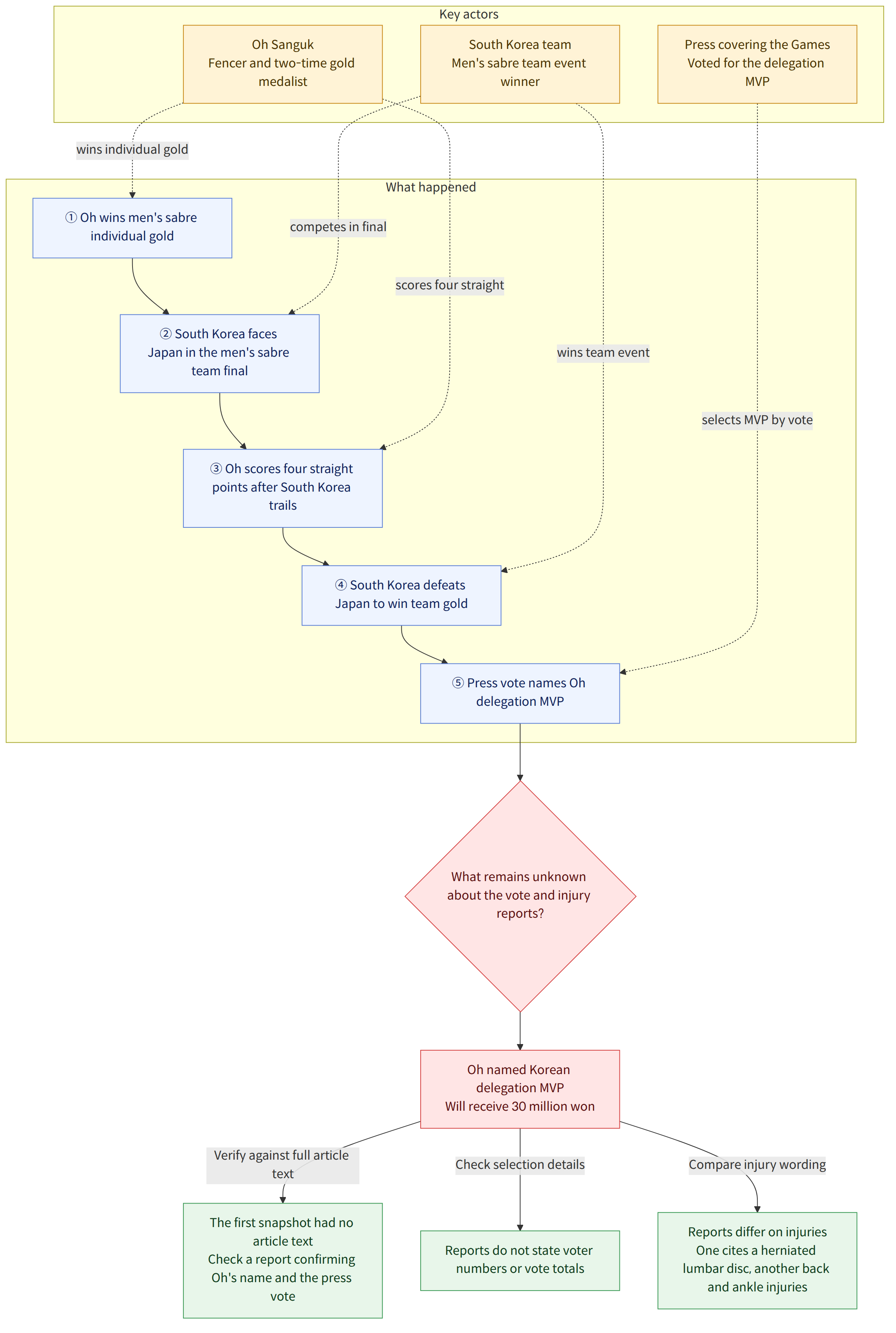
Oh Sanguk, who won two gold medals in fencing, was named MVP of the Korean delegation at the 2026 Aichi-Nagoya Asian Games. According to related reports, Oh was selected in a press vote and will receive 30 million won in prize money. However, the first original snapshot provided contained only a 1×1 image and no article text, so the athlete’s name and the voting method could not be confirmed from that material alone.
Background and context
Two other reports identify Oh Sanguk as the athlete selected. He won gold in the men’s sabre individual event for the second consecutive time and also helped South Korea win the team event. One report says Oh achieved consecutive individual-event titles and a third consecutive team title at the Asian Games.
The decisive moment in the team final was also reported alongside the MVP news. According to an English-language report, South Korea was trailing Japan 40-39 in the final bout of the men’s sabre team event when it was left to Oh to decide the outcome. After the gap widened to 44-41, Oh scored four points in a row to secure the victory. In the team event, the first side to reach 45 points wins.
What this news means
The MVP award was not automatically determined by the number of gold medals won; it was decided by a press vote. The selection is therefore noteworthy as a result that reflects not only Oh’s medal performance but also the assessment of the press covering the Games. For example, if several athletes have the same number of gold medals, medal counts alone cannot explain why one was selected as MVP; the voting results and competition itself need to be considered together.
The late comeback in the team event shows how an athlete’s performance in contributing to a team victory can draw attention. However, the reports do not provide the number of voters or the vote totals for each candidate, so the finer details of the selection process cannot be assessed.
Differences in what the reports said
The reports differ in their descriptions of Oh’s injuries. One said he had suffered a herniated lumbar disc since November of the previous year, while another mentioned injuries to his back and ankle. Rather than treating the two accounts as establishing a single specific diagnosis or injury history, it is more accurate to distinguish between what each report said.
Confirmed facts and what remains unknown
Confirmed facts
- Oh Sanguk won two gold medals in fencing at the Asian Games.
- Oh was named MVP of the Korean delegation, with a press vote reported as the method of selection.
- Oh will receive 30 million won in prize money.
- South Korea defeated Japan to win the men’s sabre team event.
What remains unknown
- The reports do not state how many people took part in the MVP vote or how many votes each candidate received.
- Reports describe Oh’s injuries differently—as a herniated lumbar disc, or as back and ankle injuries—making it difficult to determine his precise condition.
- The athlete’s name and the selection process cannot be confirmed from the first original snapshot provided alone.
What readers should check
- If you have seen only a short headline or search result, you can confirm the athlete’s name and whether there was a press vote in a report that includes the article text.
- Because reports use different wording about the injuries, take care not to interpret them as establishing a specific diagnosis or recovery timeline.
- If you want to know the detailed selection criteria or vote totals for the MVP award, check whether that information is included in the reports provided.
References
- Other coverage consulted: hani.co.kr
- Other coverage consulted: koreatimes.co.kr