Ulsan has promoted itself as a “Hangul City” (한글도시) for more than a decade, drawing on its cultural heritage as the hometown of Oesol Choe Hyeon-bae (외솔 최현배), but a report says its policies and projects have not produced clear results. Ulsan Metropolitan City (울산시) declared itself a “Central City of Hangul Culture” (한글문화 중심도시) in 2015, and Jung-gu District (중구) declared itself a “Hangul City” in 2021. The report’s central point is that Jung-gu’s current Hangul-related projects are limited to maintaining and managing facilities such as the Oesol Memorial Hall (외솔기념관) and Choe’s birth home.
Background and context
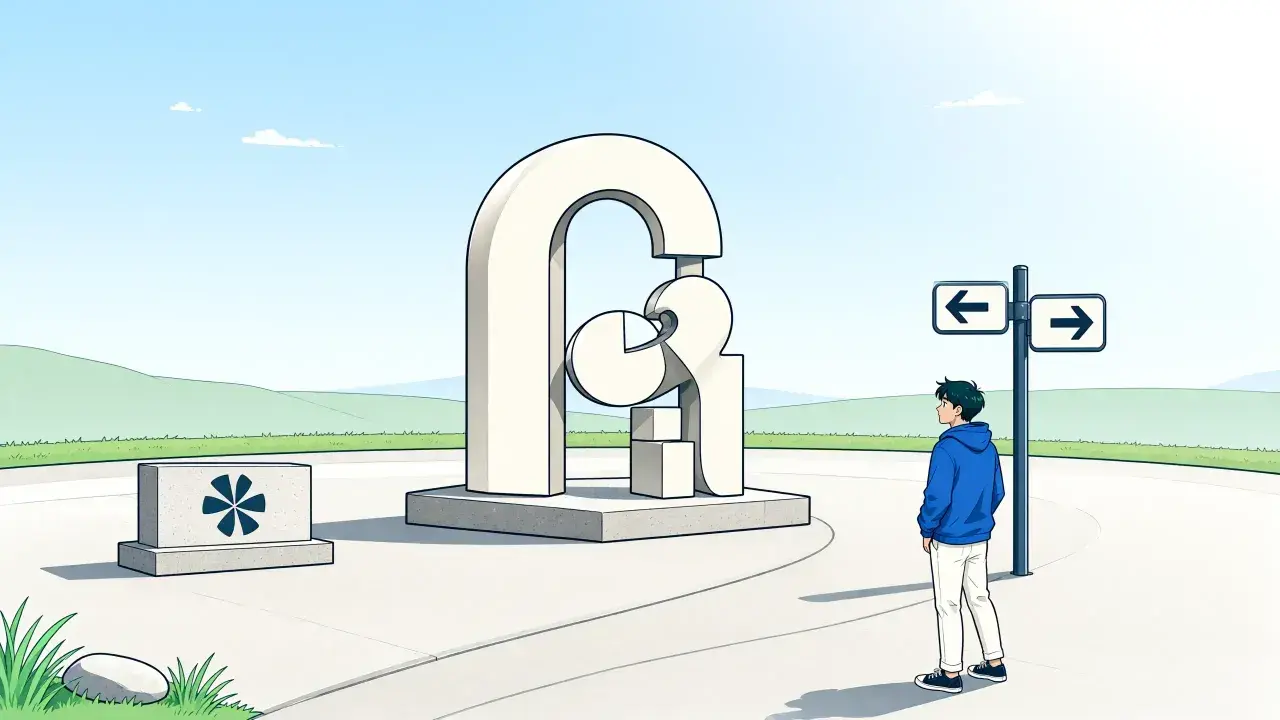
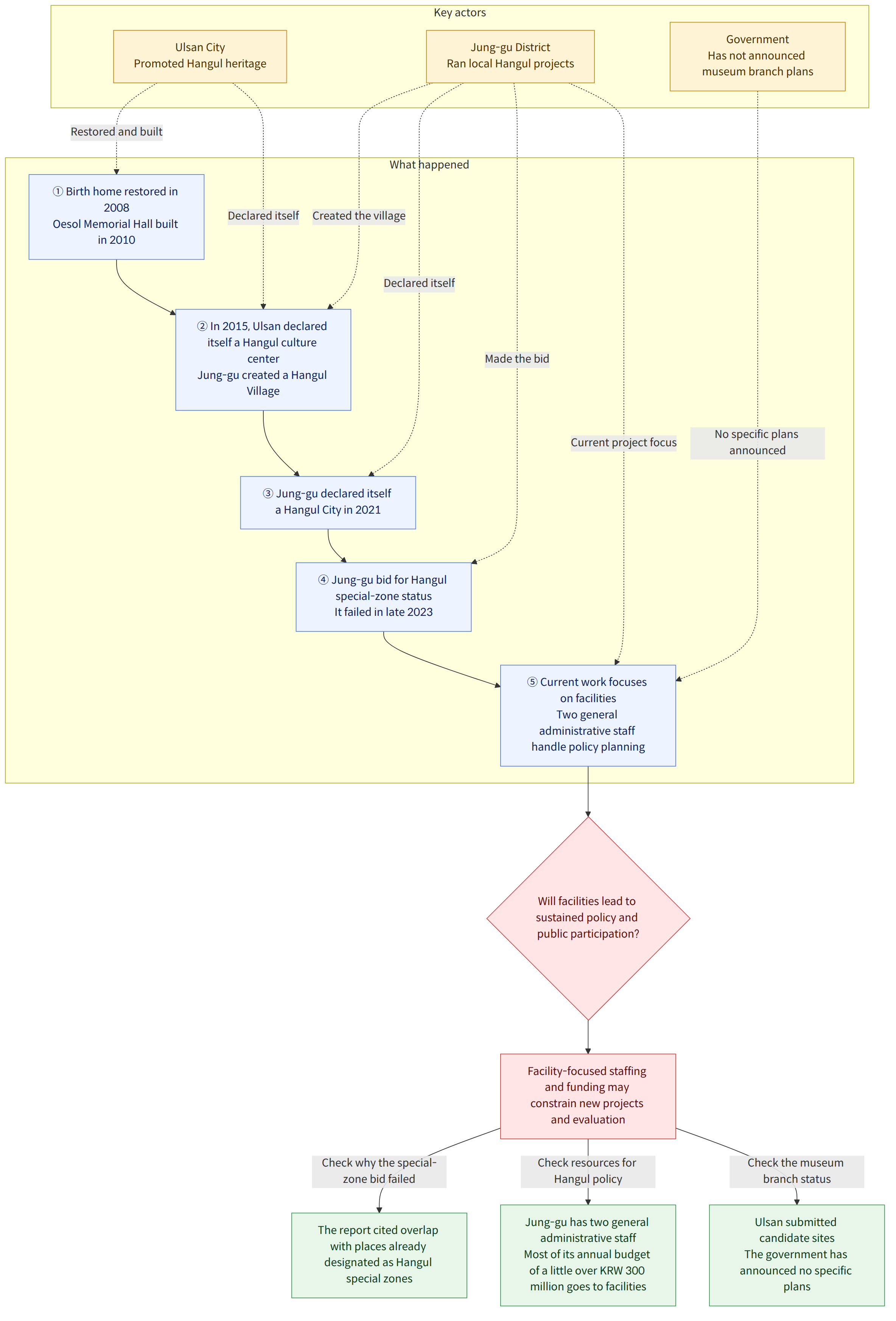
Ulsan restored Choe Hyeon-bae’s birth home in 2008 and built the Oesol Memorial Hall next to it in 2010. In 2015, Jung-gu spent KRW 1.4 billion to create a Hangul Village around Byeongyeongseong Fortress, including Dong-dong, where the birth home is located, as well as Seo-dong and Namoe-dong. As part of the project, it spent KRW 80 million on a sculpture called “The Resonance of Hangul.”
There is also a separate Hangul-themed sculpture at Oesol Roundabout, formerly the Seo-dong intersection, near Byeongyeongseong Fortress. The Korea Land and Housing Corporation (한국토지주택공사) built it in 2017 at a cost of KRW 520 million, and the Ulsan City Naming Committee (울산시 지명위원회) changed the intersection’s name to Oesol Roundabout in July 2021. The facilities and place names are examples of the Hangul City concept taking shape in public spaces, but whether their creation led to sustained policies or public participation is a separate question.
Jung-gu sought designation as a Hangul History and Culture Special Zone (한글역사문화 특구), but the bid failed in late 2023. The report cited factors including overlap with places such as Sejong and Yeoju in Gyeonggi Province, which had already been designated Hangul special zones. Since then, Jung-gu’s policy work has remained focused on maintaining the memorial hall and birth home. The dedicated department remains in place, but two general administrative civil servants, including the team leader, are responsible for policy planning, the report said.
One professional staff member at the equivalent of grade 8, who had been employed on a time-selective basis, left when their contract ended late last year and was also removed from the authorized staffing complement. The department’s annual budget is a little over KRW 300 million, most of it allocated to facilities. Ulsan also stopped supporting Hangul Day events; according to the report, the support amounted to KRW 570 million in 2023.
What this news means
The label “Hangul City” is not secured by a declaration alone. Building facilities and renaming an intersection are different from planning and implementing policies that build on that cultural heritage. If dedicated staff and funding are concentrated on maintaining facilities, that may constrain efforts to develop new Hangul-related projects or assess the results of existing ones.
This does not mean that facilities honoring Choe have no value. Rather, the challenge is how to connect the memorial hall, birth home and street monuments with ongoing education and cultural policies. Kim Gu-han, a former professor in the Department of Korean Language and Literature at the University of Ulsan, said the city should take a more active role.
For example, residents seeking to evaluate the Hangul City project could look not only at how many sculptures or facilities have been built, but also at how the staff and budget assigned to the project are being used and how future projects will build on it. This does not mean that specific follow-up projects have already been decided; it means looking at the scope and continuity of the projects currently in place.
What is confirmed and what remains unknown
Confirmed facts
- Ulsan restored Oesol Choe Hyeon-bae’s birth home in 2008 and built the Oesol Memorial Hall in 2010.
- In 2015, Jung-gu spent KRW 1.4 billion to create a Hangul Village around Byeongyeongseong Fortress and KRW 80 million on the “The Resonance of Hangul” sculpture.
- The bid for designation as a Hangul History and Culture Special Zone failed in late 2023; the report cited factors including overlap with other areas.
- Jung-gu has two general administrative civil servants responsible for Hangul policy planning, and most of its annual budget of a little over KRW 300 million is allocated to facilities.
- Ulsan submitted several candidate sites to the government for a branch of the Hangul Museum, but the government has not announced specific plans.
What remains unknown
- The report does not say what follow-up plans Jung-gu developed after the bid for special-zone designation failed.
- It is not known whether Ulsan or Jung-gu plans to increase dedicated staffing or funding.
- No decision has been made on when or what plans the government will announce regarding a branch of the Hangul Museum.
What readers can check
- Readers can check whether Jung-gu has announced new Hangul policies or project plans since the bid for special-zone designation failed, and whether those plans specify responsible staff and funding.
- Readers can check whether the next budget allocates Hangul-related funding to policy planning and projects beyond facility maintenance and management.
- Readers can check whether the government has announced specific plans for a branch of the Hangul Museum since Ulsan proposed candidate sites.