
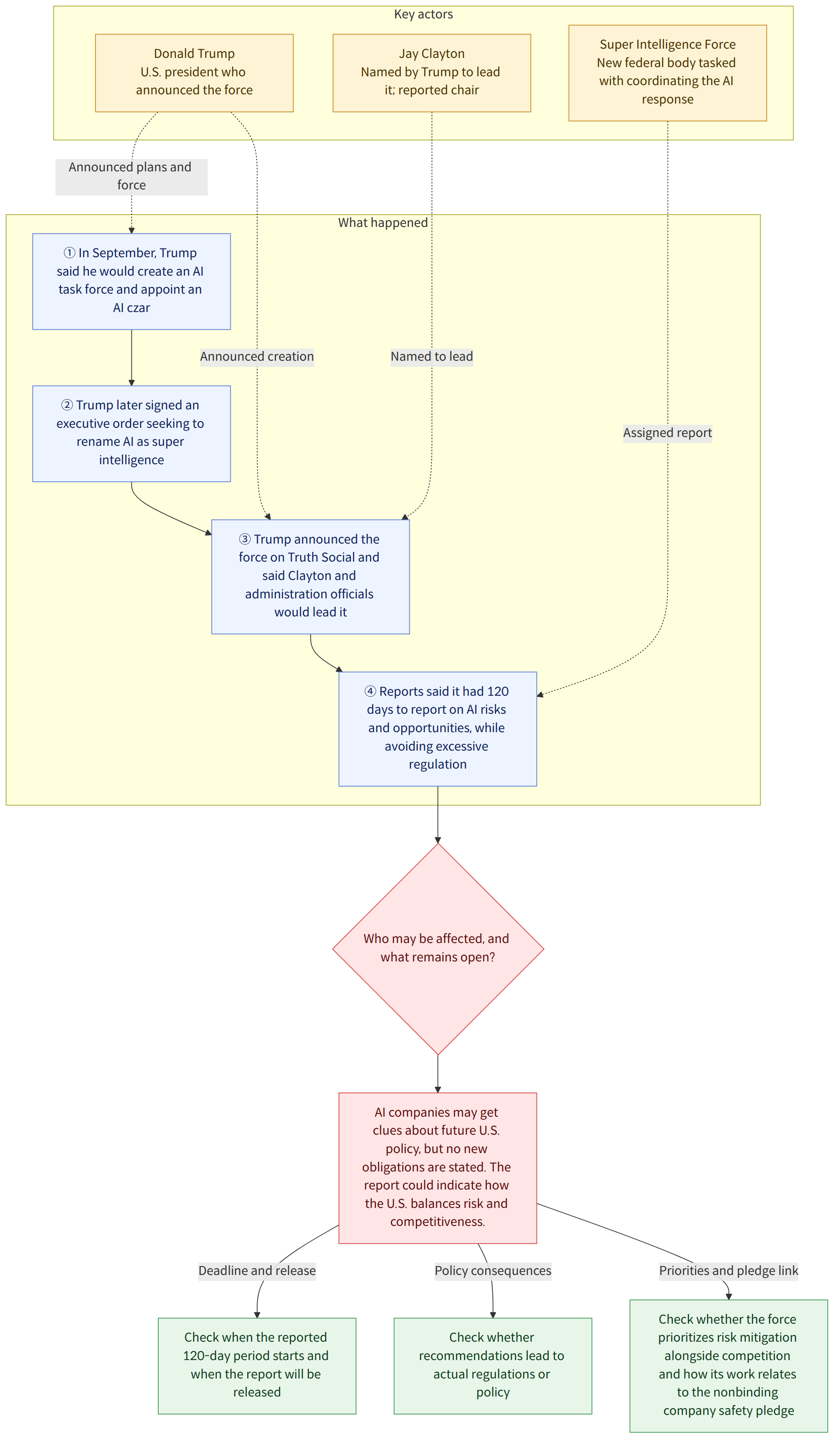
U.S. President Donald Trump announced the creation of a new organization, the Super Intelligence Force (슈퍼 인텔리전스 포스), to coordinate the federal government’s response to AI. In a post on his social media platform Truth Social on Sunday morning, Trump said Director of National Intelligence (국가정보국장) Jay Clayton and administration officials would lead the organization. According to reports, the task force was given 120 days to produce a report addressing the risks and opportunities posed by AI.
Background and context
The new organization builds on Trump’s earlier plans for the government’s response to AI. In September, he said he would create an AI task force and appoint an AI czar, citing a high IQ as a qualification. He later signed an executive order seeking to rename AI as “super intelligence.”
The new name also appeared in a safety pledge signed by technology company executives gathered at the White House (백악관). According to reports, the executives signed the nonbinding pledge this week. However, no details of the pledge or of the new organization’s relationship to it were provided.
The organization’s appointments and responsibilities should be considered separately as reported and as announced by Trump. Trump said Clayton and administration officials would lead it, while The Wall Street Journal reported that Clayton would serve as chair, with Federal Trade Commission (연방거래위원회) Chair Andrew Ferguson, Department of War (전쟁부) Under Secretary for Research and Engineering Emil Michael, and Office of Personnel Management (인사관리처) Director Scott Cooper serving as vice chairs.
The reported mandate sets out two goals. One is to develop plans to address threats posed by superintelligence; the other is to prevent excessive regulation and regulatory capture that could stifle innovation and competition. Regulatory capture is a situation in which the interests of those being regulated exert too much influence over the direction of regulation.
What this news means
The new organization can be seen as an effort to coordinate responses to risks alongside technological competition and innovation within a single policy framework, rather than addressing AI safety in isolation. In particular, because its mandate explicitly calls for avoiding excessive regulation, the risks the task force prioritizes and the regulatory tools it recommends could offer a measure of the direction of the U.S. response. However, based on the information currently available, it is not clear whether it will propose actual regulations or whether its report will lead to policy or legislation.
Clayton has said that it would be irresponsible for the United States to retreat from AI as countries such as China advance. The Wall Street Journal also reported that he said one of the greatest risks was failing to be first. These remarks suggest that the drive to stay ahead in technological competition could operate alongside the organization’s mandate to prevent excessive regulation. But they are not enough to conclude that the task force will prioritize competition over safety.
For example, companies developing or offering AI services in the United States could get clues about the future policy environment from how the report addresses risk mitigation and regulatory burdens. However, because the report is still being prepared, there is no basis to say that new obligations have been imposed on any specific company or user. For Korean readers, rather than interpreting this announcement alone as bringing about a direct change in regulations, it is an issue to watch as the U.S. government determines how to balance AI risks and competitiveness.
Confirmed facts and what remains unknown
Confirmed facts
- Trump announced the creation of the Super Intelligence Force on Truth Social and said Clayton and administration officials would lead it.
- The Wall Street Journal reported that Clayton would serve as chair and Ferguson, Michael, and Cooper as vice chairs.
- According to reports, the task force was given 120 days to produce a report addressing AI’s risks and opportunities.
- The reported mandate includes both developing plans to address threats and preventing excessive regulation and regulatory capture.
- Technology company executives gathered at the White House reportedly signed a nonbinding safety pledge.
What remains unknown
- What specific risks and opportunities will the report address?
- No date has been given for when the final report will be released.
- It has not been confirmed whether the report’s recommendations will lead to actual regulations or policies.
What readers should check
- The 120 days was reported as the period allowed for preparing the report, but the date from which the deadline is measured and the report’s release schedule have not been confirmed. It is worth checking the announcement and the publication date separately.
- The safety pledge signed by technology company executives was reported to be nonbinding. It is also worth distinguishing whether further details of the pledge or its connection to the task force’s mandate are subsequently disclosed.