
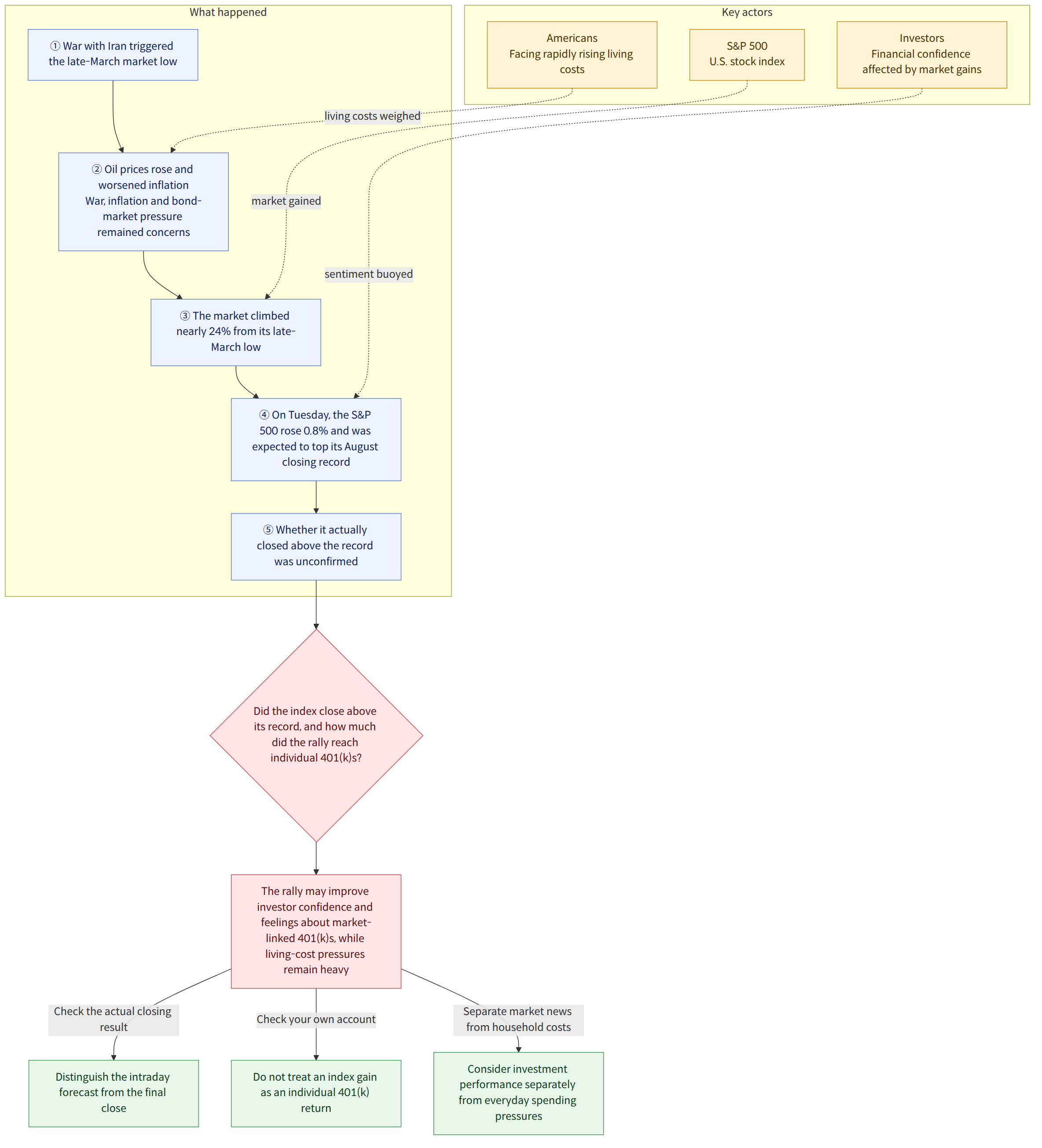
The U.S. stock market came close to a record high on Tuesday. The S&P 500 rose 0.8% and was expected to close above the closing record it set in August. However, that was an intraday forecast, and it was not confirmed whether the index actually closed above the record.
The Dow Jones Industrial Average was up 343 points, or 0.7%, at noon Eastern time. The Nasdaq Composite also rose 0.8%, reaching the record high it had set the previous day. The stock market, which underpins many 401(k) accounts, has climbed nearly 24% since its late-March low. A 401(k) is a U.S. retirement account.
Background and context
Factors weighing on the market remained even as stock prices rose. According to the article, concerns about war, high inflation and pressure from the bond market continued to weigh on stocks. In particular, concerns raised when the stock market hit a low in March, triggered by the war with Iran, materialized, and rising oil prices worsened inflation.
This means the rally can be read not as a sign that the risks have disappeared, but as a recovery in stock prices amid ongoing pressures, with the market approaching a record.
What this news means
The stock market’s record-setting run can help improve how investors feel about their financial situation. The article says record stock prices are helping investors feel better about their finances—or at least feel less badly. Because many 401(k) accounts are tied to the stock market, the rally can also affect how people with those accounts feel about their finances.
However, a rising market does not ease every household’s financial pressures. The article reports that Americans are generally feeling more discouraged about affording rapidly rising living costs. A person can experience both an improving investment account and the burden of higher everyday expenses at the same time.
For example, someone with a 401(k) account might feel positive about its performance as stock prices rise, while still feeling heavily burdened by day-to-day expenses as living costs climb rapidly. This is a hypothetical explanation; the article does not provide figures for individual account returns or the scale of living-cost pressures.
Confirmed facts and what remains unknown
Confirmed facts
- The S&P 500 rose 0.8% on Tuesday and was expected to surpass its August closing record.
- The Dow Jones Industrial Average was up 343 points, or 0.7%, at noon Eastern time.
- The Nasdaq Composite rose 0.8%, reaching the record high it had set the previous day.
- The stock market has climbed nearly 24% since its late-March low, while concerns about war, inflation and pressure from the bond market were cited as ongoing headwinds.
- In contrast with the stock market’s record-setting run, Americans were reported to be discouraged about affording rapidly rising living costs.
What remains unknown
- The article does not say whether the S&P 500 actually closed above its August closing record at the end of Tuesday’s session.
- The specific figures for the August closing record and the late-March low were not provided.
- It is not known how much the market rally was reflected in individual investors’ 401(k) accounts.
What readers should check
- To determine whether a record was broken, distinguish between an intraday forecast of a rise and the actual closing result.
- Do not assume that a stock index’s percentage gain is the same as the return on an individual’s 401(k) account; check your own account’s performance separately.
- Improved investor sentiment and the burden of living costs may be separate issues, so consider market news separately from the actual state of household spending.