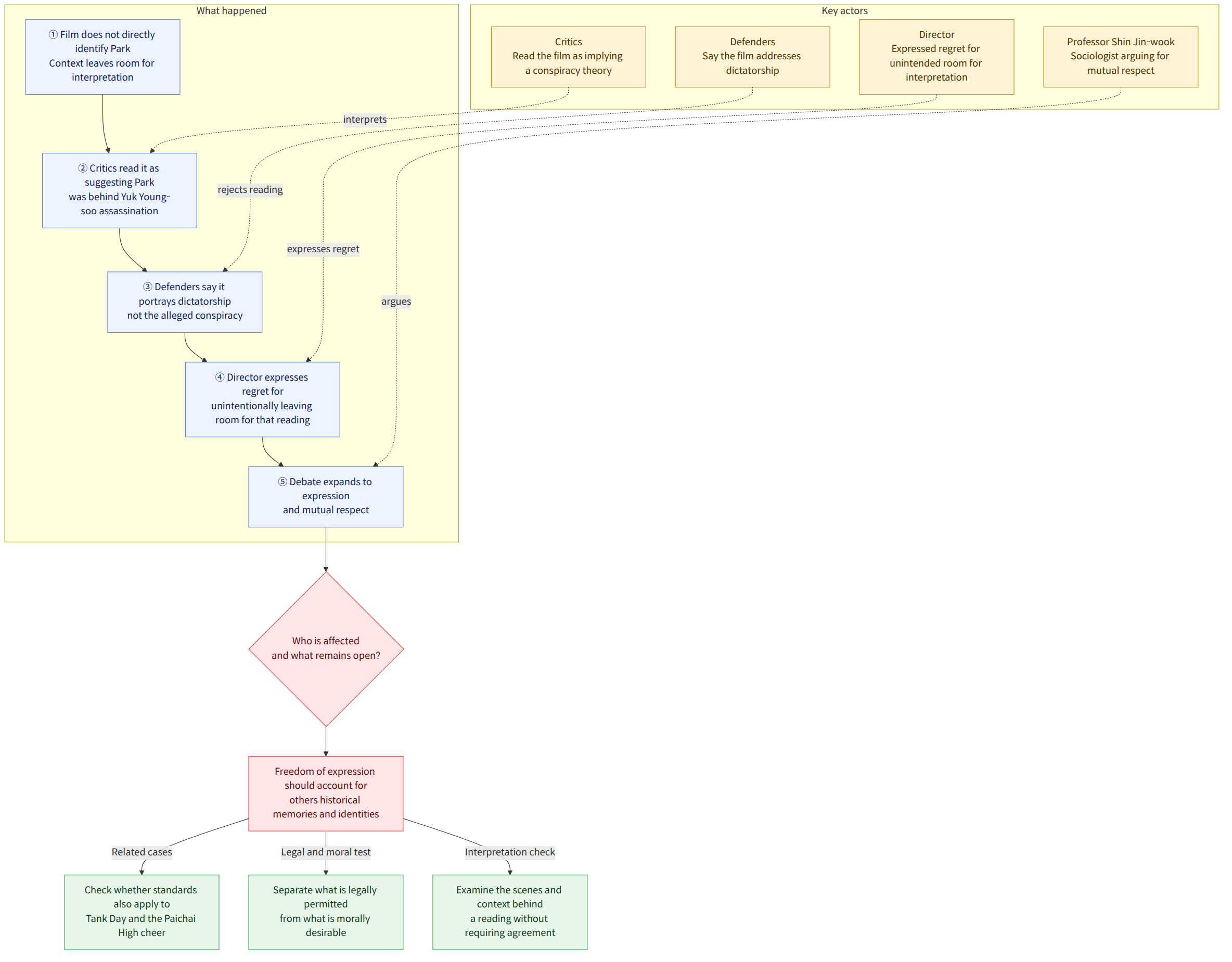
As controversy over the film ‘Assassins’ continues, Shin Jin-wook, a professor of sociology at Chung-Ang University (중앙대), says the debate goes beyond how the work should be interpreted and asks what kind of freedom South Korean society should strive for. According to a column published on October 7, 2026, critics read the film as suggesting a conspiracy theory that President Park Chung-hee was behind the assassination of First Lady Yuk Young-soo. Defenders, on the other hand, say the film deals with the brutality of dictatorship and has nothing to do with the theory that Park was behind the assassination.
Background and context
The column locates the heart of the controversy in the distinction between what the film says directly and what viewers may read into it. It explains that the film does not directly identify Park Chung-hee as the person behind the assassination, and that Park appears only in a speech scene. However, the column says that the context of the one-man dictatorship at the time, along with some dialogue and scenes, leaves room for the film to be interpreted as suggesting the theory.
The writer’s position, therefore, is not to accept either side’s claims as they stand. The claim that the film targets Park may be excessive, but dismissing viewers’ interpretation as far-fetched outright may also be dogmatic. The column also says that the director expressed regret and remorse for unintentionally leaving room for such an interpretation. It does not specify when or what the director said.
The debate has expanded from a dispute over how to interpret the film into a dispute over freedom of expression. According to the column, critics also cited Starbucks’ “Tank Day” event (탱크데이) and the Paichai High School (배재고) baseball team’s cheer that mocked May 18 (5·18), protesting that the same standards should apply when other historical events or figures are involved. The column does not explain the specific circumstances of these cases.
What this means
Professor Shin’s argument is that we should distinguish the legal question “Is this expression free?” from the moral question “Is this expression desirable?” The column emphasizes that in a democracy, even offensive and insulting expressions may be legally permitted to a considerable extent, but that being legal does not make every expression desirable. The point is that legality alone cannot determine how an expression treats memories connected to other people’s identities.
Drawing on the work of philosopher Charles Taylor, the column explains that we do not have to assume that all values and beliefs are equally valid, but we do need to start from the premise that we treat others’ identities as equal. Respect here does not mean banning criticism of a particular historical interpretation or claim. The writer’s view is that criticism of specific actions should be distinguished from disregarding, disparaging, or insulting something connected to another person’s identity.
The column also uses sociologist Émile Durkheim’s distinction between “the sacred” and “the profane” to explain that members of a society may regard certain values and symbols as absolutely precious. What people value in this way can differ from one person to another. Rather than claiming that the memories people cherish have the same historical significance, the column emphasizes the mutual recognition that people can deeply cherish something and feel hurt when it is insulted.
For example, if a viewer takes a particular scene in the film as an insult to a historical figure, there is no need to assume that the viewer’s reaction is the same as the film’s intention. At the same time, the column’s argument is that, rather than automatically branding the viewer’s interpretation as far-fetched, we should examine which scenes and what context gave rise to that reading. This does not mean that people must agree with the interpretation; it is a suggestion that those asserting freedom of expression can also reflect on the meaning their expression has for others.
Professor Shin argues that South Korean society, nearly 40 years after democratization in 1987, needs a deeper concept of freedom. To form a society together despite disagreement, he says, we must exercise restraint when dealing with what matters to others, just as we expect respect for what matters to us. This can be read not as an argument for weakening freedom of expression, but as a proposal to include mutual respect among the conditions for exercising freedom legitimately.
What is confirmed and what remains unknown
What is confirmed
- The column reports that social controversy surrounding the film ‘Assassins’ is continuing.
- Critics read the film as suggesting a conspiracy theory that President Park Chung-hee was behind the assassination of First Lady Yuk Young-soo, while defenders say the work is about the brutality of dictatorship and is unrelated to the theory.
- The column explains that the film does not directly identify Park Chung-hee as the person behind the assassination, and that Park appears only in a speech scene.
- The column reports that the director expressed regret and remorse for unintentionally leaving room for such an interpretation.
- The writer argues that what is legally permissible is not the same as what is morally desirable, and that other people’s identities and memories should be respected.
What remains unknown
- The column does not specify which dialogue and scenes in the film left room for it to be interpreted as suggesting the theory that Park Chung-hee was behind the assassination.
- The specific content and timing of the director’s expression of regret and remorse are not confirmed.
- The specific circumstances of Starbucks’ “Tank Day” event and the controversy over the Paichai High School baseball team’s cheer are also unknown based on this column alone.
What readers can check
- When encountering the film or claims related to it, readers can distinguish between what the work states directly and what viewers interpret based on context.
- When criticism or defense of an expression arises, readers can consider not only whether it is legally permitted, but also what it is about and whose identity or memory it is connected to.
- If citing the “Tank Day” and baseball-team cheer cases as evidence, readers should separately check the specific circumstances and facts not provided in this column before deciding whether the comparison with the film controversy is appropriate.
References
- Other coverage consulted: en.yna.co.kr