
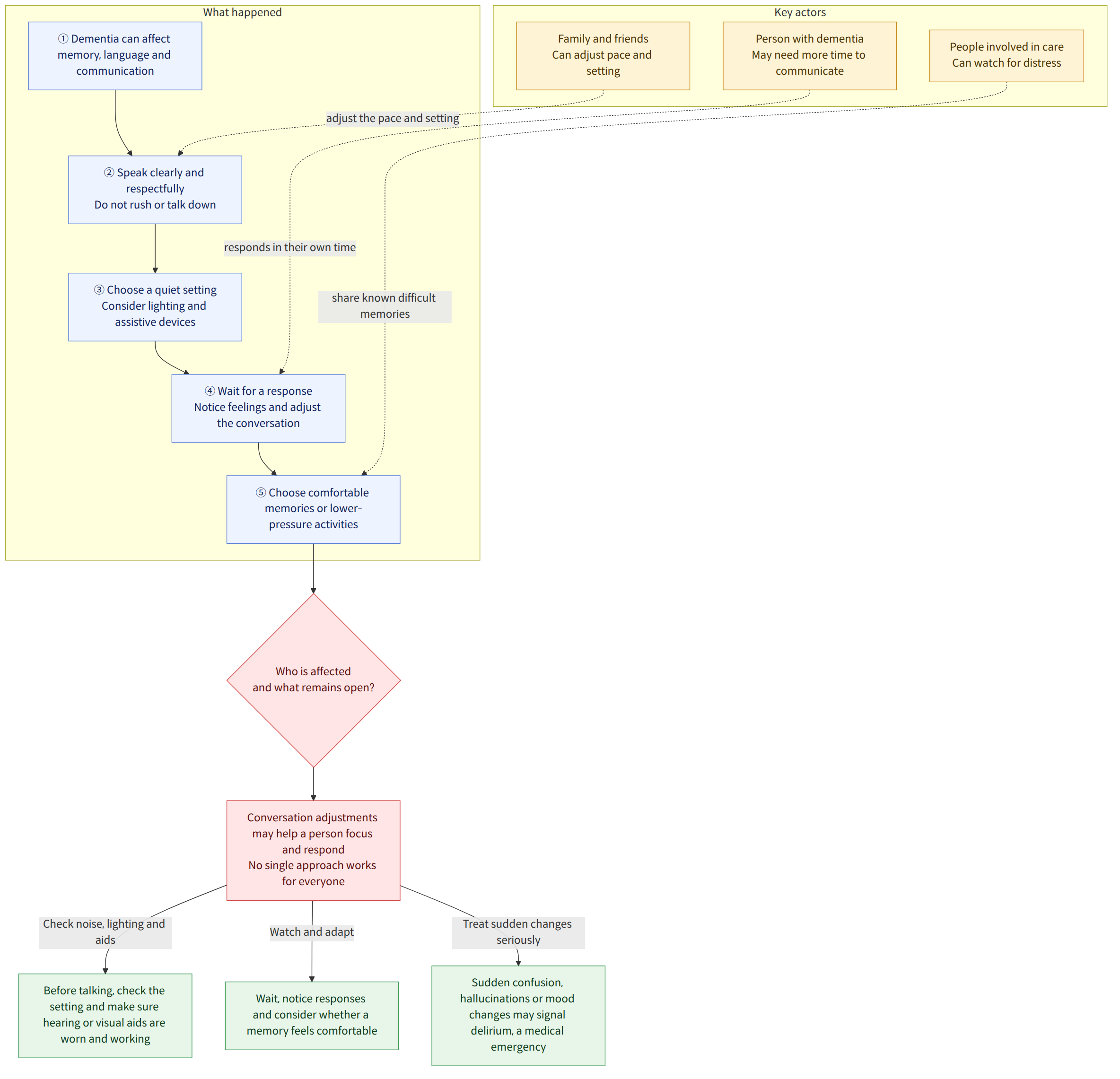
When talking with someone with dementia, it can help to avoid rushing them, wait for their response and create an environment where it is easier to focus on the conversation. Dementia is an umbrella term for a range of brain diseases that can affect not only memory but also language and communication. Some types affect the ability to understand the meaning of words or produce language, and it may take longer to find the right word or process information.
Background and context
A person with dementia may have difficulty following the flow of a conversation or remembering what they were going to say. But there is no single way of talking that works for everyone. Dementia affects people differently, so it is important not to assume in advance what the other person can understand.
The basics of conversation are to speak clearly and show respect. Even if you simplify your wording to suit the situation, you should not talk down to the other person. This also matters for ensuring that they are not excluded from the conversation and are treated with respect as an individual.
The surroundings also matter. It may be harder to focus on a conversation in a noisy place, so if possible, choose somewhere quiet and consider keeping the conversation to one or two people. At a larger gathering, someone can stay nearby and watch for signs that the person is feeling overwhelmed.
What this means
For family and friends, adjusting the pace and setting of a conversation can be a practical place to start. Speak slowly and give the person time to respond, rather than finishing their sentences for them or pressing them for an answer. Adequate lighting so the person can see the speaker may also help. If they use a hearing aid or visual aid, checking that it is being worn and working properly can help with conversation too.
When a conversation goes off track, one suggested approach is to pay attention to the person’s feelings rather than immediately correcting the facts. If someone with dementia talks about a person or event from the past as though it is happening now, you can check whether the subject is causing distress, offer reassurance or steer the conversation in another direction. It is also important to avoid lying whenever possible.
For example, if the person does not respond right away, wait a moment rather than finishing their sentence for them. If there is a lot of background noise, you can move to a quieter place and continue the conversation. These are not one-size-fits-all answers, but adjustments to try while paying attention to the person’s response.
Sharing memories from the past can lead to an enjoyable conversation, but not all past experiences or family relationships are positive. If you know that a memory is difficult, you can tell others involved in the person’s care so they can watch for signs of distress. Other options include listening to music together or turning to activities that involve less pressure to talk, such as art or gardening.
What is confirmed and what remains unknown
Confirmed facts
- Dementia is an umbrella term for a range of brain diseases that can affect memory, language and communication.
- Some types of dementia can affect the ability to understand the meaning of words or produce language.
- A person with dementia may have difficulty finding words or need more time to process information.
- A quiet place, limiting the conversation to one or two people, adequate lighting and checking assistive devices can help with communication.
- Sudden confusion, hallucinations or mood changes may be signs of delirium, which is a medical emergency.
What remains unknown
- The source does not specify how conversation strategies should be adapted to different types or stages of dementia.
- It does not explain in detail whom to contact or how to seek help after noticing a sudden change.
What readers can check
- Before a conversation, check the background noise and lighting, and make sure any hearing aid or visual aid the person uses is being worn and working.
- Wait until the person has finished speaking, watch their facial expressions and responses, and adjust the pace and subject of the conversation. When sharing memories from the past, consider whether the subject brings up comfortable memories.
- If you notice sudden confusion, hallucinations or mood changes, do not assume they are simply the person’s usual dementia symptoms. Check for infection or recent changes in medication and seek help; remember that delirium is a medical emergency.