
1. A Human Story
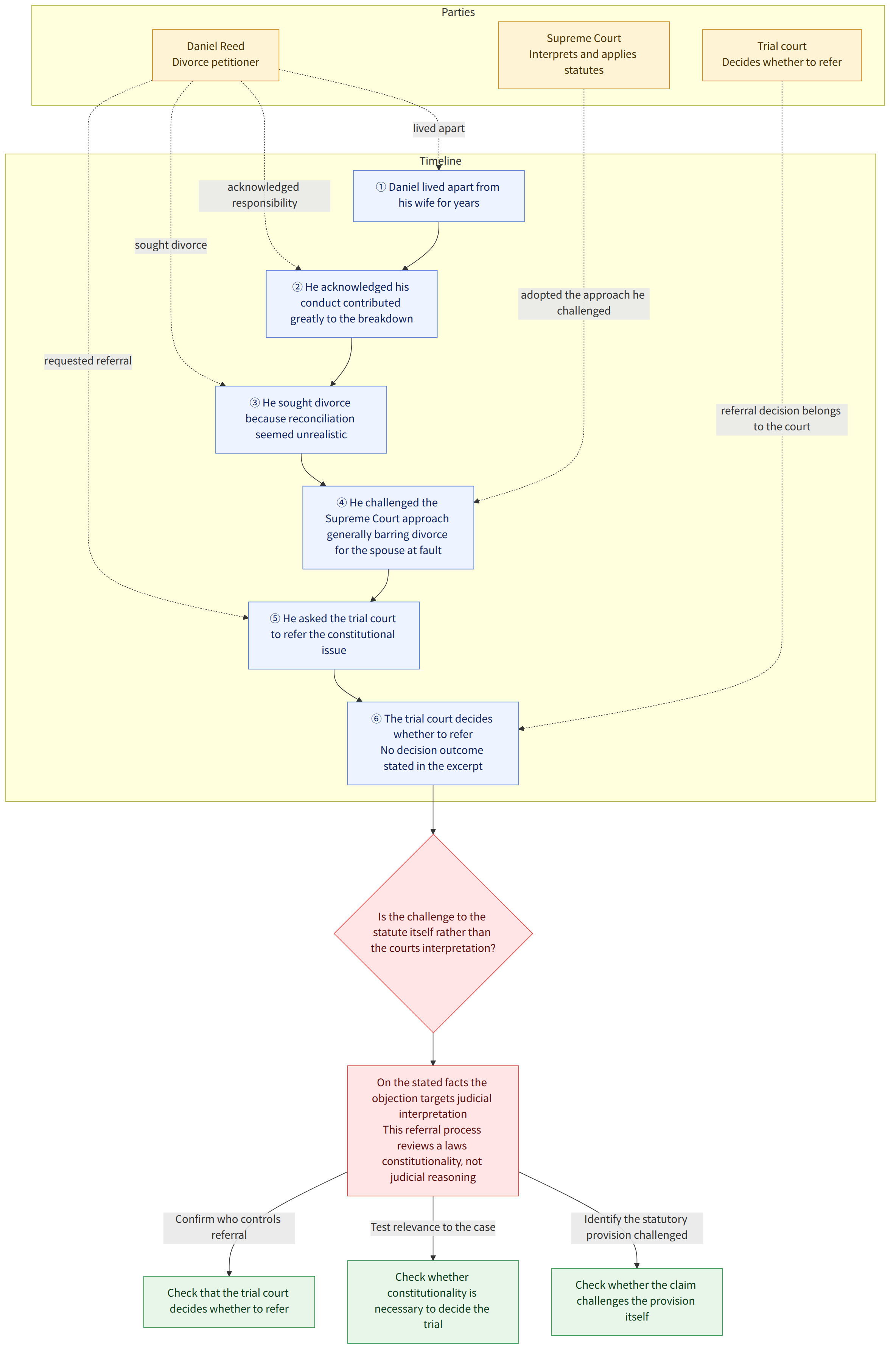
Daniel Reed had been living apart from his wife, Sophie, for years. He did not deny that his own conduct had played a major part in the breakdown of their marriage. Still, he believed there was no realistic prospect of reconciliation and that the law should allow both spouses to move on.
Daniel’s lawyer argued that Korea’s Civil Act should be understood to let a marriage end when it has irretrievably broken down. In Daniel’s view, the Supreme Court’s approach—generally preventing the spouse responsible for the breakdown from obtaining a divorce—conflicted with the Constitution. He asked the trial court to refer the issue to the Constitutional Court.
The difficulty was not just what Korean divorce law meant. It was what, precisely, Daniel was asking the Constitutional Court to review: the wording of a law, or the way the courts had interpreted it?
2. The Legal Question
Can a litigant obtain a constitutional referral by arguing that a statutory provision is unconstitutional as the courts interpret it, even if the challenge is directed at the judicial interpretation rather than the provision itself?
3. What Korean Law Says
Korea’s constitutional review system allows a court handling a specific case to refer a question about a law’s constitutionality to the Constitutional Court. The issue must matter to the outcome of the case, and the referral is made by the court—not directly by the litigant.
Under Article 107(1) of the Constitution and Article 41(1) of the Constitutional Court Act, when the constitutionality of a law is a necessary issue in a trial, the court may decide to refer the question to the Constitutional Court.
The key distinction is between a law’s constitutionality and a court’s interpretation of that law. A referral under this procedure concerns whether the statutory provision itself violates the Constitution. It is not a route for asking the Constitutional Court to decide that a particular interpretation adopted by the ordinary courts is unconstitutional.
In concrete disputes, the courts—including the Supreme Court as Korea’s highest court—are responsible for interpreting and applying statutes. That authority includes choosing an interpretation consistent with the Constitution where the statutory text permits one.
For a referral request to fit this procedure, the central points are therefore:
- The challenge must concern the constitutionality of an identifiable statutory provision, not only the meaning a court has assigned to it.
- The provision’s constitutionality must be relevant to deciding the case before the court.
- The trial court must decide whether to make the referral. A party may ask, but cannot compel one merely by filing an application.
A request framed as “the provision is unconstitutional insofar as it is interpreted to mean a particular thing” is procedurally different from a claim that the provision itself is unconstitutional. If the substance of the request is only to contest the courts’ interpretation, it falls outside the scope of this referral procedure.
4. How Korean Courts Approach This
Korean courts draw a firm line between constitutional review of legislation and review of judicial reasoning. The Constitutional Court’s role in this referral process is to consider whether a law is compatible with the Constitution. The ordinary courts’ role is to interpret and apply that law in the case before them.
A party cannot turn disagreement with a court’s interpretation into a statutory constitutional challenge simply by describing that interpretation as unconstitutional.
This does not mean that a court’s interpretation is immune from criticism. A litigant may argue that the court has misconstrued a statute, applied the wrong legal principle, or reached an incorrect result. But those arguments belong in the ordinary court process, including any available appeal. A referral request aimed only at the interpretation is not the proper procedural vehicle.
5. Applying the Law to the Case
Daniel’s application must be assessed by looking at its substance, not just its wording.
- What was he challenging? Daniel argued that the Civil Act should recognize a breakdown-based approach to divorce, but that the Supreme Court interpreted it through a fault-based rule that generally blocks a divorce petition by the spouse responsible for the marriage’s collapse. His constitutional objection targeted that interpretation.
- Was he claiming that the statutory provision itself was unconstitutional? On the facts described, his complaint was not that the text of a particular provision was inherently unconstitutional. It was that the courts had interpreted and applied the law in a way he considered unconstitutional.
- Could the referral procedure decide that dispute? No. The court’s task under the referral procedure is to determine whether the constitutionality of the statutory provision itself must be referred. It is not to send the Constitutional Court a question about whether the Supreme Court’s interpretation is the correct or constitutionally permissible one.
- What follows procedurally? Because Daniel’s application challenged the judicial interpretation rather than the statute itself, it would be treated as an improper request for referral and dismissed as inadmissible. That result would not, by itself, decide whether Daniel should receive a divorce. It would decide only that this particular constitutional referral request could not be used to contest the courts’ interpretation.
Daniel could still make his argument about the meaning and application of divorce law in the ordinary proceedings. Whether that argument succeeds is a separate question from whether the statutory referral procedure is available.
6. Conclusion: What Happened, and What Should You Do?
Daniel’s application would be dismissed as procedurally improper. His argument challenged how the courts interpreted the Civil Act, not the constitutionality of the statutory provision itself. The ruling would not resolve the underlying divorce case; it would leave Daniel to pursue his interpretation argument through the ordinary litigation process.
For readers facing a similar issue:
- Identify the real target. Before seeking a constitutional referral, distinguish a challenge to the statute itself from disagreement with a court’s reading of it.
- Use the right procedure. Raise disputes about statutory meaning and application in the case and through any available appeal. A party can request a referral, but only the court can make one.
- Get focused legal advice. Constitutional procedure is narrow, and a request aimed at the wrong target may be dismissed without resolving the underlying dispute.