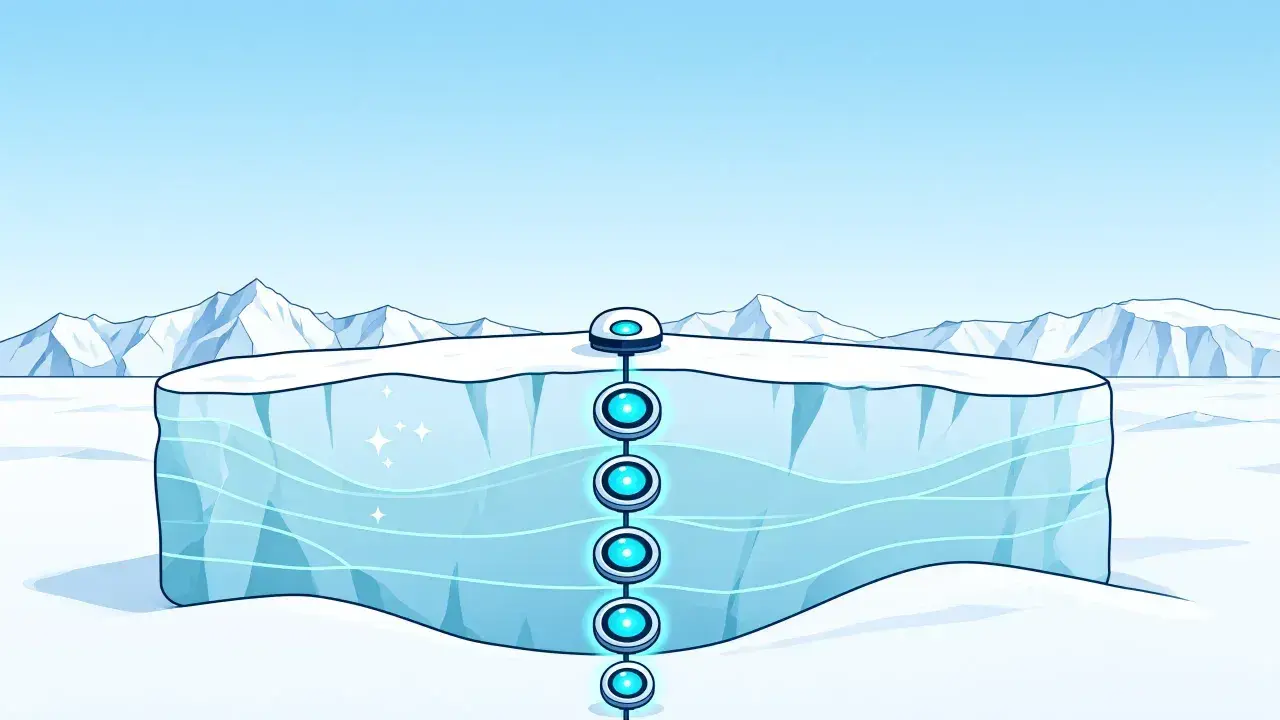
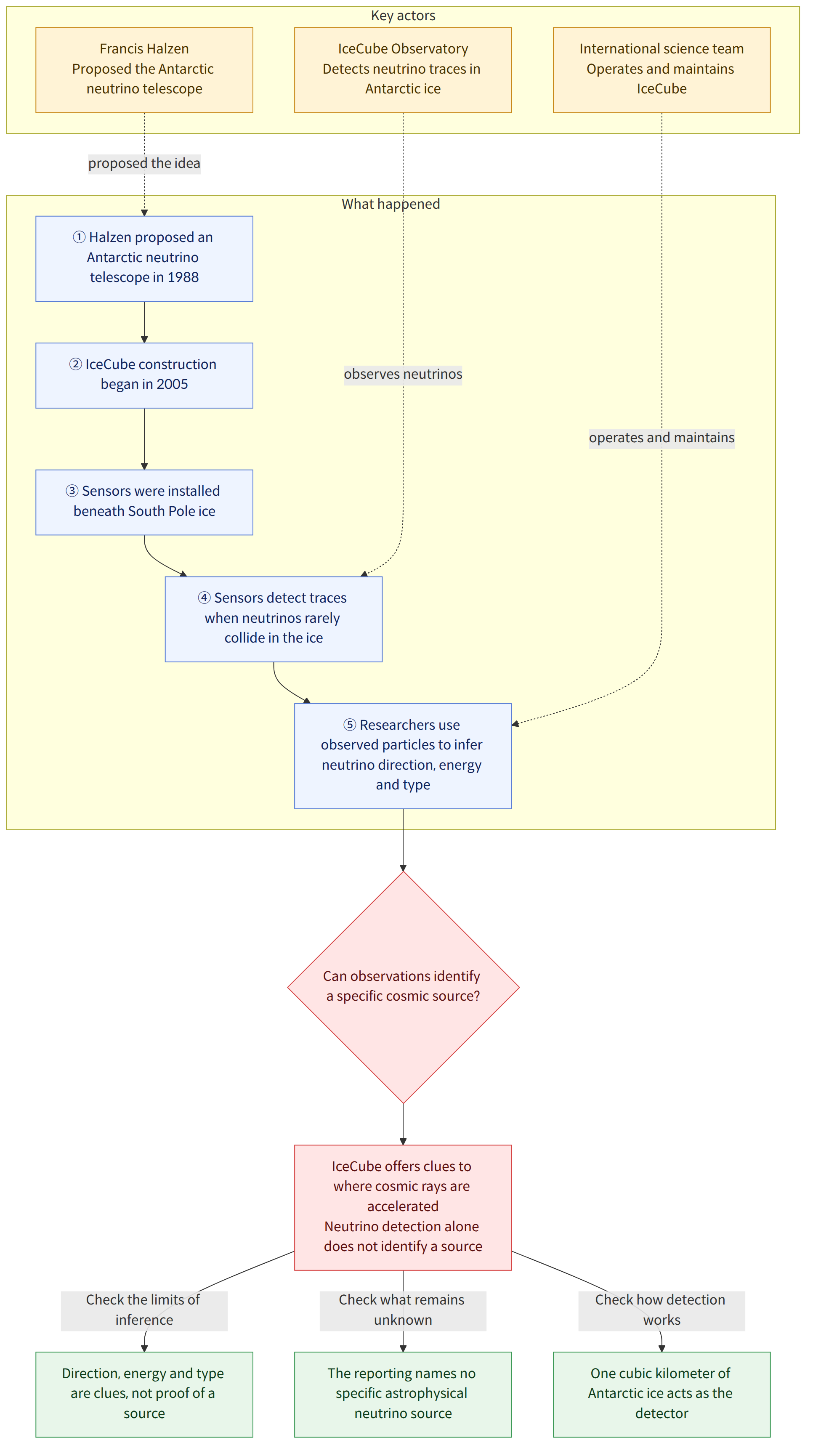
Francis Halzen received the 2026 Nobel Prize in Physics for proposing an Antarctic neutrino telescope and leading the IceCube Observatory. IceCube is an observatory that searches for neutrinos from space by installing sensors beneath the ice at the South Pole. The facility has drawn attention because it uses the vast ice sheet itself as a detector, providing clues to where cosmic rays are produced.
Magnetic fields bend the paths of cosmic rays, so it is difficult to determine their original sources from their directions when they reach Earth. IceCube sidesteps this problem by observing neutrinos, which can be produced alongside cosmic rays as they are accelerated.
Background and context
High-energy particles such as protons and atomic nuclei—cosmic rays—travel from space to Earth. According to the article, more than 10,000 of these particles reach every square meter of Earth’s atmosphere each second. Some are mostly absorbed in the atmosphere, but the direction in which cosmic rays reach Earth may be the result of their paths being bent by magnetic fields as they travel through space. This makes it difficult to trace their paths back to where they were produced based on direction alone.
That is why neutrinos are the target of observation. They can be produced as byproducts when cosmic rays are accelerated, so tracing where neutrinos came from can provide clues to the origins of cosmic rays. The most extreme environments in space may be difficult to observe using light, in particular, but high-energy neutrinos make it possible to study such celestial environments in a different way.
Neutrinos interact with matter only very rarely. They often pass through Earth or observation equipment without leaving a trace, making them difficult to detect with small instruments. IceCube uses one cubic kilometer of Antarctic ice—about one billion tons—as a giant detection volume.
The South Pole station sits on a layer of clear, pure ice about 1.8 miles (3 kilometers) thick. IceCube’s sensors were installed in holes melted into the ice with hot water, to a depth of 1.5 miles (2.4 kilometers). The sensors are arranged along 91 strings, with sensor modules spaced vertically about 55 feet (17 meters) apart on each string.
When a neutrino rarely collides with a proton or neutron in the ice, it can produce other particles, including high-energy electrons and photons. The sensors are designed to detect traces of these collisions. By measuring the number and direction of the particles observed, researchers can infer the direction, energy, and type of the original neutrino. Each visible particle is a clue that helps reveal the path of a neutrino.
Halzen proposed the idea of building a neutrino telescope in Antarctica in 1988. Construction of IceCube began in 2005, and an international team of scientists continues to operate it. The equipment is operated mostly remotely, but on-site work is also needed to maintain and replace electronics, install new hardware, and upgrade instruments.
What this news means
The significance of IceCube lies not only in the technical achievement of detecting neutrinos in ice. Its central contribution is to provide an observational method for finding where particles are accelerated in space by using the direction of neutrinos, when the arrival direction of the cosmic rays themselves does not point to their source. In other words, it expands the window onto the universe beyond light to include traces left by particles that interact only rarely.
For example, if particles were accelerated at a distant celestial object and neutrinos were produced as byproducts of that process, the direction and energy of neutrinos detected by IceCube could provide clues for studying the environment of that object. This is a hypothetical example for explanatory purposes; based on this material alone, it cannot be said that any particular celestial object is the actual source of neutrinos identified by IceCube.
When interpreting observational results, it is also important to distinguish between the fact that “neutrinos were detected” and the conclusion that “their source was identified.” Determining a neutrino’s direction, energy, and type is related to identifying the celestial object it came from, but these are not the same step. The reporting provided does not name a specific source of high-energy neutrinos of astrophysical origin.
Confirmed facts and what remains unknown
Confirmed facts
- IceCube is a neutrino observatory with sensors installed beneath the ice at the South Pole.
- The observatory uses one cubic kilometer of ice, or about one billion tons.
- The sensors are installed along 91 strings, with modules spaced vertically about 17 meters apart.
- Traces of particles produced by neutrino collisions are used to infer the direction, energy, and type of the original neutrinos.
- Halzen proposed the idea of an Antarctic neutrino telescope in 1988, and construction of IceCube began in 2005.
What remains unknown
- The specific sources of high-energy neutrinos of astrophysical origin that IceCube has identified to date.
- The specific citation and list of laureates for the 2026 Nobel Prize in Physics.
- The extent to which neutrino observations have identified specific sources.
What readers should look for
- In follow-up reporting, distinguish between results that indicate the direction of neutrinos and results that identify their sources.
- If a particular celestial object is mentioned as a source, check whether the report presents it as a possibility or describes it as a confirmed source.
- When looking for additional information about the Nobel Prize, check separately how the reason for the award and the list of laureates were announced; this can make the scope of the achievement clearer.
References
- Other coverage consulted: theconversation.com
- Other coverage consulted: koreatimes.co.kr