
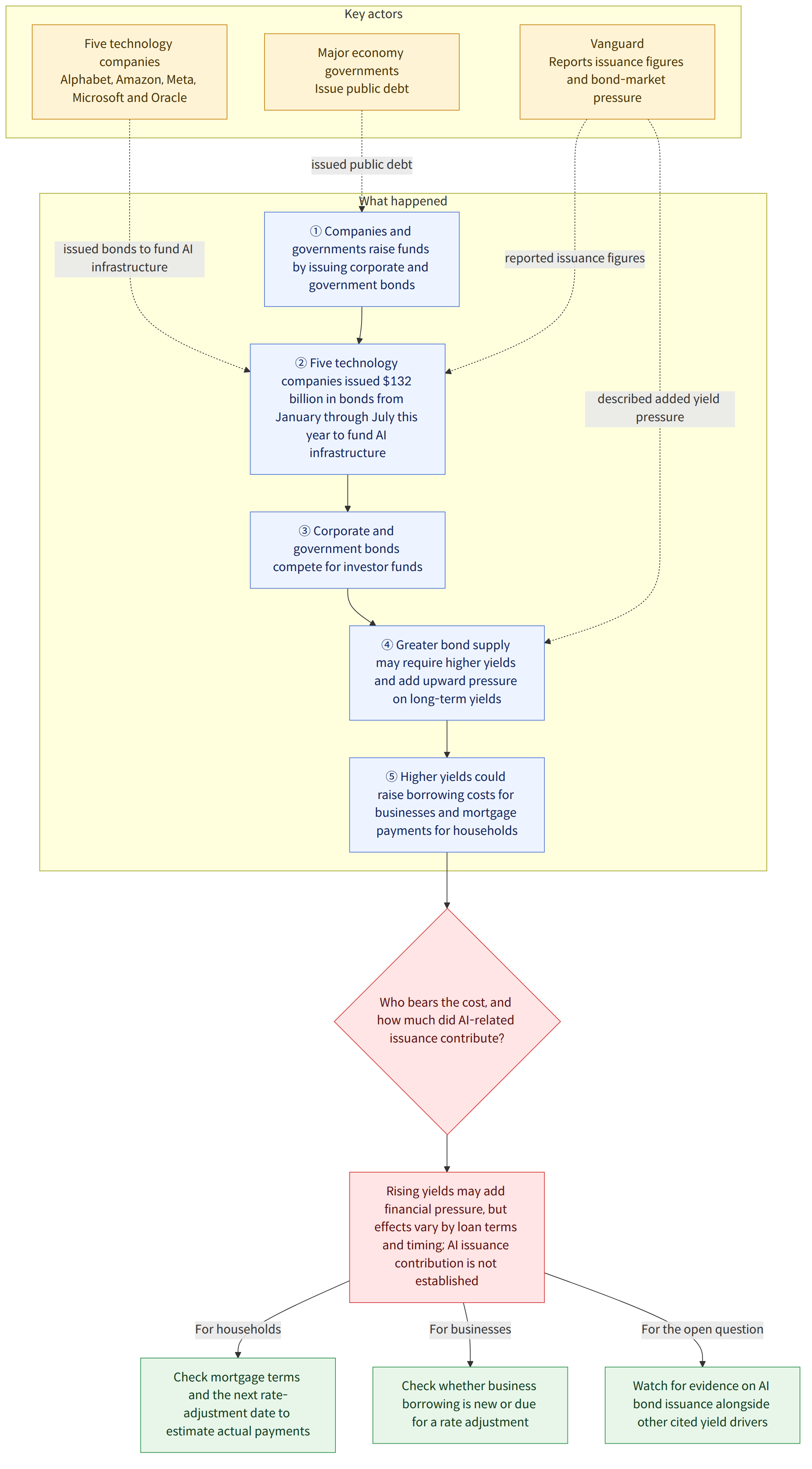
With long-term yields in the United States, Europe and Japan rising to unusually high levels, increased corporate bond issuance by global companies to fund artificial intelligence (AI) infrastructure investment has been cited as one factor behind the rise in government bond yields. The explanation is that when government and corporate bonds compete for investor funds, this can put upward pressure not only on companies’ financing costs but also on government bond yields. Concerns have also been raised that higher yields could increase borrowing costs for businesses and mortgage payments for households, adding downward pressure on the economy.
Background and context
The 10-year government bond yield is a key indicator used to compare long-term interest rates across countries. According to the article, the U.S. yield rose as high as 5.34% intraday on October 1, its highest level in 24 years, since it reached the 5.4% range in 2002. The U.K. yield stood at 5.51% on the same day, its highest level in 19 years, since 2007, while France’s rose as high as 4.994% intraday on October 2, its highest level in 24 years.
Japan’s 10-year government bond yield remained around 3.1% in October, following a similar level the previous month. Its absolute yield is lower than those of other countries, but by the benchmark cited in the article, it is at its highest level in 30 years, since 1996. It is also notable that the yield is up about 1.45 percentage points from a year earlier. However, these figures alone do not support the conclusion that interest rates in Japan are more burdensome than those in other countries. The article emphasizes that the scale of the increase and the current level are unusual in light of Japan’s long period of low interest rates.
The article does not identify a single cause for rising yields. Traditional factors cited include uncertainty over international energy prices amid the situation in the Middle East involving Iran and concerns about worsening public finances in major economies. Analysts say the bond market is also facing greater competition for funds as companies issue more corporate bonds to raise money for AI investment.
According to Vanguard (뱅가드), the five companies Alphabet, Amazon, Meta, Microsoft and Oracle issued $132 billion in bonds from January through July this year. That is about 40% more than the $93 billion they issued over all of last year. These companies are using corporate bonds to finance infrastructure investments, including data centers, needed for the race to develop AI.
Companies borrow by issuing corporate bonds, while governments raise funds by issuing government bonds. Corporate bonds generally offer higher yields than government bonds because they are less safe. If the supply of both types of bonds increases, issuers may have to offer higher yields to attract investors, which could put upward pressure on government bond yields as well. In a report, Vanguard explained that the expansion of corporate bond issuance to fund companies’ AI-related investment spending, together with increased government bond issuance by major economies, adds to upward pressure on long-term yields.
What this means
When interest rates rise, businesses that are taking out new loans or whose borrowing rates are being adjusted may face higher financing costs. Households may also see their mortgage payments increase. However, the article discusses government bond yields in major economies and concerns about the resulting burden. It does not mean that borrowing rates for every business or payments for every household will change by the same amount, or immediately.
For example, a household approaching the date when its mortgage rate will be adjusted may need to check how rising rates could affect its actual monthly payment. By contrast, the change people experience may differ depending on their loan terms and when their rates are adjusted. This example does not mean that the yield levels cited in the article directly determine the mortgage rate of any particular household.
For business investment, demand for AI infrastructure could lead to more corporate bond issuance while also pushing up the cost of raising funds through bonds. Since governments issuing public debt and companies issuing corporate bonds are seeking funds at the same time, the expansion of AI investment is drawing attention as something that could affect yield formation in the bond market, not just the stock market. However, the article does not quantify how much AI companies’ corporate bond issuance has contributed to the rise in long-term yields in different countries.
What is known and what remains unclear
What is known
- The U.S. 10-year government bond yield rose as high as 5.34% intraday on October 1, and the U.K. yield stood at 5.51% on the same day.
- France’s 10-year government bond yield rose as high as 4.994% intraday on October 2.
- Japan’s 10-year government bond yield was around 3.1% in October, up about 1.45 percentage points from a year earlier.
- Alphabet, Amazon, Meta, Microsoft and Oracle issued $132 billion in bonds from January through July this year, about 40% more than the $93 billion they issued over all of last year.
- Uncertainty over energy prices, concerns about worsening public finances and increased corporate bond issuance were cited as factors behind rising yields.
What remains unclear
- The exact extent to which increased issuance of AI-related corporate bonds has contributed to rising long-term yields in different countries was not provided.
- It is not known how long the yield levels cited in the article will persist.
- The article alone does not show how much rising government bond yields in major economies will be reflected in individual businesses’ borrowing costs or households’ mortgage payments.
What readers can check
- If you have a mortgage, check the type of interest rate and when it is adjusted in your loan agreement so you can distinguish changes in government bond yields from changes in your actual payments.
- If you are preparing to raise funds for a business or enterprise, check the proposed loan or bond rate and financing terms. The government bond yields cited in the article should not be assumed to be the same as the terms of an individual borrower’s financing.
- Follow subsequent reporting to see whether the upward trend in yields in major economies continues. The article alone does not make it possible to determine how long the increase will last.