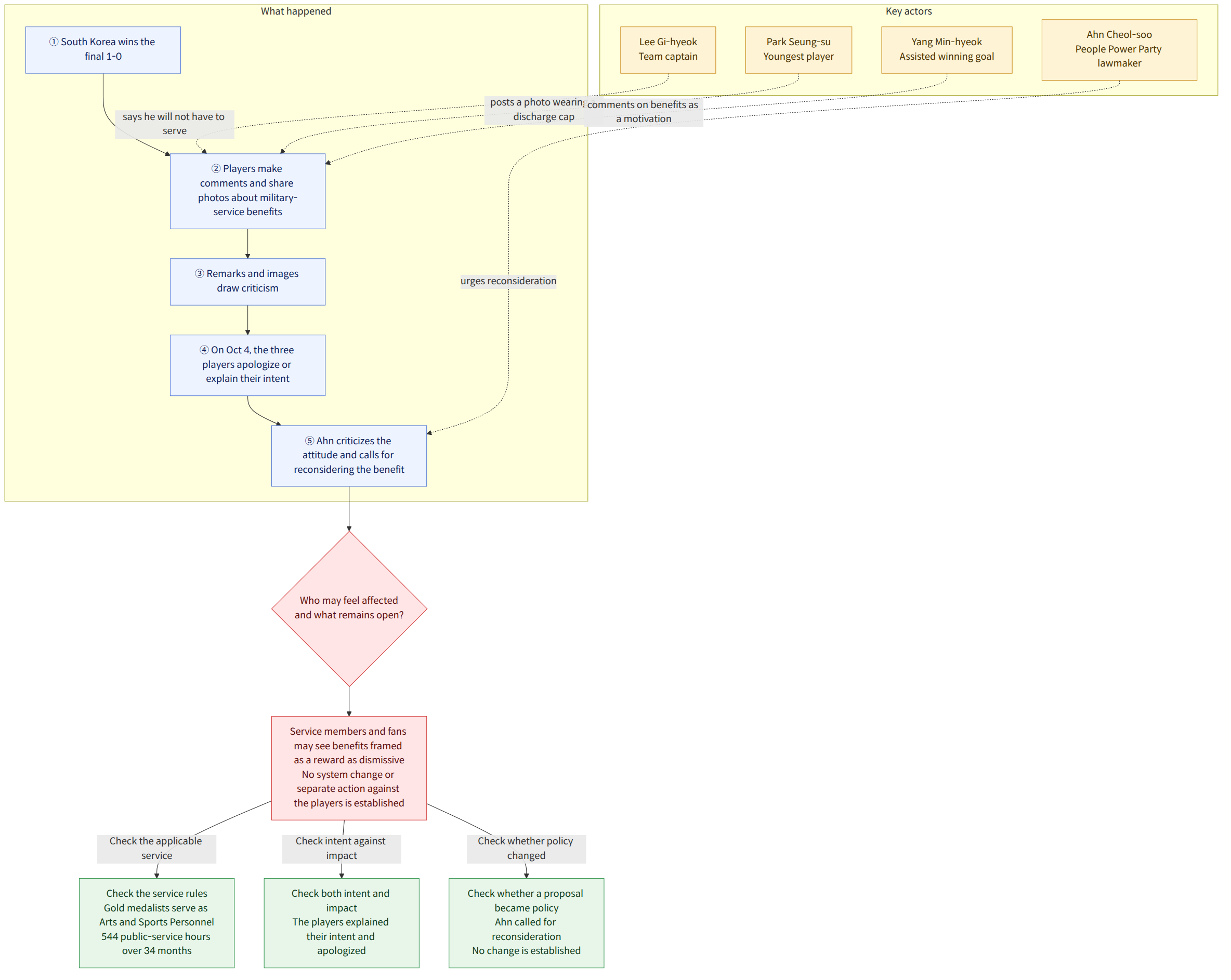
After the South Korean team won 1-0 in the final of the 2026 Aichi-Nagoya Asian Games men’s soccer tournament, comments and photos by players about military-service benefits became controversial. In an interview, captain Lee Gi-hyeok held up his gold medal and said, “I won’t have to go to the military.” The youngest player, Park Seung-su, posted a photo on social media wearing a “discharge cap” (전역모), then deleted it. Yang Min-hyeok, who assisted the winning goal, also faced criticism for a comment referring to military-service benefits as a reward. The three players posted apologies or explained what they meant on October 4.
Background and context
Lee also said that winning the gold had lifted a heavy burden, making it especially meaningful. He was talking about both the joy of victory and the pressure on a player facing military service, but his interview remark, “I won’t have to go to the military,” was interpreted differently.
Just after the game, Park posted a photo from the locker room wearing his gold medal and a “discharge cap.” A video of him wearing the same cap, smiling and saluting the crowd, was also posted on social media. In his apology, Park explained that he had accepted the cap from a fan right after the game and posted the photo without giving enough thought to its meaning.
Reports said that in a postgame interview, Yang responded in a way that suggested he had played with military-service benefits as his sole reward in mind. He later said that his intended meaning—that military-service benefits were one of several possible motivations for winning—had been conveyed incorrectly. The three cases show that words and images can take on public significance apart from a player’s intent. They drew attention to the fact that national team members speak not only to express personal joy, but also from a position where they need to consider how people serving their military duty and cheering fans may take their words.
What this news means
The core of the criticism is not that the players were happy to win gold, but that presenting military-service benefits as a reward for victory, or wearing a “discharge cap,” could appear to trivialize the people fulfilling their military duty. On October 4, Ahn Cheol-soo, a lawmaker from the People Power Party (국민의힘), criticized the players’ attitude, asking whether young men enlisting in the military were “suckers,” and argued that the military-service exemption benefit should be reconsidered. These were the lawmaker’s claims; the reports do not establish that the system was changed or that any separate action was taken against the players.
The players’ apologies also focused on different things. Lee said he had hurt people fulfilling their military duty and the fans who supported the team. Park said he had not intended to mock anyone, while apologizing for not thinking carefully about the meaning of the cap. Yang explained that his meaning—that military-service benefits were one of several motivations—had been conveyed incorrectly. It is important to distinguish an explanation that there was no harmful intent from the impact of the words or actions.
For example, if a national team player mentions military-service benefits immediately after a victory, the player may intend to express relief at being freed from stress and pressure, while listeners may feel that the efforts of those who perform military service as a matter of duty are being treated lightly. What is established in this case is the criticism over that interpretation and the players’ apologies. It cannot be generalized as the view of all fans or members of the public.
Relevant system and support information
According to the article, athletes who win gold at the Asian Games serve as Arts and Sports Personnel instead of serving on active duty. Arts and Sports Personnel is the name of the alternative service described in the article, and the athletes must complete 544 hours of public service over 34 months. Therefore, understanding the commonly used phrase “military-service exemption” to mean that the military-service obligation disappears altogether would differ from the system described in the article.
This distinction is also important when considering the controversy. The system applicable to the athletes involves completing a set period and number of hours of public service instead of active-duty service; the information presented in this article does not establish each individual’s service status or any additional requirements. Ahn Cheol-soo’s call to “reconsider” the benefit was reported as a politician’s proposal; the article does not say that the system applying to gold medalists has changed.
Differences in how reports presented the story
Both reports agreed that the players’ comments, photos and apologies were at the center of the controversy. However, they differed in how they quoted Yang Min-hyeok’s remarks. One report described his comments as suggesting that he seemed to have played with military exemption as his sole reward in mind; another rendered them as meaning that medals and victory did not matter and that he had focused only on military exemption. Yang later apologized, saying that his meaning—that military-service benefits were one of several motivations—had been conveyed incorrectly. The differing wording in the reports should therefore be considered alongside his subsequent explanation.
Another report added a claim by Ahn Cheol-soo that the players had played “A Letter from a Private” during training, as well as information about the team’s fourth consecutive tournament title and the number of people eligible for the military-service exception. These details do not appear in the other report. In particular, the training-related detail was reported as the lawmaker’s claim, not as a fact confirmed by both reports.
What is confirmed and what remains unknown
Confirmed facts
- The team won the final 1-0, and after the game Lee Gi-hyeok said in an interview, “I won’t have to go to the military.”
- Park Seung-su posted a photo of himself wearing his gold medal and a “discharge cap” on social media, then deleted it; a related video was also posted online.
- After reports of his comment referring to military-service benefits, Yang Min-hyeok apologized, saying that what he meant had been conveyed incorrectly.
- Lee Gi-hyeok, Park Seung-su and Yang Min-hyeok each apologized or offered an explanation on October 4.
- According to the article, gold medalists serve as Arts and Sports Personnel and complete 544 hours of public service over 34 months instead of serving on active duty.
What remains unknown
- The reports do not say whether the national team or the Korea Football Association took separate action over the comments and photos.
- It has not been established how the controversy between the players and their critics continued after the apologies.
- The reports alone do not establish whether the lawmaker’s call to reconsider the military-service benefit led to an actual review of the system.
What readers should check
- When you see the phrase “military-service exemption,” distinguish between not serving on active duty and having the military-service obligation disappear altogether. The system for gold medalists described in this article is service as Arts and Sports Personnel.
- Distinguish a politician’s call for a system change from an actual, finalized change. The reports include a call to reconsider the benefit, but do not say that a change was decided.
- When following a controversy, checking the original remarks, the player’s subsequent explanation and the context in which a photo was posted can help prevent confusion between claims about intent and the impact on the public.
References
- Other coverage consulted: chosun.com