Australia’s Bureau of Meteorology expected the declared El Niño to be strong or very strong, and southeastern Australia is preparing for the possibility of an extended period of dangerous fire weather. But a new study suggests that climate change alone cannot explain wildfire vulnerability in some of the region’s forests. The researchers argue that current fuel loads—that is, the vegetation that can burn—took shape during colonization about a century before human-caused climate change began in earnest.
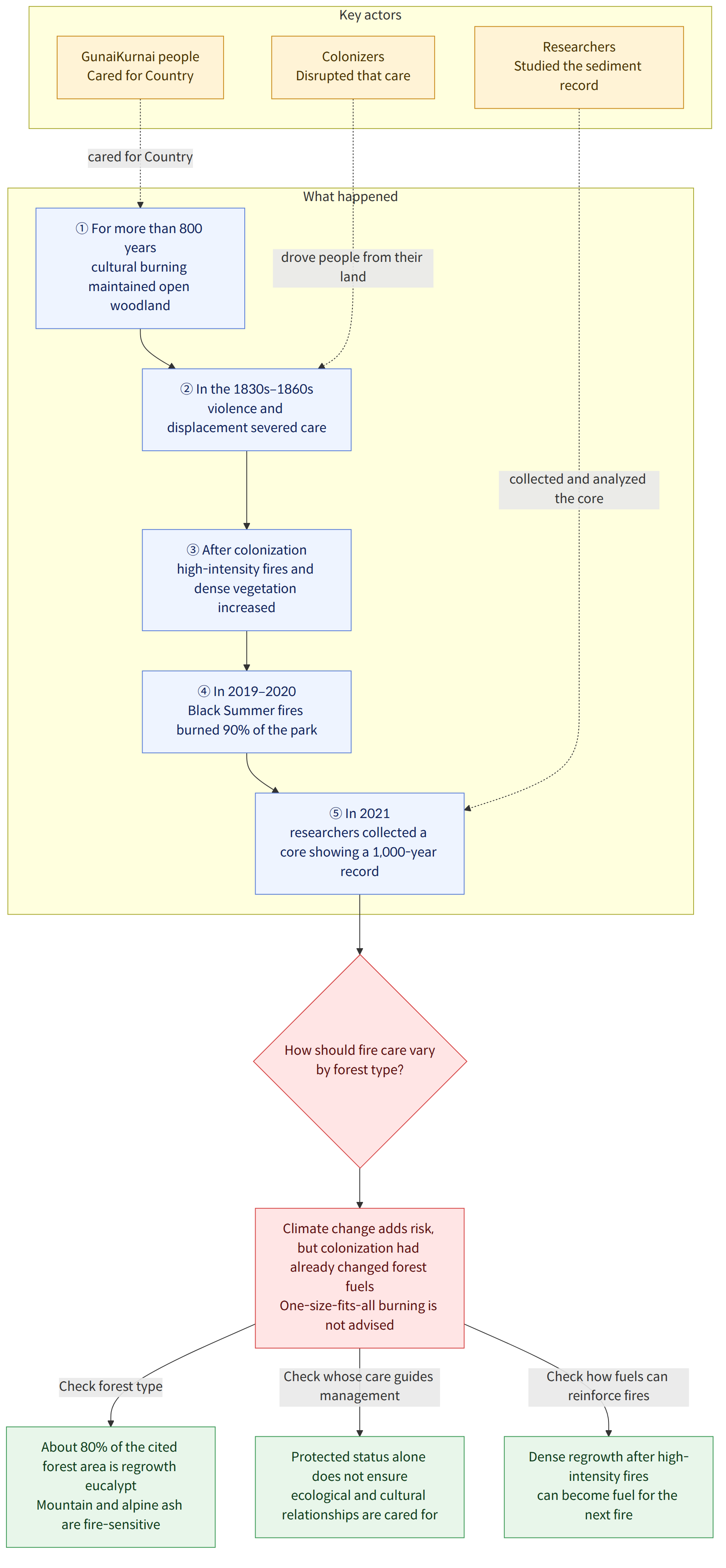
The study site, Croajingolong National Park at the eastern tip of Victoria, is protected as a national park, a designated wilderness area and a UNESCO Biosphere Reserve. Yet the 2019–2020 Black Summer bushfires burned 90% of the park. According to the article, the interval between fires shortened from about 40 years in the late 1800s to about five years over the past decade. The study starts from the fact that protected status alone does not eliminate wildfire risk, and that it is also necessary to examine the principles that have guided forest management.
Background and context
The study was carried out in GunaiKurnai Country within Croajingolong National Park, in partnership with the GunaiKurnai Land and Waters Aboriginal Corporation (구나이쿠르나이 토지·수역 원주민 법인). In February 2021, the researchers collected a sediment core from Fergurala (Lake Elusive) and examined a record covering the past 1,000 years. A core is a cylindrical sample taken from layers of sediment built up on the lakebed.
Pollen in the sediment reveals what kinds of plants grew in the area, while charcoal indicates what fires were like. The researchers analyzed the charcoal’s infrared spectrum to assess how hot the fires were, distinguishing low-intensity cultural burning from high-intensity wildfires. The researchers say that the pollen and charcoal record accumulated from material carried from an area of 10,000 square kilometers around the site.
The analysis found that frequent low-intensity cultural burning, practiced for more than 800 years under GunaiKurnai care, kept the land as stable open woodland. The researchers said that high-intensity fires were rare during this period, and that there was little charcoal and soil erosion. Although severe fire weather, like that associated with Ash Wednesday, Black Saturday and Black Summer, also occurred in the past, the researchers report that catastrophic wildfires did not occur in Country that was cared for.
The study identifies violence and massacres during the colonization of Gippsland in the 1830s to 1860s as the turning point. The article explains that GunaiKurnai people were driven from their land in this process, severing longstanding relationships of care. The sediment record after colonization shows high-intensity fires becoming dominant and shrubs growing densely. The researchers said eucalyptus cover increased to nearly four times its pre-colonization level, and soil erosion also increased.
The study is not claiming that climate change has no effect on wildfires. Its explanation is that colonization first changed forest structure and fuel loads, creating vulnerability, and climate change has further increased that vulnerability. After a high-intensity fire, flammable vegetation can grow back densely and become fuel for the next fire. The researchers describe this as a cycle in which repeated fires and regrowth reinforce the danger.
What this news means
If wildfire measures are based only on weather conditions or climate change, they may overlook the condition of forests that allows fires to spread and the historical causes that shaped that condition. The study also questions management approaches that treat Croajingolong’s forests as a ‘natural state’ that has always existed. It draws attention to the fact that designating a protected area and caring for the ecological and cultural relationships within it may be different matters.
However, the findings cannot be applied in the same way to every forest. According to the article, about 3 million to 4 million hectares of forest extend from Victoria’s Central Highlands to the southern coast of New South Wales, and about 80% of this area is regrowth eucalypt forest that could benefit from regular low-intensity cultural burning. The original article explains that the remaining roughly 20%—mountain and alpine ash forests—is fire-sensitive, with an ecology in which high-intensity fires are needed after a long fire-free period for seed capsules to open and seeds to germinate. The direction suggested by the study, then, is not to set fires uniformly, but rather to take forest type and Indigenous care for Country into account in management decisions.
For example, when reviewing a forest management plan for a given area, one could check whether the forest is regrowth eucalypt forest or fire-sensitive mountain and alpine ash forest, and how the care knowledge and participation of Indigenous communities such as the GunaiKurnai have been considered. This does not mean the study alone can determine a particular burning interval or method. The original article does not specify how cultural burning should be applied or how often.
What is confirmed and what remains unknown
What is confirmed
- The researchers worked in GunaiKurnai Country within Croajingolong National Park, in partnership with the GunaiKurnai Land and Waters Aboriginal Corporation.
- They collected a sediment core from Fergurala in February 2021 and examined a record spanning 1,000 years.
- The findings show that frequent low-intensity cultural burning practiced for more than 800 years under GunaiKurnai care maintained open woodland.
- The researchers said that the record after colonization shows high-intensity fires, dense shrubs, increased eucalyptus cover and soil erosion.
- The article reports that about 80% of the forest in the area covered by the study is regrowth eucalypt forest that could benefit from regular low-intensity cultural burning.
What remains unknown
- The original article does not say what methods or intervals should be used to apply cultural burning in forest management.
- This article alone does not establish how widely the past changes identified by the study apply to forests in other areas.
What readers should check
- When assessing wildfire risk in southeastern Australia, it is worth considering not only weather forecasts but also the vegetation type in the forest concerned and the interval between fires.
- When evaluating forest management plans, readers can distinguish between regrowth eucalypt forests and mountain and alpine ash forests, and check whether the rationale for managing each type has been provided.
- When cultural burning is discussed, readers should not assume that this study prescribes a specific method or interval. They should check whether the participation of Indigenous communities and a separate management plan suited to the area have been set out.