Renewables account for more than 40% of generation across Australia’s main electricity grid, but investment in wind power projects and their progress toward construction have stalled. The article’s assessment is that the federal government’s target of 82% renewable energy generation by 2030 is becoming more difficult to meet. If wind projects do not proceed on time, there may not be enough replacement power when coal-fired power plants close, disrupting electricity supply plans.
Background and context
The transformation of Australia’s electricity grid is already well underway. Renewables’ share of generation has risen from less than 10% 20 years ago to more than 40% today. However, an estimate cited in the article says that completing the transition will require A$106 billion in investment by 2050.
The problem is that investment in clean energy is not growing at the same pace across all areas. In a 2026 survey by the Clean Energy Investor Group (청정에너지 투자자 그룹), the proportion of major investors who considered Australia’s clean energy sector “attractive” fell from 69% in 2025 to 58%. The share who rated it “somewhat unattractive” rose from 8% to 19% over the same period.
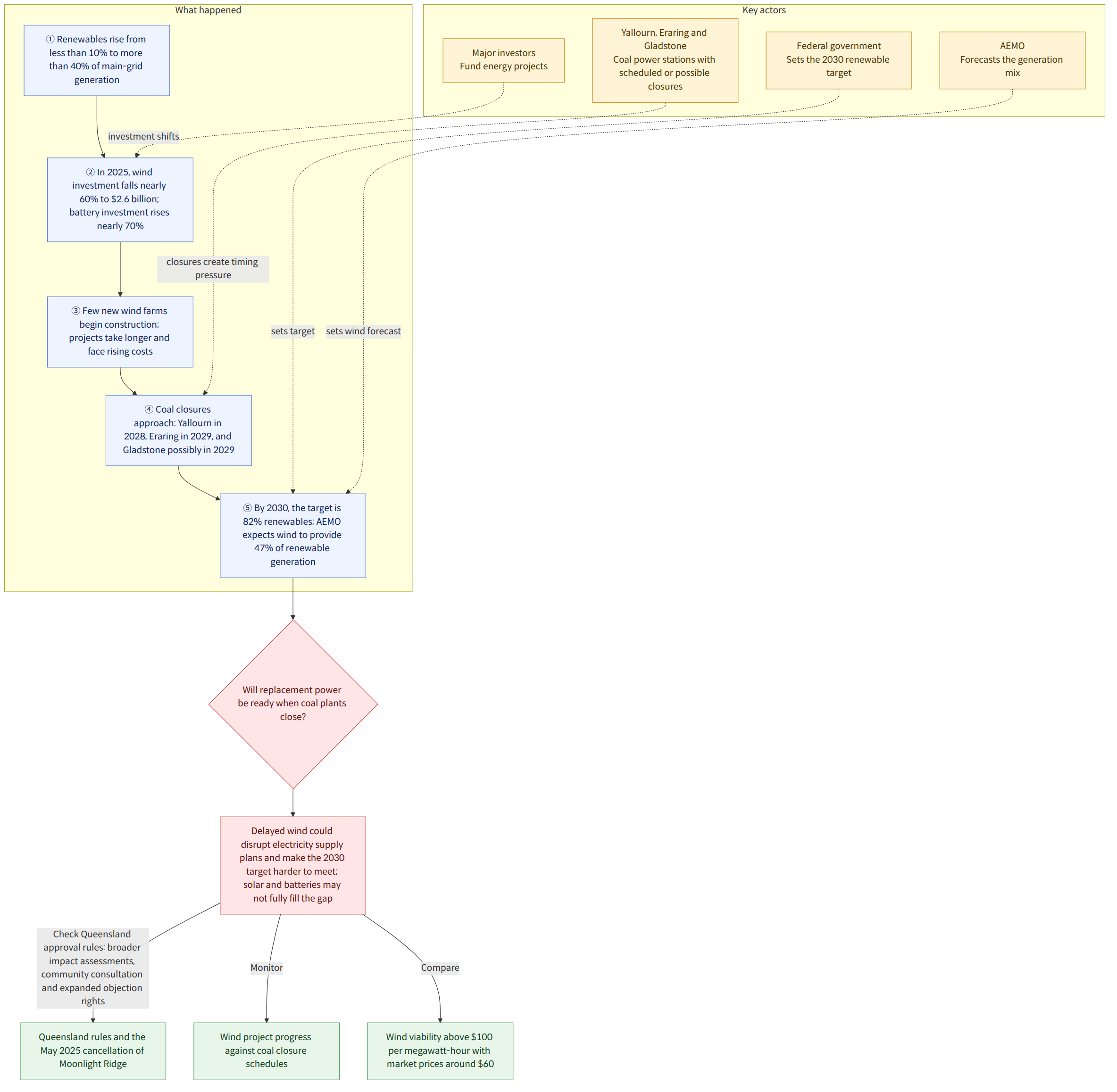
The weakness in wind contrasts with the trends in solar and batteries. In 2025, investment in Australian batteries rose by nearly 70% to $4.8 billion, while wind investment fell by nearly 60% to $2.6 billion. Investment in solar power plants declined by 5% to $1.9 billion. The article also reports that few new wind farms had reached the stage of actually beginning construction this year.
Wind projects take a long time to build. On average, they take more than a year longer to construct than solar projects, and they require years of financing before they become profitable. Other cost pressures include a nearly 40% rise in wind turbine prices between 2020 and 2022, transmission line costs, and a shortage of skilled workers.
There is also a large gap between the electricity price wind projects need to be viable and the current market price. According to the article, electricity prices need to exceed $100 per megawatt-hour for wind farms to be viable, while the current market price is about $60. With construction taking longer and costs rising, this price gap could make investment decisions more difficult.
What this means
Delayed wind investment is not just a setback for one type of power generation. The Australian Energy Market Operator (AEMO; 호주 에너지시장운영자) expects wind to account for 47% of renewable generation on the main grid in 2030. The article’s analysis is that if wind does not expand as expected, solar and batteries may make up some of the shortfall but may not be able to fill the gap entirely.
This issue is tied to the schedule for coal plant closures. Victoria’s Yallourn power station is scheduled to close in 2028, and Eraring power station is scheduled to close in 2029 after a two-year extension. Queensland’s Gladstone power station could also close in 2029, six years earlier than scheduled. The three plants generate a combined total of about 30 terawatt-hours a year, roughly twice South Australia’s total annual generation.
Wind projects take time to move from planning to generating electricity. To have replacement power ready when coal-fired power plants close, delays to investment and project development need to be monitored so they do not later result in a supply gap.
For example, if a wind project is delayed during investment decisions or the permitting process, there could be a gap between when it was expected to supply power and when a coal-fired power plant closes. This is a hypothetical explanation; the article does not provide timelines for individual projects or figures for any actual shortfall.
What different reports said
There is only one source text provided, so differences between reports cannot be compared.
What is confirmed and what remains unknown
Confirmed facts
- Renewables account for more than 40% of generation across Australia’s main electricity grid, compared with less than 10% 20 years ago.
- The 2030 renewable energy target is 82%, and AEMO expects wind to account for 47% of renewable generation in 2030.
- Battery investment increased in 2025, while investment in wind and solar power plants declined.
- Queensland requires wind project developers to conduct broader impact assessments and community consultations, and has expanded third parties’ right to lodge objections. In May 2025, it cancelled the Moonlight Ridge wind farm, which had received conditional approval.
- Yallourn and Eraring are scheduled to close in 2028 and 2029, respectively, while a 2029 closure is being considered for Gladstone.
What remains unknown
- The article does not specify what concrete policies the Australian government will implement to revive wind investment and project development.
- The number of wind projects that have yet to enter the construction phase, and when each will proceed, has not been disclosed.
- The article alone does not make it possible to determine how much delayed wind investment could reduce electricity supply in each region.
What readers should check
- When assessing Australia’s renewable energy targets or electricity supply plans, readers should look not only at the overall share of renewables but also at the progress of wind investment and construction.
- Comparing coal plant closure dates with the expected supply dates for new power projects can help identify the possibility of a gap in replacement power.
- For wind projects in Queensland, readers can also check how impact assessment and community consultation requirements, as well as third-party objection procedures, affect project development.