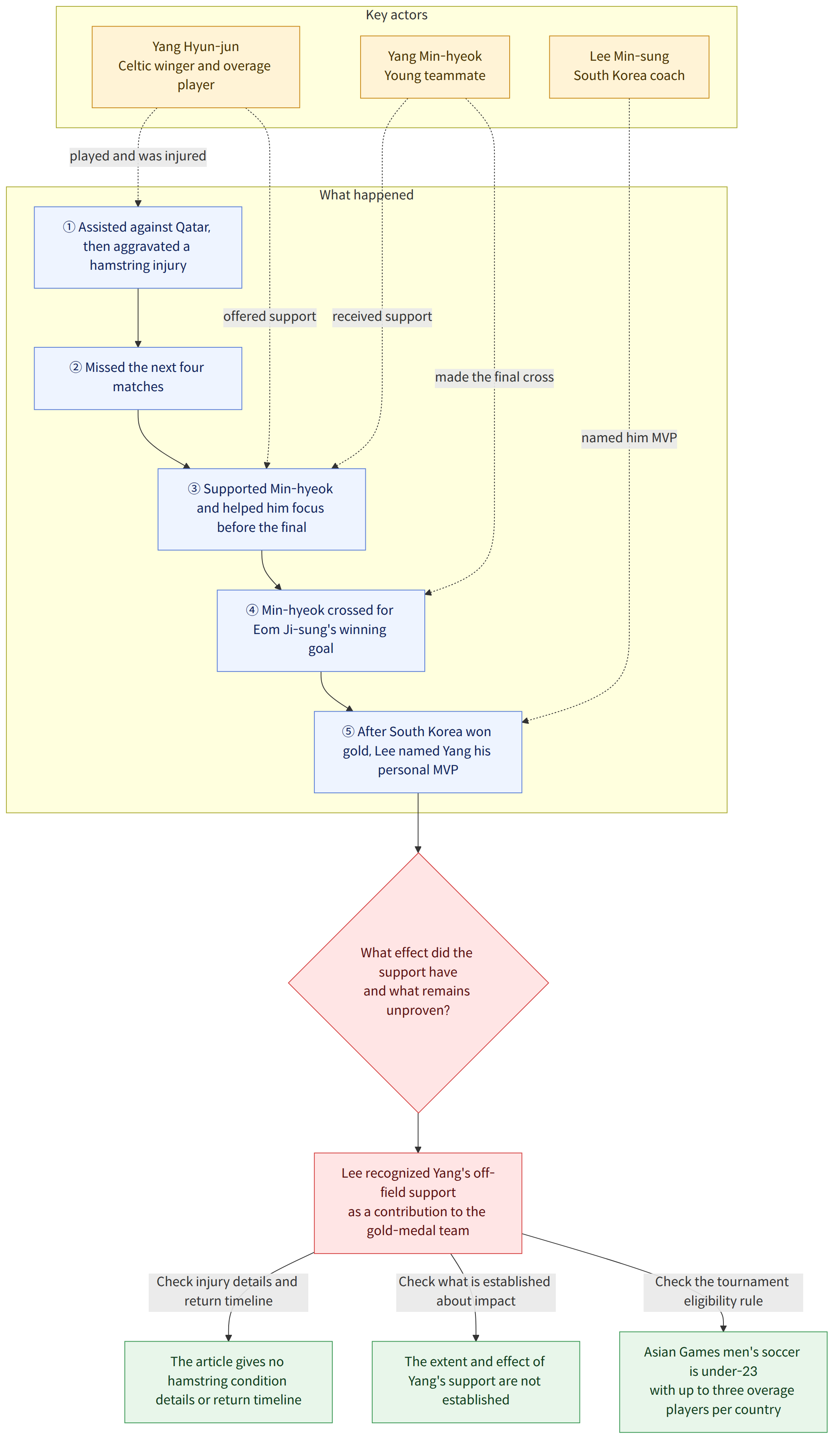
After South Korea’s men’s national soccer team won the gold medal at the Aichi-Nagoya Asian Games, coach Lee Min-sung named Yang Hyun-jun, who did not play in the final, as his personal MVP. Yang, a winger for Celtic FC, played in just one match at the tournament because of an injury, but the coach said his unseen sacrifices were a great help to the players on the field.
Yang recorded an assist in South Korea’s first group-stage match, against Qatar, on September 15. South Korea won 4-1, but Yang aggravated a hamstring injury in that match and missed the next four. His appearance record suggested that his opportunities to contribute to the tournament were limited, but the coach’s assessment focused on a role that cannot be seen from playing time alone.
Background and context
Yang’s support went beyond general encouragement. He explained that after he was injured during the tournament, Yang Min-hyeok, who was brought into the lineup, was putting a lot of pressure on himself. Yang said he tried to help Min-hyeok focus on the match in front of him and worry less about other things, and that he thought the coach had recognized this.
After the players traveled to Toyota ahead of the final, they were free to choose new roommates, and Yang chose Yang Min-hyeok. Yang said he saw Min-hyeok blame himself whenever he made a mistake in a match, and told him not to be so hard on himself and that he just needed to keep at it. Yang said he had only offered a few words, but this is a concrete example of what the coach meant by “unseen sacrifices.”
At the time, Yang Min-hyeok was 20, the second-youngest player on the national team, and Yang Hyun-jun was 24. Men’s soccer at the Asian Games is a tournament for players under 23, and each country can select up to three overage players. Yang was one of those overage players. Yang said he thought Min-hyeok’s confidence had fallen because he had not established himself at his club, and that he also felt pressure to live up to expectations after signing with Tottenham Hotspur.
What this news means
Contributions to a soccer team cannot always be explained by moments that appear in the record, such as goals, assists or playing time. Yang did record an assist in one match, but the coach also cited his support for teammates after his injury as a reason for naming him MVP. This shows how a player’s performance on the field and the support around that player, which helps them prepare for and carry on through a match, can contribute to a team’s results in different ways.
The final offered a symbolic illustration of that connection. Yang Min-hyeok won the ball on the wing, advanced and sent in a cross, which Eom Ji-sung converted for the winning goal. Yang did not play in the final, but the younger teammate he said he tried to help was involved in the winning goal. However, there is no basis for concluding that Yang’s advice directly produced Min-hyeok’s play or the team’s title. What can be established is Yang’s own account that he tried to help his junior teammate, and the fact that Min-hyeok took part in the move that led to the winning goal.
For example, even if a player is unable to play because of an injury, they can contribute to the team in ways not reflected in the appearance record by easing a teammate’s burden and helping them focus on the match. It cannot be established in this case exactly how much of an effect that support had, but the support he offered his teammates was the basis for the coach’s high regard for Yang’s role.
Another forward, Eom Ji-sung, led the tournament in both goals and assists, recording four of each. He also scored the only goal in the final against Japan at Toyota Stadium, leading South Korea to a 1-0 victory. Eom’s performance, reflected in the statistics, and Yang’s support, which the coach singled out separately, show that different kinds of contributions were recognized along South Korea’s path to the gold medal.
Confirmed facts and what remains unknown
Confirmed facts
- Coach Lee Min-sung named Yang Hyun-jun as South Korea’s personal MVP.
- Yang recorded an assist against Qatar, then aggravated a hamstring injury and missed the next four matches.
- Yang said he helped Yang Min-hyeok focus on matches and advised him not to blame himself too much.
- Yang Min-hyeok assisted Eom Ji-sung’s winning goal in the final against Japan. South Korea won 1-0.
- Eom Ji-sung recorded four goals and four assists at the tournament.
What remains unknown
- It has not been established how extensive or sustained Yang’s support for his teammates off the field was.
- No details were provided about the condition of Yang’s hamstring injury or his return timeline.
- It is not known how much Yang’s advice influenced Yang Min-hyeok’s performance in the final.
What readers should check
- This report does not establish Yang’s injury status or return timeline. Readers should check whether the player or his club provides further information.
- The coach’s assessment of team contributions and the official match statistics contain different information. When considering a player’s role, readers can distinguish between appearance and scoring records and the examples of teammate support reported here.
- The specific help Yang described in this report consisted of the advice he gave Yang Min-hyeok and his choice of Min-hyeok as a roommate. It is important not to interpret this as evidence of other activities beyond that scope.
References
- Other coverage consulted: en.yna.co.kr
- Other coverage consulted: hani.co.kr