
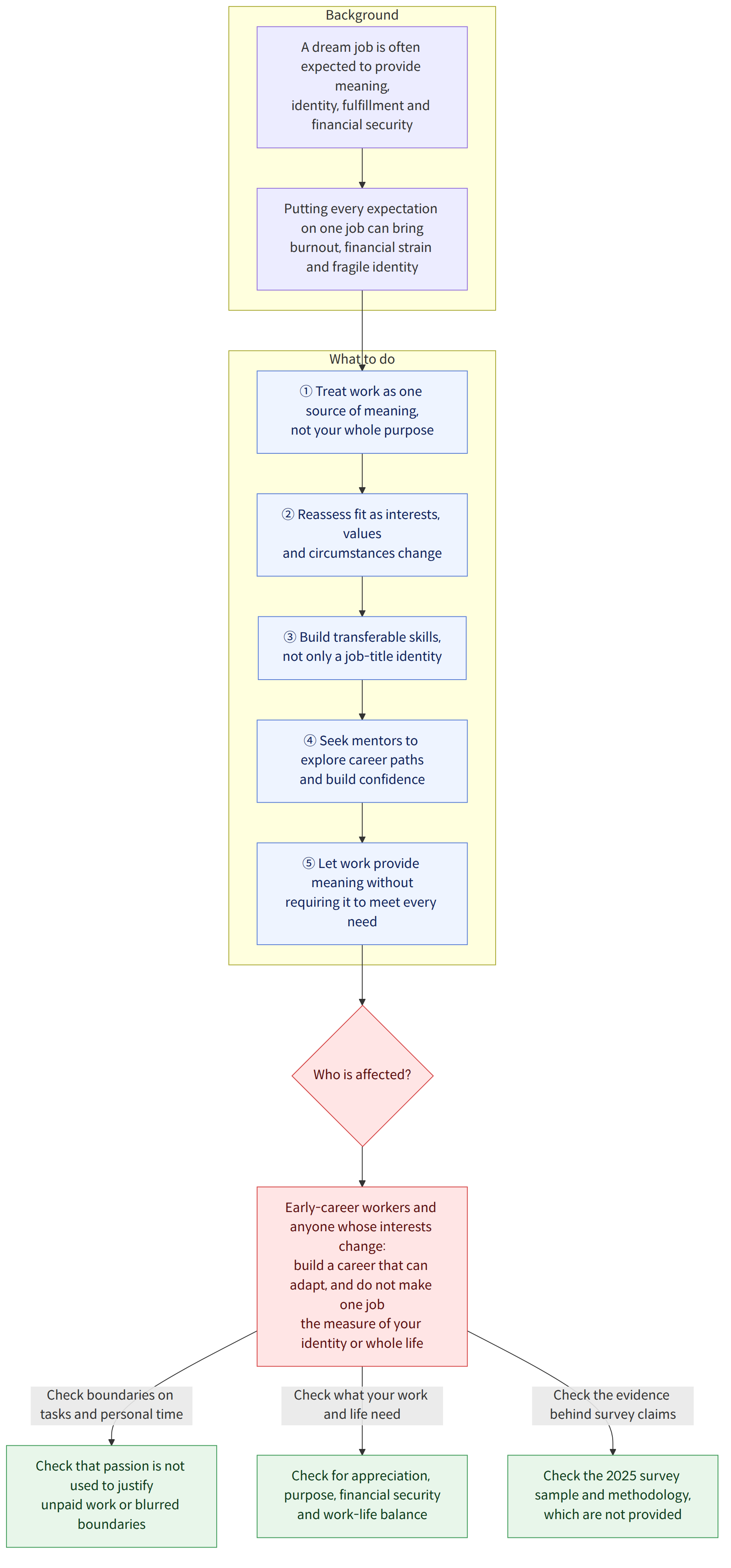
The advice to find work you love so it won’t feel like work is familiar. But when that means expecting one job to provide all of life’s meaning, identity, financial security and personal fulfillment, it can become a burden. People just entering the labor market may especially take it as a personal failure if their work does not feel like a “calling” or their interests change. The point is not to stop finding meaning in work, but not to stake your entire sense of purpose and identity on a single job.
Background and context
The idea of a “dream job” is tied to the expectation that work can provide meaning, identity and personal fulfillment. But research on careers and motivation suggests that the expectation that a single job should provide all of those things, as well as financial security, may itself be a problem. Work can be an important part of a fulfilling life, but it does not have to stand in for life as a whole.
When work does not feel like a calling or your interests change over time, you may conclude that you made the wrong choice rather than that the job is no longer a good fit. The original article explains that constantly pursuing a “dream job” can lead to burnout, financial strain and a fragile sense of identity.
It is also worth considering how passion can operate in the workplace. Research by psychologist Aaron Kay and colleagues suggests that people may be more accepting of asking passionate workers to do unpaid work, take on tasks outside their job responsibilities or sacrifice personal time. The explanation is that extra demands can be justified by the belief that the work itself is rewarding.
Loving your work does not mean it is acceptable for the boundaries of your job responsibilities and personal time to become blurred.
The original article says that in fields where passion and creativity are often closely linked, such as media, fashion, entertainment and the arts, workers tend to closely associate their work with their personal identity and creative fulfillment. In such environments, passion can be a source of motivation and satisfaction, but it can also make it easier to accept unrealistic expectations.
What this means
Professional identity is not a fixed label. It can develop over time as people’s interests, values and circumstances change. So rather than immediately interpreting a career change as a failure, it may be viewed as a process of reassessing what work suits you under changed circumstances. The original article also points out that a career transition can feel more unsettling when a person’s identity is narrowly tied to one job.
It is also worth considering how turning a hobby or personal interest into a job can change it. For example, if you make a creative activity you enjoy your profession, deadlines, client feedback and income targets may come with it, turning what used to be a way to unwind into a source of pressure. This does not mean that turning a hobby into a job inevitably leads to burnout; rather, it means that passion and working conditions can change together.
A 2025 survey identified financial security and work-life balance as priorities for Gen Z and millennials, along with growth opportunities and meaningful work. The original article describes this as a trend among young workers to rethink what counts as a successful career. However, the survey’s sample size and methodology are not provided, so those limitations should be kept in mind when interpreting the results.
Emily Durham, a recruiter and career coach, argues that three needs should be met: feeling appreciated at work, having a sense of purpose and having a lifestyle that works for you. The proposal in the original article is not to assume that a single job must meet all of these needs. It may be more flexible to recognize that one job can provide meaning while another provides stability or balance in life, rather than concentrating every expectation in one job.
Think about your career in terms of skills, not a job title
Rather than making one job title, such as “marketing director,” the center of your identity, the original article suggests developing a portfolio of transferable skills—abilities that can be used in different roles or fields—such as persuasive writing, data analysis and project management. Building capabilities you can use even if your interests change or you move into another field can make a career transition feel less like having to start over from scratch.
Mentoring is also presented as a strategy for exploring career options and building confidence. The original article’s author explains that effective mentoring can broaden people’s understanding of career paths and help clarify their options. The article adds that mentoring that provides emotional support can also help people separate their sense of worth from their job title.
What is known and what remains unclear
What is known
- The original article explains that the expectations attached to a “dream job” can be burdensome, particularly for people just entering the labor market.
- Research by Aaron Kay and colleagues suggests that people may be more accepting of asking passionate workers to take on additional work or sacrifice personal time.
- The original article explains that professional identity can develop as interests, values and circumstances change.
- A 2025 survey identified financial security, work-life balance, growth opportunities and meaningful work as priorities for Gen Z and millennials.
- The original article’s author, Valerie Onia Babatope, stated that, apart from relevant academic appointments, she had no affiliations with any company or organization that could benefit from the article.
What remains unclear
- The 2025 survey’s sample size and methodology are not provided in the original article.
- The original article alone does not make it possible to determine how Aaron Kay and colleagues’ research examined whether people tolerate additional demands on passionate workers.
- The original article does not provide specific comparative figures showing what outcomes the career approaches it proposes produce for particular individuals or occupations.
What readers can consider
- You can think separately about what you expect from your current work in terms of meaning, recognition, lifestyle, financial security and work-life balance. A starting point is not to assume that one job must meet every need.
- You can consider whether you are treating unpaid work, demands outside your job responsibilities or sacrificing personal time as a given simply because you love your work.
- You can list the skills you can use regardless of your job title and explore possible career paths and options through mentoring.