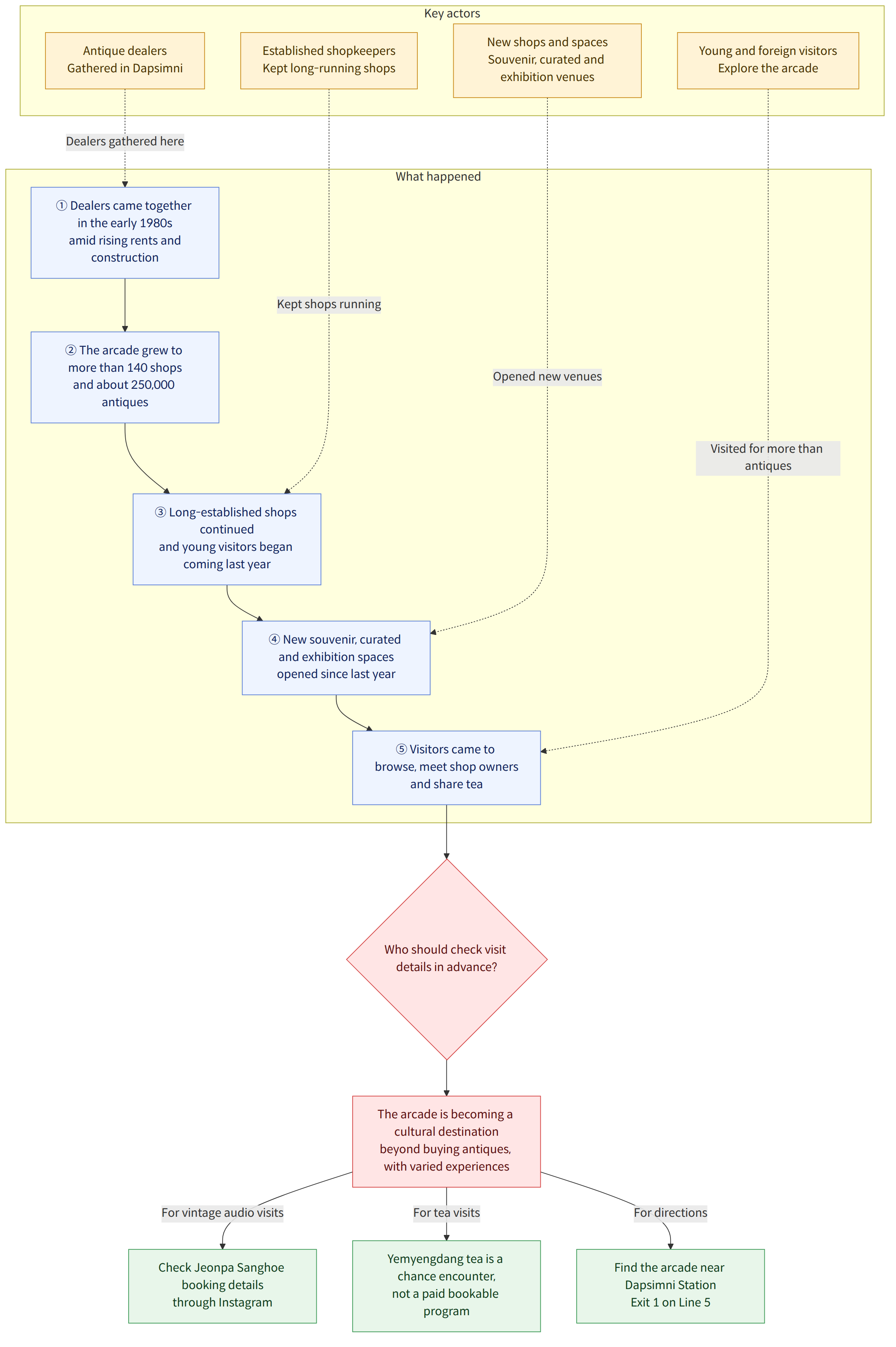
The Dapsimni Antique Arcade (답십리 고미술 상가) in Seoul’s Dongdaemun-gu (동대문구) is becoming a cultural destination for younger generations and foreign tourists, beyond its traditional role as a place to browse antiques. More than 140 shops are located in the commercial areas of Buildings 2, 3, 5 and 6 of Samhee Apartment (삼희아파트). According to Dongdaemun-gu materials, the arcade began taking shape in the early 1980s and houses about 250,000 antiques. Its current scene brings together long-established shops and newly opened souvenir shops, curated shops and exhibition spaces.
Background and context
The Dapsimni Antique Arcade can be reached from Exit 1 of Dapsimni Station (답십리역) on Seoul Subway Line 5. The center of the arcade is inside an apartment complex, but its shops deal in objects from different eras and with different uses. Visitors can browse everything from small items such as wooden dolls and water droppers to furniture such as document cabinets and vanity tables.
The arcade took shape as antique dealers gathered in one place. According to an account quoted in the article, dealers had been scattered across Hwanghak-dong, Sinseol-dong and Insa-dong, and came together here in the early 1980s amid rising rents in Insa-dong and construction work on Cheonggyecheon, among other developments. Dongdaemun-gu materials say the arcade began taking shape around that time.
There is also an account from a shop owner about how the arcade buildings came to be. Jung Young-seop, head of Yemyengdang (예명당), said that a two-story apartment-style factory built with a loan from the Asian Development Bank (ADB, 아시아개발은행) failed to sell, leading to a change in the design and its conversion into a commercial-residential complex. This is an account of the arcade’s origins as told by Jung and should not be treated as its official history.
The arcade’s transformation has not simply meant that existing shops have disappeared and been replaced by new businesses. Lee Jeom-sook has run Jangmibang (장미방) for 30 years, while her husband, Yoon Gap-young, has operated a shop with the same name in another building for more than 40 years. Lee said that in the past, visits from the general public were rare, but that many young people began coming last year.
What this news means
It is notable that people are visiting for reasons beyond buying antiques. Till Spurni, a traveler from Germany, told the article that he added the Dapsimni Antique Arcade to his South Korea travel itinerary after seeing a social media video. His experience shows how seeing old objects in person and meeting shop owners can itself become a travel goal.
New shops and spaces have also played a part in the changing visitor mix. Since last year, souvenir shops such as Gobokhui (고복희) and Hobak Folk Art Gallery (호박 포크 아트 갤러리), as well as the antique curation shop Obeu (오브), have opened. This could broaden the ways people visit the arcade, since those unfamiliar with traditional antique shops can explore it through souvenirs or exhibitions.
The tea experience at Yemyengdang shows that this change is about more than simply “more shops appealing to young tastes.” Jang Ok-sun makes matcha at the shop from 1 p.m. She said that serving tea to visitors as part of a tea ceremony is not a paid program, but an event that takes place when she meets someone who has dropped in by chance. In this way, looking at antiques and sharing tea happen in the same space.
There is no basis for saying that the entire arcade follows a set visitor program or a single way of operating. Some places, such as Jeonpa Sanghoe (전파상회), operate by reservation, while other experiences, such as the tea ceremony at Yemyengdang, arise from chance encounters.
For example, visitors who want to see the vintage audio equipment at Jeonpa Sanghoe can check how to book through Instagram rather than simply turning up, as reservations are required. By contrast, the article does not describe the tea experience at Yemyengdang as a paid program that visitors can book. The amount of advance checking needed therefore depends on the purpose of the visit.
What is confirmed and what remains unknown
Confirmed facts
- The arcade is in the commercial areas of Buildings 2, 3, 5 and 6 of Samhee Apartment in Seoul’s Dongdaemun-gu, and can be reached from Exit 1 of Dapsimni Station.
- According to the article, which cites Dongdaemun-gu materials, the arcade began taking shape in the early 1980s and brings together about 250,000 antiques and more than 140 shops.
- Lee Jeom-sook has run Jangmibang for 30 years, while her husband, Yoon Gap-young, has operated a shop with the same name in another building for more than 40 years.
- Souvenir shops and an antique curation shop have opened since last year, and DDD Space (디디디 스페이스), which combines tea ceremonies and exhibitions, recently opened in Building 5.
- Jeonpa Sanghoe operates by reservation, and reservations can be made through its Instagram account.
What remains unknown
- The article does not give individual shops’ opening hours or days off.
- It does not explain the price ranges for antiques or specific ways to verify whether they are genuine.
- It does not provide figures for the increase in younger visitors or foreign tourists, or visitor trends for the arcade as a whole.
What readers should check
- Before visiting, check the opening hours and days off of the shops you want to visit. The article does not give the arcade’s overall operating hours, so you will need to check with individual shops.
- If you plan to visit Jeonpa Sanghoe, check whether it is operating by reservation and how to book through Instagram. The article says that tea ceremonies at Yemyengdang take place through chance encounters rather than as a paid program, so it is more accurate not to expect them to run like a regular program.
- If you plan to buy an antique, the article alone cannot establish its price or authenticity. Before buying, ask the seller about the item and the terms of sale, and do not treat unverified information as confirmed fact.