President Lee Jae-myung urged the two Koreas to break the vicious cycle of hostility and confrontation and create a virtuous cycle of peace and prosperity on the 19th anniversary of the October 4 Inter-Korean Summit Declaration (10·4 남북정상선언). He delivered the message in a written congratulatory address read aloud at the commemorative ceremony by Vice Minister of Unification (통일부) Kim Nam-jung. Lee said that although resolving issues on the Korean Peninsula and establishing peace would not be easy, the path that must be taken was clear.
Background and context
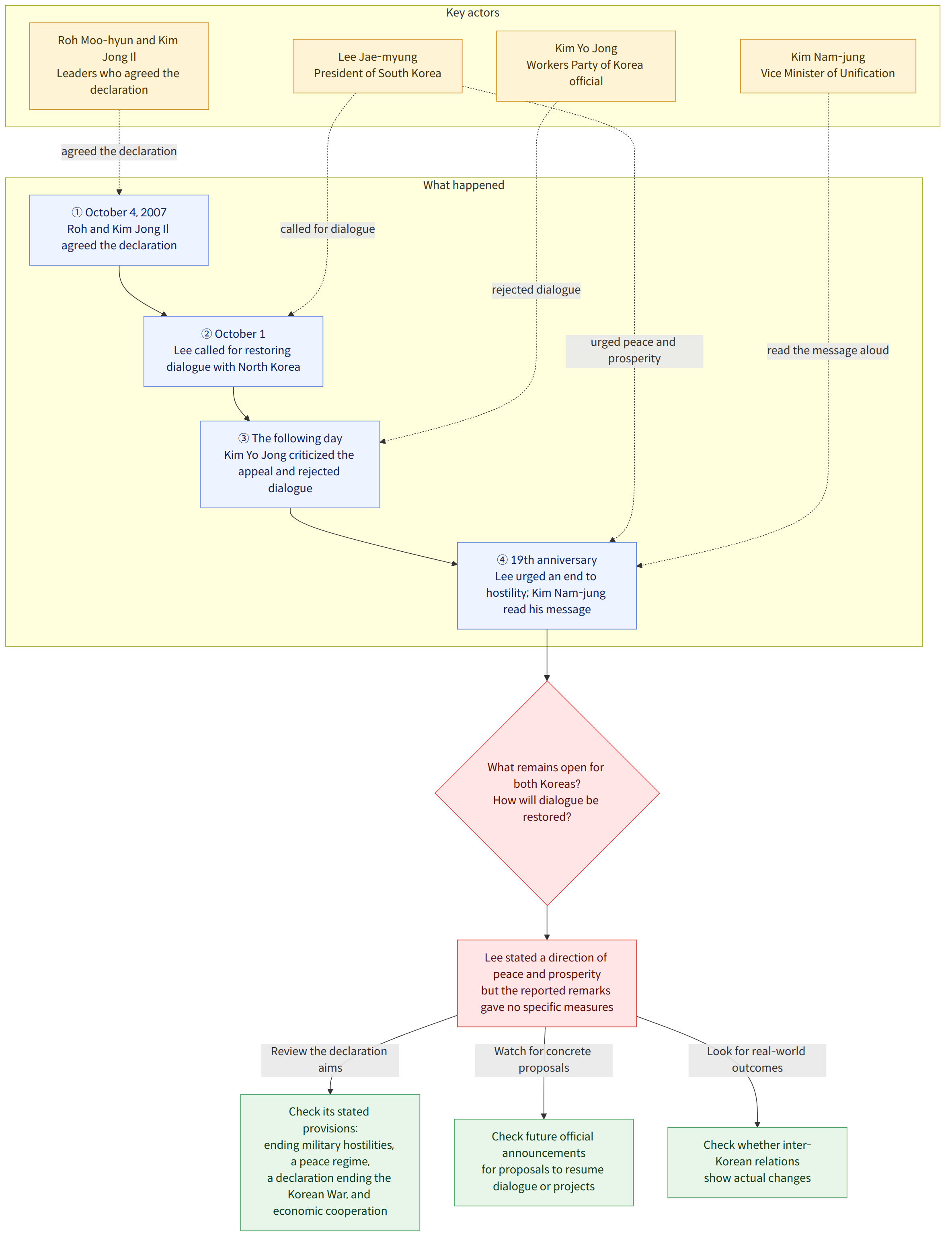
The October 4 Inter-Korean Summit Declaration was agreed on October 4, 2007, by the late former President Roh Moo-hyun and the late Chairman of the National Defense Commission Kim Jong Il. Kim Jong Il was the father of current North Korean leader Kim Jong Un. Lee described the declaration as a historic agreement to transform inter-Korean relations into a relationship of mutual trust and move forward together toward a permanent peace regime.
One report said the declaration included provisions on carrying forward the spirit of the June 15 South-North Joint Declaration, ending military hostilities, establishing a peace regime, cooperating to pursue a declaration ending the Korean War, and economic cooperation projects. This background helps explain why Lee cited the October 4 Declaration not merely as something to commemorate, but as an agreement that set out a direction for inter-Korean relations.
The lack of smooth dialogue between the two Koreas in recent times is also relevant to understanding the message. According to one report, in his October 1 Armed Forces Day address, Lee offered condolences to service members injured in a landmine explosion in the Demilitarized Zone (DMZ) and called for the restoration of dialogue with North Korea. The following day, Kim Yo Jong, director of the General Affairs Department of the Workers’ Party of Korea, criticized the appeal in a statement and rejected dialogue. The October 4 anniversary message, delivered in this context, can be seen as once again emphasizing the need for peaceful coexistence.
What this news means
Lee’s remarks are a political message showing that the government’s goals for inter-Korean relations are to ease hostility and pursue peace and prosperity. In particular, his assessment that hostility and confrontation filled the void left when promises of peace and prosperity went unfulfilled reflects a view that the vicious cycle in relations must be changed, rather than simply commemorating a past agreement.
However, stating a goal is different from setting out measures to pursue it in practice. The reported remarks do not indicate how dialogue would be restored or which procedures or projects would be prioritized. The key follow-up question for readers is therefore not only whether peace is the stated direction, but also whether that direction leads to concrete policies and actual changes in inter-Korean relations.
For example, readers interested in inter-Korean relations can watch for whether future official government announcements include concrete proposals to resume dialogue or projects that carry forward the aims of the declaration. This is an example of one way to follow developments; it does not mean that the remarks have already finalized such measures.
Differences in how reports described the issue
The two reports differed in how they described the declaration’s significance and in the details they included. One described it as an agreement to transform relations through “mutual respect and trust” and end military hostilities, while the other summarized it as an agreement based on mutual trust and aimed at a permanent peace regime. Both point broadly toward peace and trust, but they differ in the scope and emphasis of their wording.
What is confirmed and what remains unknown
Confirmed facts
- Vice Minister of Unification (통일부) Kim Nam-jung read aloud President Lee’s message marking the 19th anniversary of the October 4 Declaration.
- The president urged the two Koreas to break the vicious cycle of hostility and confrontation and create a virtuous cycle of peace and prosperity.
- The October 4 Declaration was signed on October 4, 2007, by former President Roh Moo-hyun and Chairman of the National Defense Commission Kim Jong Il.
- Lee said that promises of peace and prosperity had not been fulfilled, and hostility and confrontation had taken their place.
- Lee called for carrying forward former President Roh’s determination to pursue peace and prosperity.
What remains unknown
- What specific measures did the president propose to break the vicious cycle of hostility and confrontation?
- What vision for North Korea or inter-Korean relations, if any, was included in the portions of the address not covered in the reports?
- It has not been confirmed whether the commemorative message will lead to actual policy or changes in dialogue between the two Koreas.
What readers should watch for
- Readers can watch for future government announcements of concrete proposals or action plans to restore dialogue.
- It is worth checking what policies or projects are presented as carrying forward the spirit of the declaration, and distinguishing announced goals from actual measures.
- Watch for North Korea’s response and any subsequent developments between the two Koreas, but do not assume that the commemorative address itself means an agreement has been reached or dialogue has resumed.
References
- Other coverage consulted: hani.co.kr
- Other coverage consulted: en.yna.co.kr