
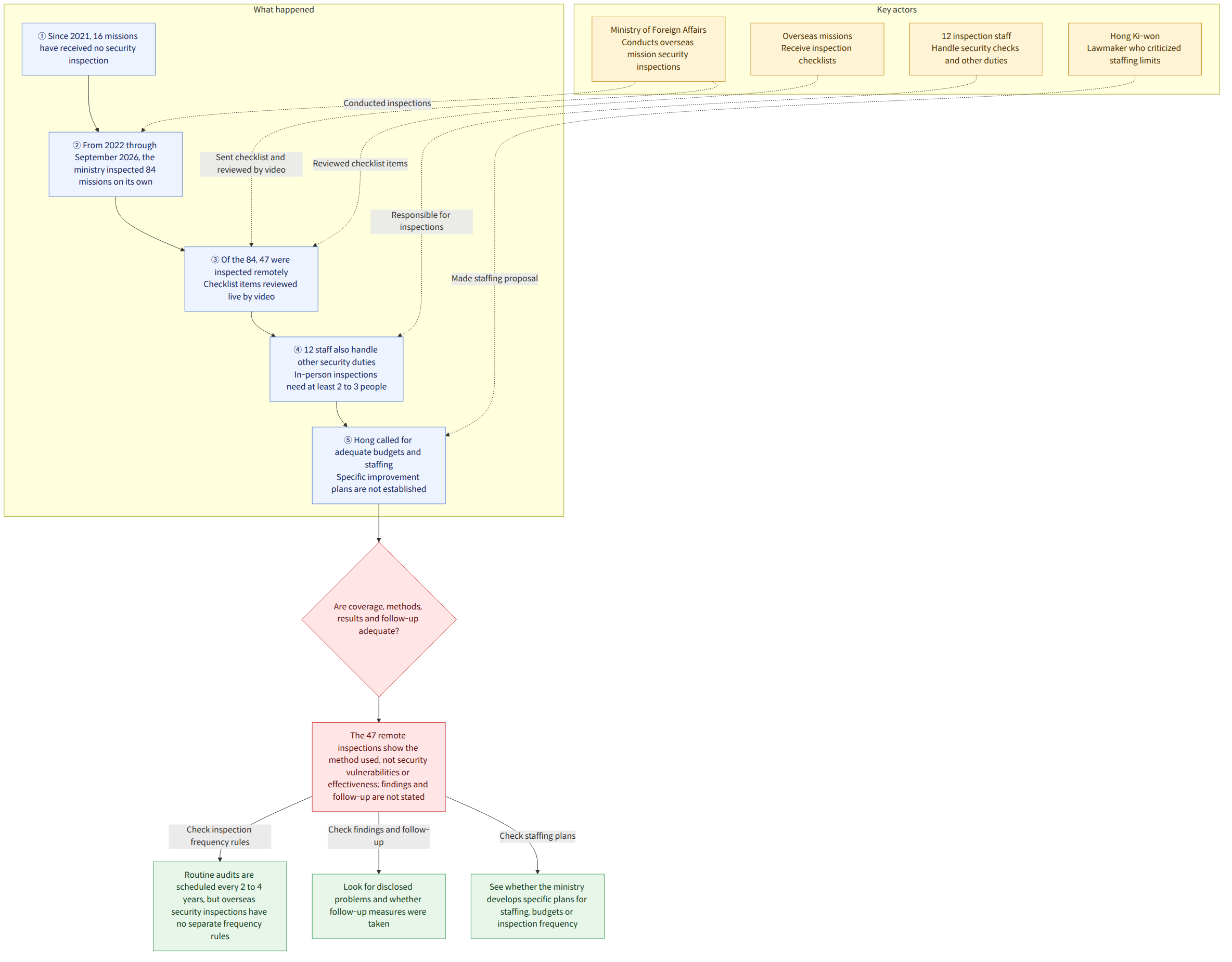
Of the 84 overseas missions that the Ministry of Foreign Affairs inspected for security on its own from 2022 through September 2026, 47 (55%) were inspected remotely rather than in person. In a remote inspection, the ministry’s headquarters sends the mission a preliminary checklist and reviews the items in real time over a video call.
Background and context
This figure does not mean that only 47 of all 195 missions received remote inspections. It means that 47 of the 84 missions that the Ministry of Foreign Affairs inspected for security on its own from 2022 through September 2026 were inspected remotely. The ministry was reported to inspect all missions either by dispatching personnel for joint inspections with relevant agencies or inspections conducted by the ministry alone, or by carrying out its own remote inspections.
The frequency of inspections is an issue as well as the method. While general routine audits are scheduled every two to four years, overseas mission security inspections reportedly have no separate rules setting their frequency.
Staffing conditions also affect how inspections are conducted and how many missions can be covered. Twelve Ministry of Foreign Affairs employees are responsible for security inspections at overseas missions. They also handle privacy-protection operations, manage national security equipment, and build and operate eavesdropping systems. Hong Ki-won, a lawmaker with the Democratic Party of Korea (더불어민주당), said that each in-person inspection requires at least two to three people, making it virtually impossible for the current staff to inspect every mission in person.
What this news means
A remote inspection involves headquarters and an overseas mission reviewing inspection items over a video call. This method can allow a broad range of missions to be checked without sending personnel to the site. However, it is difficult to conclude that a remote review can assess the same range of conditions as an in-person inspection. The fact that an inspection was conducted remotely, on its own, does not establish either that security is weak or that there are no problems.
The key question for readers is not just the “share of remote inspections,” but whether there is a system for disclosing and managing the inspection targets, methods and frequency together. The results of the 84 in-house inspections and the status of the 16 missions not inspected show the scope of the inspections, but do not say what vulnerabilities were found at each mission or whether follow-up measures were taken. Because the number of inspections alone cannot determine the level of security, information about identified problems and whether they were addressed is needed as well.
For example, the fact that a mission received a remote inspection does not mean that the mission had a problem. Conversely, the fact that inspection items were reviewed by video does not establish that all on-site conditions were assessed. Inspection methods, results and any necessary follow-up measures need to be disclosed separately so that readers can assess how effective the inspections are.
Lawmaker Hong said that cyberattack attempts are increasing and that an actual information leak occurred following a hack of the Korea National Diplomatic Academy (국립외교원). He said the government should coordinate with the Ministry of the Interior and Safety (행정안전부) and others to secure adequate budgets and staffing and respond to the issue. These are the lawmaker’s criticism and proposal. The information presented in the article does not establish how the Ministry of Foreign Affairs will change staffing or inspection frequency, or whether it has developed specific improvement plans.
The figure of 47 remotely inspected missions shows the distribution of inspection methods; it does not directly demonstrate security vulnerabilities at those missions or the effectiveness of the inspections.
What is confirmed and what remains unknown
Confirmed facts
- From 2022 through September 2026, the Ministry of Foreign Affairs conducted its own security inspections at 84 overseas missions.
- Of these, 47 (55%) were inspected remotely rather than in person.
- Remote inspections involve sending missions a preliminary checklist and reviewing it in real time by video call.
- A total of 16 missions have not received a security inspection at all since 2021.
- The 12 staff members responsible also handle privacy-protection operations, manage national security equipment, and build and operate eavesdropping systems, in addition to conducting security inspections.
What remains unknown
- The article does not say which 16 missions have not been inspected or why they were not inspected.
- It is not known what security vulnerabilities were actually found in in-person or remote inspections, or whether any follow-up measures were taken.
- It has not been confirmed whether the Ministry of Foreign Affairs plans to establish a new inspection schedule or increase staffing and budgets.
What readers should watch for
- Readers can look for whether future explanations from the Ministry of Foreign Affairs include each mission’s inspection date and method, as well as any corrective measures taken afterward.
- It is worth checking whether plans to establish a regular inspection schedule or increase staffing and budgets to reduce inspection gaps are made more concrete.
- A key point in any follow-up explanation will be the criteria for deciding between remote and in-person inspections, and how the process will be supplemented when an on-site assessment is needed.