

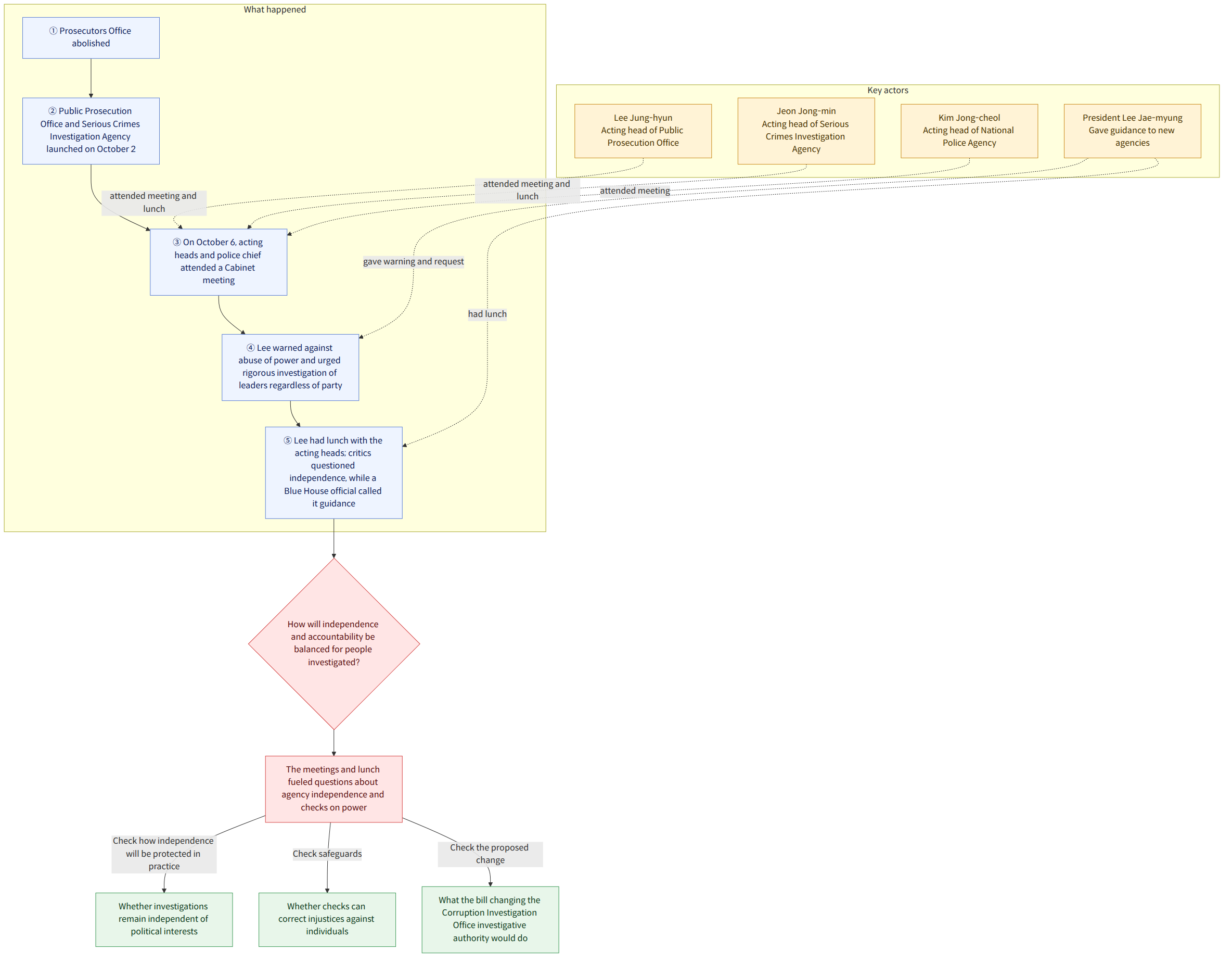
Following the abolition of the Prosecutors’ Office (검찰청), the Public Prosecution Office (공소청) and the Serious Crimes Investigation Agency (중대범죄수사청; 중수청) were launched on October 2. On October 6, President Lee Jae-myung met with the acting heads of the two agencies and the police at a Cabinet meeting at the Blue House (청와대). Lee called the launch of the new system “the people’s historic decision” and said that investigative and prosecutorial functions must never again be abused or swayed by political power. He asked the Serious Crimes Investigation Agency to rigorously investigate crimes by people in leadership positions, regardless of party affiliation.
Background and context
The acting head of the Public Prosecution Office, Lee Jung-hyun; the acting head of the Serious Crimes Investigation Agency, Jeon Jong-min; and the acting head of the National Police Agency (경찰청), Kim Jong-cheol, attended the Cabinet meeting. Lee told them that investigative and prosecutorial agencies must not wrong individuals or allow injustices against them to go unaddressed. After the meeting, he had lunch with the three acting heads.
Lee said the prosecution had wielded enormous power since the government was established after liberation, and that at some point it had come to abuse state power and pin crimes on individuals who had committed none. He did not specify which cases he had in mind. He stressed the role of the new agencies, saying that now that investigative and prosecutorial functions were being separated and even moved to different organizations, abuses of power like those of the past must not be repeated.
The controversy arose not only over the substance of the president’s request but also over how it was delivered. Politicians and members of the legal community criticized the heads of investigative and prosecutorial agencies for attending a Cabinet meeting and having lunch with the president, saying this could undermine the agencies’ independence. A Blue House official, by contrast, said the president had offered guidance to help the new agencies establish themselves without disruption to investigations or prosecutions. The competing interpretations center on how the new agencies’ accountability can be ensured while also keeping them at a distance from political power.
The opposition criticized Lee, saying that, among other things, his renewed mention of the need for a special counsel to investigate fabricated indictments was part of a continued “build-up” toward dropping prosecutions. This is the opposition’s claim; the reported facts alone do not establish that the president ordered prosecutions to be dropped or that he had such an intention. It is important to distinguish the president’s guidance from the opposition’s criticism.
What this means
The powers of investigative agencies can be used to uncover crimes, but they must also be constrained to prevent abuses of power from harming individuals. Lee’s emphasis on not turning innocent people into suspects highlights why the new agencies should not be judged solely by their investigative results. At the same time, the sight of agency heads attending a meeting with the president and having lunch with him may heighten questions about how investigative independence will be protected in practice.
For example, if a citizen is investigated, what matters to that person is not just the name of the agency conducting the investigation. It also matters whether the investigation is conducted independently of political interests and whether checks are in place to correct an injustice. This is a hypothetical explanation; the report alone does not establish that the investigative process or available remedies for any individual citizen have changed.
The target and scope of the request to the Serious Crimes Investigation Agency also need to be understood precisely. The request to investigate crimes by highly educated and wealthy people in leadership positions rigorously and without hesitation, regardless of party affiliation, was directed to the Serious Crimes Investigation Agency. Recasting it as a request made to all three agencies would misrepresent whom the president was addressing.
Debate over changes to the Corruption Investigation Office’s authority
The Corruption Investigation Office for High-ranking Officials (고위공직자범죄수사처; 공수처) opposed amendments to the Corruption Investigation Office Act (공수처법) being pursued by the Democratic Party (민주당). According to reports, the bill would transfer the office’s authority to investigate the president, prime minister, ministers, lawmakers and others to the Serious Crimes Investigation Agency, and authorize the office to investigate judges, prosecutors, investigators and police. The amendments have not been finalized. The Corruption Investigation Office argued that the Serious Crimes Investigation Agency and the police are under the Ministry of the Interior and Safety (행정안전부), and that their ministers are appointed by the president. It said that assigning investigations only to agencies within the presidential chain of command would be a regression in the system of checks and balances.
The Democratic Party is also reportedly considering expanding the Corruption Investigation Office into a nationwide organization to check the Public Prosecution Office, Serious Crimes Investigation Agency and police agencies in each region. The office said it would be difficult to take on that role without the necessary staff and organizational capacity. The issues include not only where authority should be assigned, but also how to ensure the capacity to exercise that authority effectively and check other agencies.
What is known and what remains unclear
Confirmed facts
- The Public Prosecution Office and Serious Crimes Investigation Agency were launched on October 2, and acting heads Lee Jung-hyun and Jeon Jong-min, along with acting National Police Agency head Kim Jong-cheol, attended a Cabinet meeting on October 6.
- Lee said investigative and prosecutorial powers must not be abused by political power or used to wrong individuals.
- The request to rigorously investigate crimes by people in leadership positions, regardless of party affiliation, was directed to the Serious Crimes Investigation Agency.
- The opposition criticized the remarks as part of a move to drop prosecutions, while politicians and members of the legal community raised concerns that the agencies’ independence could be undermined.
- The Corruption Investigation Office opposed amendments to the Corruption Investigation Office Act that would transfer its authority to investigate high-ranking officials to the Serious Crimes Investigation Agency.
What remains unclear
- The reports available do not identify the specific cases Lee had in mind when he referred to abuses of power by the prosecution.
- No decision has been made on how the amendments to the Corruption Investigation Office Act or the proposal to expand the office into a nationwide organization will proceed.
- No specific systems or measures to guarantee the independence of the new Public Prosecution Office and Serious Crimes Investigation Agency have been presented.
What readers should watch for
- The details of the investigative targets and the distribution of authority among agencies should be followed as debate over amendments to the Corruption Investigation Office Act continues. The reported information concerns a proposal under consideration and the office’s opposition to it, not a finalized law.
- Readers can watch how relations with the government, including attendance at Cabinet meetings, are handled when permanent heads are appointed and the Public Prosecution Office and Serious Crimes Investigation Agency begin operating.
- In assessing concerns about the new agencies’ independence, readers should consider not only claims made by politicians but also the checks that are put in place and how investigative powers are distributed.
References
- Other coverage consulted: hani.co.kr

















