

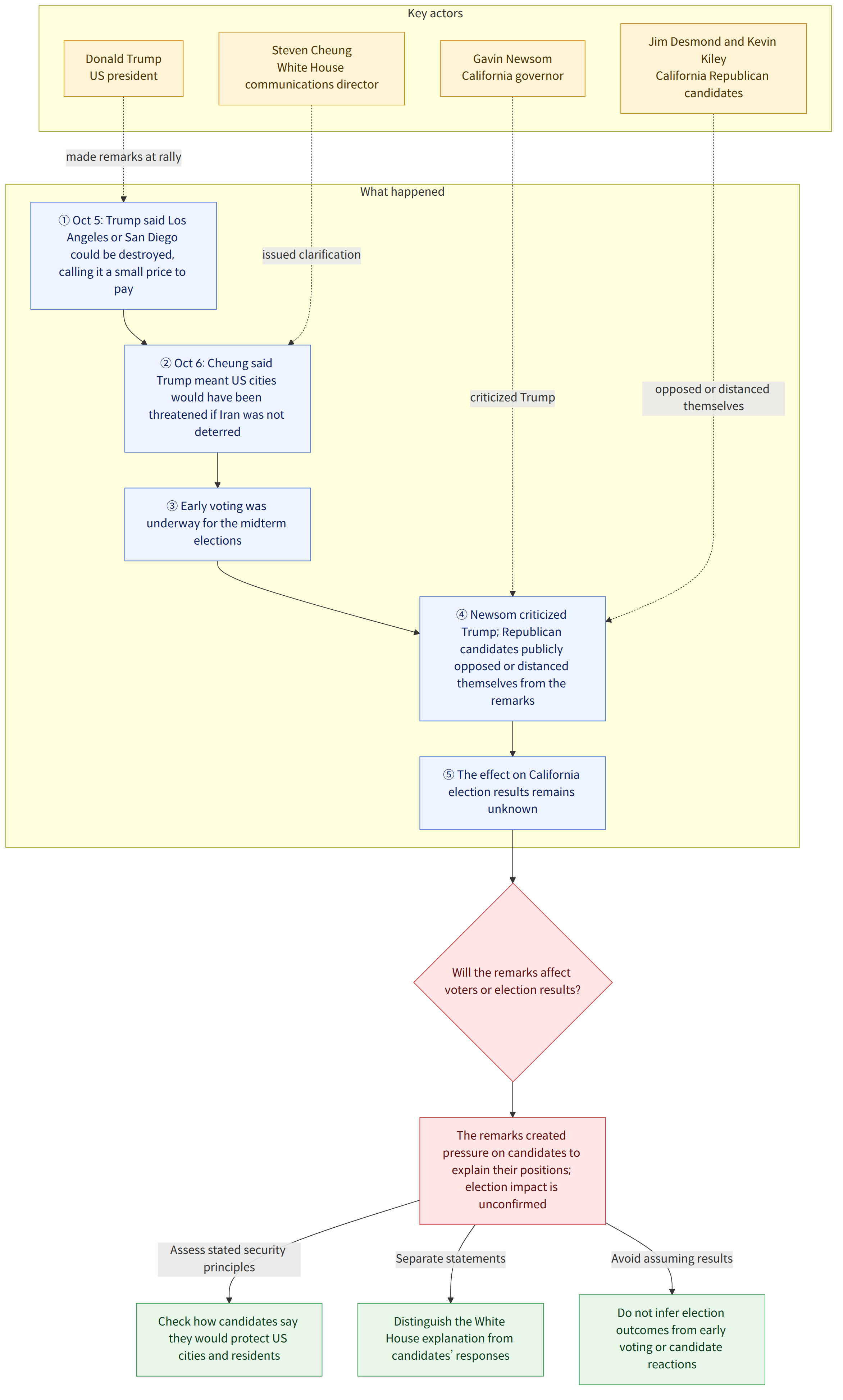
President Donald Trump said at a rally in Grand Island, Nebraska, on October 5, while discussing the war with Iran, that Los Angeles or San Diego could be destroyed but that it would be a “small price to pay” for the safety of the world and the United States. He also said the war was “pretty much almost over” and described the resulting rise in prices as “artificial and a little bit high.” The remarks became a political issue ahead of the midterm elections as California’s governor and Republican candidates pushed back or distanced themselves from them.
Background and context
The remarks came as Trump was discussing the cost of the war with Iran. After saying that rising prices were a small price worth paying, he added that cities such as Los Angeles and San Diego could be attacked. The core of the controversy, then, is not just the war’s results or the burden of higher prices, but that the possibility of American cities being destroyed was presented as a cost that could be borne.
White House Communications Director Steven Cheung said on X on October 6 that the media reaction was not grounded in reality, and clarified that Trump meant U.S. cities would have been threatened if Iran had not been deterred. He argued that the United States was safer because of President Trump and said Iran had no nuclear weapons, navy, air force or money. The White House’s explanation is that the remarks should be understood in the context of deterring a threat, not as a call to accept risk.
What this news means
The controversy shows that a president’s remarks can become more than an explanation of security policy: they can also create political pressure on candidates to state their positions to the voters they represent. In California, home to the cities mentioned in the remarks, the governor strongly criticized Trump, and Republican candidates running in competitive districts in the state also publicly distanced themselves from his comments. With early voting for the U.S. midterm elections underway, how candidates explain their relationship with the president could affect voters’ judgments. However, it is not known whether these remarks have had any actual impact on election results.
For example, if a California voter considers a candidate’s security policy alongside whether the candidate supports the president, the candidate’s response to these remarks could offer one clue about how far the candidate supports the president’s rhetoric and policies. But the fact that candidates criticized the remarks or distanced themselves from them is not enough to draw conclusions about voters’ choices or the election results.
What is confirmed and what is not yet known
Confirmed facts
- At a rally in Grand Island, Nebraska, on October 5, Trump said Los Angeles or San Diego could be destroyed, but that it would be a small price to pay.
- He said the war was “pretty much almost over” and described the war-related rise in prices as “artificial and a little bit high.”
- California Governor Gavin Newsom accused Trump of being “unhinged and dangerous.”
- On October 6, the White House clarified that Trump meant U.S. cities would have been threatened if Iran had not been deterred.
- Jim Desmond firmly opposed the remarks, and Kevin Kiley said they were “not helpful.”
What is not yet known
- This report does not establish the context of the full rally speech or the audience’s reaction when the remarks were made.
- It is not known what effect the remarks and the candidates’ distancing themselves from them will have on California’s election results.
What readers should watch for
- When considering candidates’ remarks, readers can look not only at whether they support or oppose Trump’s wording, but also at the principles each candidate sets out for protecting the safety of U.S. cities and their residents.
- Distinguishing the White House’s explanation from the candidates’ responses can help prevent confusion between what Trump originally said and how political figures interpreted it.
- The impact on election results is not currently a confirmed fact, so it is important not to predict the outcome simply because early voting has begun.
References
- Other coverage consulted: koreatimes.co.kr

















