

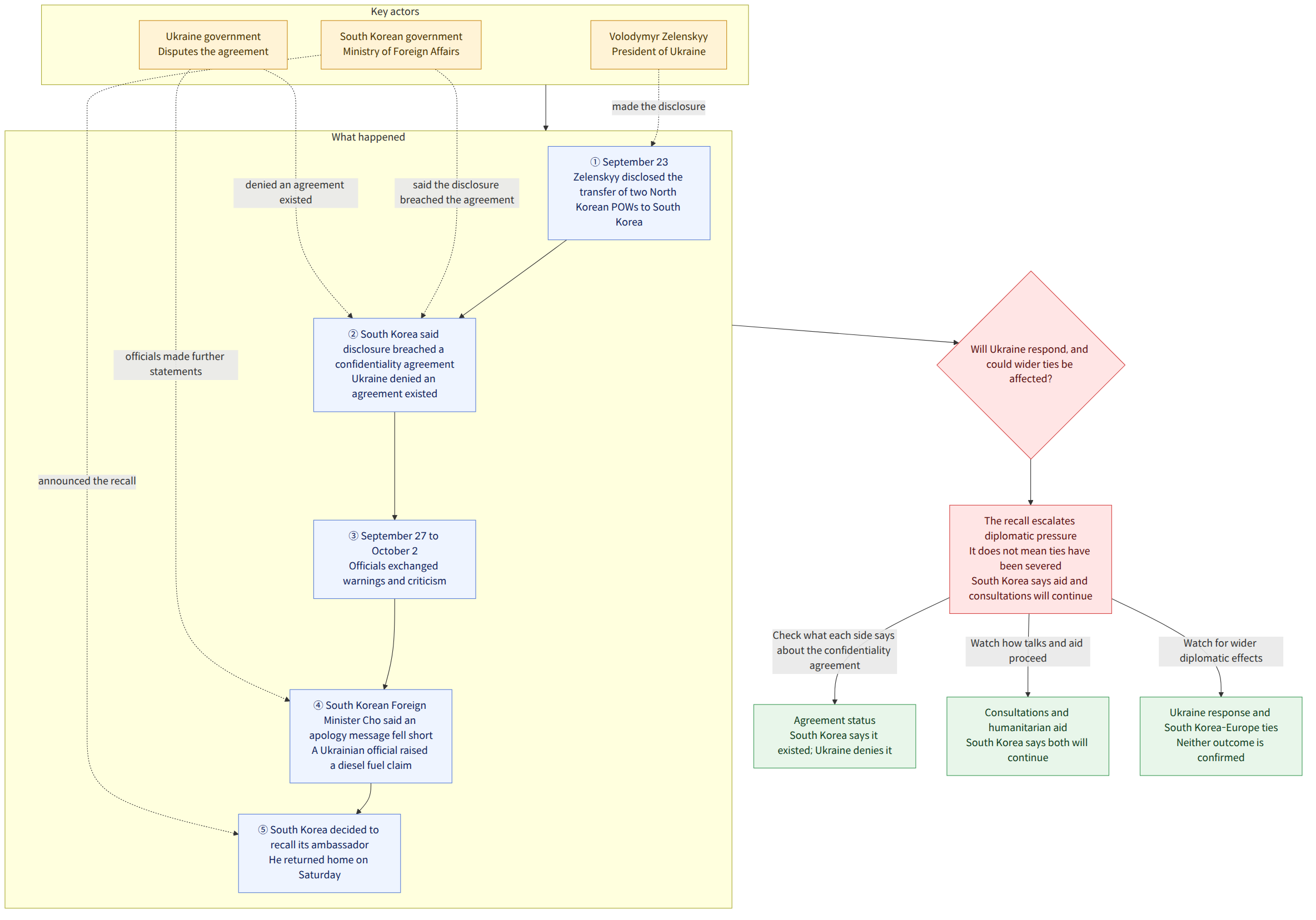
South Korea’s Ministry of Foreign Affairs (외교부) announced Thursday that it would recall Park Ki-chang, its ambassador to Ukraine, and the ambassador returned home on Saturday. The move came as South Korea and Ukraine disagreed over whether a confidentiality agreement existed concerning the disclosure that two North Korean prisoners of war had been transferred to South Korea. The South Korean government said it would continue consultations with Ukraine and maintain humanitarian aid.
Background and context
The dispute began with Ukrainian President Volodymyr Zelenskyy’s address to the United Nations General Assembly on September 23. He disclosed that two North Korean prisoners of war had been transferred to South Korea, and President Lee expressed regret, saying the disclosure violated a confidentiality agreement between the two countries. Ukraine, in contrast, denied that such an agreement existed.
South Korea said the confidentiality agreement had been made at Ukraine’s request. According to related reports, the prisoners arrived in South Korea in mid-September after being captured in the Kursk region while fighting for Russia. South Korea’s position is that disclosing this information breached an agreement intended to protect the individuals and their families, but the two sides have not bridged their differences, with Ukraine refusing to acknowledge that an agreement existed.
Statements that further heightened tensions between the two countries followed. On September 27, Kyrylo Budanov, head of Ukraine’s presidential office, referred to a land-mine explosion in the Demilitarized Zone and warned that a serious armed conflict between North and South Korea was only a matter of time. On October 1, Ukrainian Foreign Minister Andrii Sybiha described the dispute between the two countries as a “diplomatic misunderstanding.” The next day, President Lee posted on X expressing displeasure.
South Korean Foreign Minister Cho Hyun told a parliamentary audit of the National Assembly’s Foreign Affairs and Unification Committee (국회 외교통일위원회) that he had received a message from Minister Sybiha concerning an apology, but that it fell short of what South Korea had hoped for. At the same audit, he also said the South Korean government would take firm measures. The dispute was further inflamed when an official at the Ukrainian presidential office claimed that South Korea’s sanctions policy toward Russia contrasted with reports that it was supplying diesel fuel.
What this news means
Recalling an ambassador is a stronger diplomatic measure than expressing regret or lodging a protest with another country, or than summoning that country’s ambassador. South Korea’s decision to take this step can be seen as an escalation from a public exchange of words to diplomatic pressure. However, recalling an ambassador does not in itself mean that diplomatic relations are being severed, and there has been no confirmation that a break in relations has been decided.
The impact may not be limited to relations between the two countries. Since Ukraine is continuing its war with Russia with support from European countries, analysts have suggested that the dispute could also affect South Korea’s relations with Europe. This is a potential development to watch, rather than a confirmed outcome. Park Byung-hwan, director of the Eurasia Strategy Institute (유라시아전략연구소), said Ukraine might also retaliate and urged the South Korean government to respond calmly.
For example, if consultations between the two countries take longer than expected, it will be worth watching how the humanitarian aid South Korea has said it will maintain is delivered and whether diplomatic consultations continue. This does not mean that a suspension of aid or any specific retaliatory measure has been decided. An official at the Ministry of Foreign Affairs said South Korea would continue consultations to resolve outstanding issues between the two countries amicably.
What is confirmed and what remains unknown
Confirmed facts
- South Korea’s Ministry of Foreign Affairs decided to recall Park Ki-chang, its ambassador to Ukraine, and the ambassador returned home on Saturday.
- President Zelenskyy disclosed that two North Korean prisoners of war had been transferred to South Korea, and South Korea expressed regret, saying this violated a confidentiality agreement.
- South Korea said an agreement existed, while Ukraine denied that it did.
- The South Korean government said it would continue consultations with Ukraine and maintain humanitarian aid.
What remains unknown
- What action Ukraine will take in response to the ambassador’s recall has not been determined.
- It has not been confirmed whether the dispute will lead to a break in diplomatic relations.
- The actual effect of this dispute on South Korea’s relations with Europe is also still unknown.
What readers should watch
- Watch for any further measures announced by South Korea’s Ministry of Foreign Affairs and whether consultations with Ukraine continue.
- Look for an official response from Ukraine, but do not interpret the ambassador’s recall as an immediate break in diplomatic relations.
- Check whether the South Korean government continues its stated policy of maintaining humanitarian aid.
References
- Other coverage consulted: koreatimes.co.kr
- Other coverage consulted: en.yna.co.kr
















