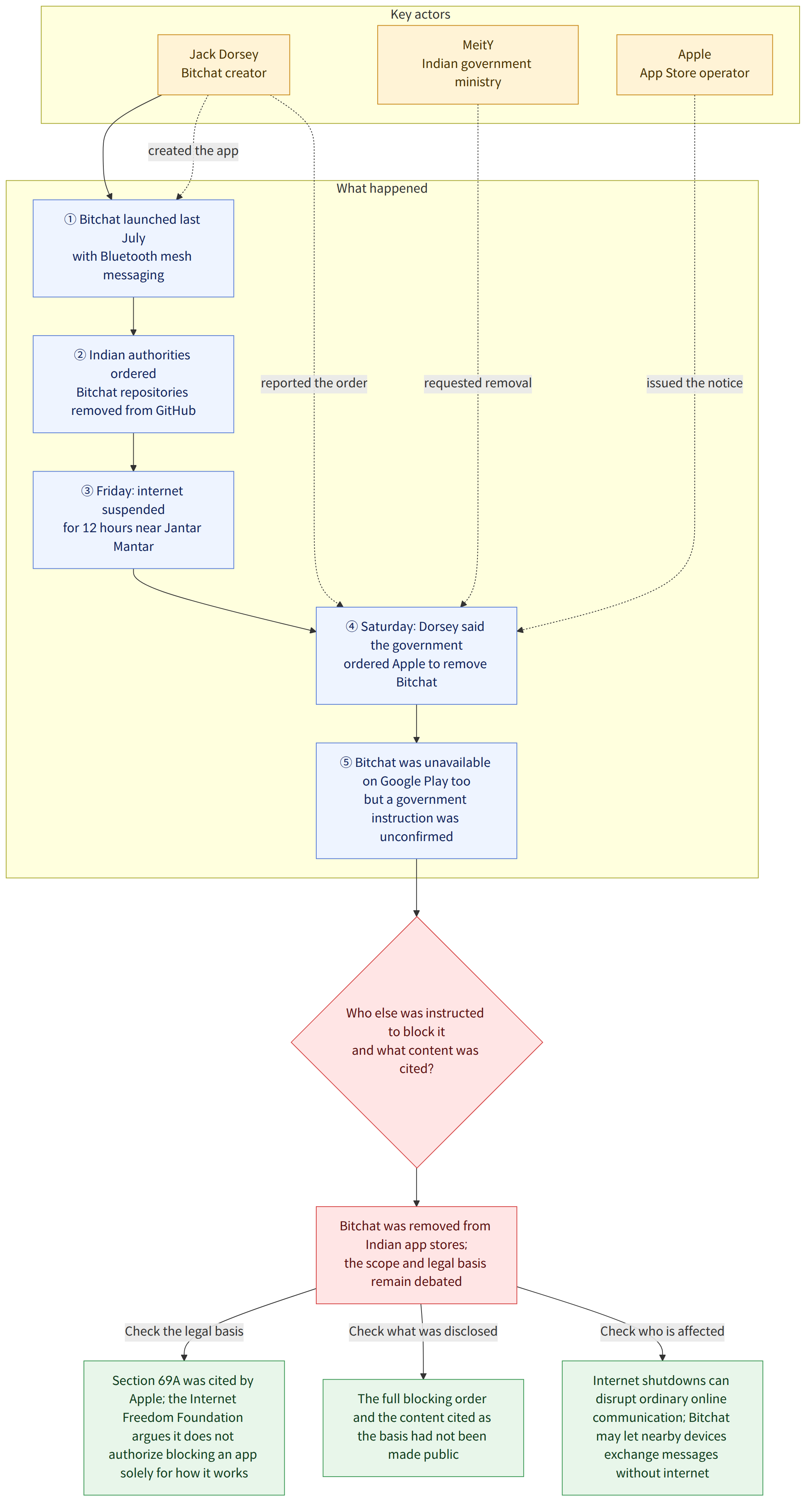
Bitchat, a decentralized messaging app created by Jack Dorsey, has disappeared from Apple’s App Store and Google Play in India. On Saturday, Dorsey said the Indian government had ordered Apple to remove Bitchat from the Indian App Store. A notice from Apple that he posted on X said the Ministry of Electronics and Information Technology (전자정보기술부) had requested the removal under Section 69A of the Information Technology Act (정보기술법).
Apple’s notice said Bitchat would remain available on App Stores outside India, but would not be available in India even through the TestFlight beta service. Bitchat could not be downloaded from Google Play either, but it has not been confirmed whether the federal government instructed Google or internet service providers to block it.
Background and context
Bitchat launched last July. It uses Bluetooth mesh networking—a method in which nearby devices connect to one another to relay messages—and is designed to let nearby devices exchange encrypted messages without relying on cellular networks, the internet or a central server. Its key feature is that it can therefore work even when ordinary internet access is cut off.
This is not the first action by Indian authorities involving Bitchat. In July 2026, Dorsey disclosed that Indian authorities had ordered Bitchat-related open-source repositories removed from GitHub. At the time, the government was reported to have cited the app’s design—which makes it difficult for law enforcement to intercept communications or track users, and allows it to work during internet shutdowns—as the reason for the order.
The legal bases for the two actions are not the same. The GitHub-related order was reportedly based on a provision of the Information Technology Act dealing with intermediary and third-party content liability, while Apple’s notice this time cited Section 69A, which concerns the blocking of online information. The difference in legal provisions shows that even actions involving the same app may rely on different legal grounds and target different entities.
What this news means
The issue is not simply that the app provides encrypted messaging, but what legal grounds the government can use to restrict a feature that allows communications to continue even when internet access is cut off. The Internet Freedom Foundation (인터넷자유재단) argued that Section 69A permits the blocking of unlawful information but does not provide grounds for blocking a messaging app because it can work during an internet shutdown, and criticized the latest order as unconstitutional. This is the group’s legal argument, not a court ruling that the order is unconstitutional.
Internet shutdowns do not affect only Bitchat users. If authorities suspend internet service in a particular area, ordinary online communication may also be disrupted, and apps designed to work without an internet connection could potentially be used there as alternative means of communication. On the other hand, the government’s stated concern is that such features can make it difficult for law enforcement to intercept communications or track users. The debate ultimately centers on how to balance continuity of communications with the needs of law enforcement and regulation.
For example, if internet service is suspended in an area where a protest is taking place and people there have already installed Bitchat, they may be able to exchange messages between nearby devices. This is a hypothetical example of what the app’s design makes possible; it does not confirm who exchanged what messages at any specific protest.
The debate emerged as protests and internet shutdowns intersected. On Friday, authorities suspended internet service for 12 hours around Jantar Mantar in New Delhi. According to the article, internet service was also suspended during protests in July, after which protesters reportedly used Bitchat and its competitor Briar. Data from Sensor Tower showed that India accounted for about 85% of Bitchat’s worldwide downloads from July 17 to 23, up sharply from about 1% in the preceding 30 days.
Relevant laws and support information
The Indian authorities’ action cited Section 69A of the Information Technology Act. The Internet Freedom Foundation interprets this provision as a basis for blocking unlawful information and argues that it does not permit blocking an app solely because of how it works. However, the group said the full blocking order and the content reportedly cited as the basis for the action had not been made public. As a result, the available information does not make it possible to determine what content the government took issue with or whether the action was legally justified.
The internal legal guide L1 (사내 법률 가이드 L1) is a resource on South Korea’s constitutional adjudication procedures. According to the guide, a jurisdictional dispute adjudication (권한쟁의심판) is a procedure in which a party, such as a state agency or local government, claims that its authority has been infringed or is at risk of infringement; individuals cannot file such a claim. A petition must be filed within 60 days of learning of the grounds and within 180 days of the date those grounds arose. This is guidance on South Korean law and should not be applied as the procedure or requirements for challenging the Bitchat block in India. The reports provided do not establish who could take what legal action in this case.
What is confirmed and what remains unknown
Confirmed facts
- Dorsey said the Indian government had asked Apple to remove Bitchat, and the Apple notice he posted cited Section 69A of the Information Technology Act.
- Apple’s notice said the app would be unavailable in India through both the App Store and TestFlight.
- Bitchat is designed to let nearby devices exchange encrypted messages through Bluetooth mesh networking without the internet or a central server.
- Bitchat could not be downloaded from Google Play in India, and its website could not be accessed on several internet service provider networks.
- The Internet Freedom Foundation criticized the latest order as unconstitutional and said the order and the unlawful content reportedly cited as its basis had not been made public.
What remains unknown
- Whether the Indian government also instructed Google or internet service providers to block Bitchat.
- The specific content cited as the basis for the blocking action.
- Whether Apple, Google or Bitchat will take legal action.
- Whether the fact that Bitchat’s website could not be accessed on several networks was the result of a government instruction.
What readers should check
- Readers in India who want to use or download Bitchat should check Apple’s notice, which says its availability may differ across the Apple App Store, Google Play and TestFlight.
- If an app or website cannot be accessed, the fact of the access problem should be distinguished from its cause. The reports currently available do not establish whether the government instructed Google or internet service providers to block it.
- When considering possible legal action, readers should not confuse the Internet Freedom Foundation’s argument that the order is unconstitutional with a court ruling. The materials provided do not include the full order issued by Indian authorities or details of specific procedures for challenging it.