
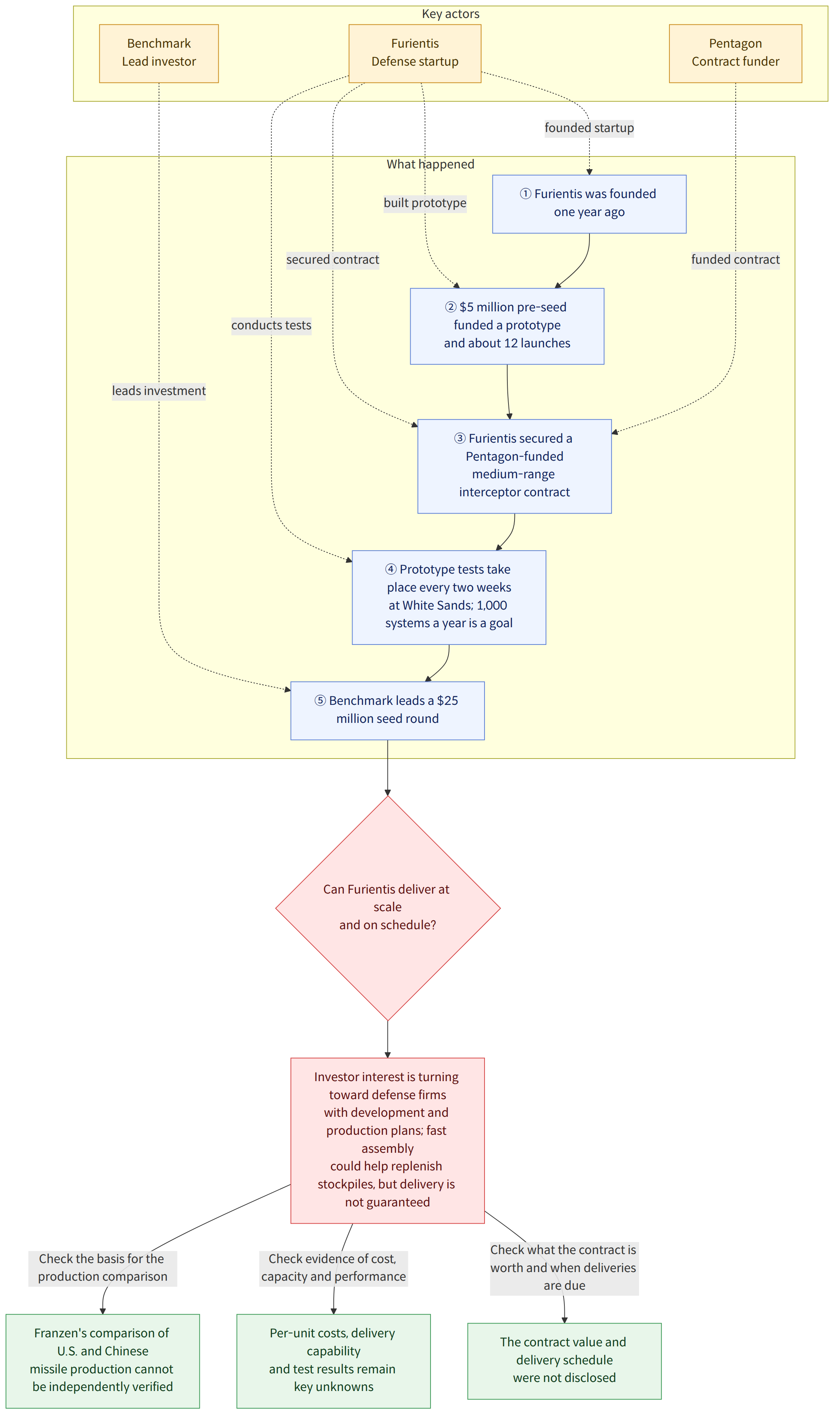
Silicon Valley venture capital firm Benchmark is leading a $25 million seed round for defense startup Furientis. Founded one year ago, Furientis has secured a Pentagon-funded contract to develop a medium-range interceptor missile. A person familiar with the company said it was valued at $125 million. The investment follows a $5 million pre-seed round announced in May.
This is Benchmark’s first investment in a defense-only startup. The deal is noteworthy not simply as a financing event for a new company, but as an example of venture capital meeting demand to rapidly replenish missile stockpiles. However, the disclosed information does not include the value of the Pentagon contract or a delivery schedule.
Background and context
Defense has long been an area venture investors kept at a distance, partly because the process of winning government contracts is lengthy and uncertain, and partly because investing in military equipment can be ethically controversial. The article explains that the mood has changed quickly as conflicts in Ukraine and Iran have depleted the U.S. military’s missile supplies. It says startups that can demonstrate they can build equipment quickly and cheaply are now more likely to win Pentagon contracts.
Rather than competing on performance with the highest-performing existing interceptor missiles, Furientis is focused on designing and manufacturing systems that can be assembled quickly using readily available components. An interceptor missile is a weapon used to intercept enemy missiles and other targets. The company’s approach offers an alternative to relying solely on equipment engineered for maximum performance, at a time when costs need to come down and production volumes need to rise.
The founders’ backgrounds also illustrate the company’s origins. Co-founder Brody Franzen served as deputy chief engineer at Virgin Galactic before joining Castelion, a hypersonic missile startup valued at $13 billion. Co-founder Aris Simsarian previously led rocket engine testing at Virgin Orbit.
Benchmark general partner Chetan Puttagunta said Furientis built a prototype with $5 million in pre-seed funding and successfully completed about 12 launches before raising this round. The company is currently working out of a Los Angeles facility and conducting prototype test launches at White Sands in New Mexico. Field missile tests are taking place every two weeks, and the long-term goal is to produce 1,000 systems a year at a single factory.
What this news means
The investment shows venture capital interest in defense startups becoming tied to actual development and production plans. Benchmark has made its first investment in a defense-only startup, and Furientis has already secured a Pentagon-funded contract. The combination highlights how military procurement demand can be seen by private investors as a business opportunity. Still, raising investment and securing a contract do not, by themselves, guarantee that production targets will be met or deliveries made.
The company’s central proposition is less about “maximum performance” and more about whether it can “make more, faster.” Franzen said the U.S. Navy receives 300–500 interceptor missiles a year, while China claims to produce 3,000 anti-ship cruise missiles a month. He argued that the United States is lagging by more than 100 times in production volume, and said this was why the company was founded. This comparison is presented as Franzen’s claim; the figures and basis for comparison cannot be independently verified from the article alone.
Furientis is not the only company targeting mass production. Franzen said larger defense startups such as Anduril, Castelion, and Shield AI are also working to develop mass-produced interceptor missiles. The direction of the market attracting investor and government attention, then, is not limited to a single company. Whether Furientis can establish a real competitive advantage will depend on more concrete information about production costs, delivery capability, and test results.
For example, if the Pentagon needs to acquire more interceptor missiles on a fixed schedule, systems that can be assembled quickly and use easily sourced components could be one way to replenish stockpiles. But the potential depends on how quickly and at what cost the company can actually supply them. The information currently available does not include per-unit production costs or a specific delivery schedule.
What is confirmed and what remains unknown
Confirmed facts
- Benchmark is leading Furientis’s $25 million seed round. According to the article, this is Benchmark’s first investment in a defense-only startup.
- Furientis was founded one year ago and has secured a Pentagon-funded contract to develop a medium-range interceptor missile.
- The seed round follows a $5 million pre-seed round announced in May. Puttagunta said the pre-seed funding was used to build a prototype and that the company had successfully completed about 12 launches before the investment.
- The company works out of a Los Angeles facility and conducts test launches at White Sands. Field tests take place every two weeks, and the long-term goal is to produce 1,000 systems a year at a single factory.
What remains unknown
- The value of the Pentagon contract and a specific delivery schedule have not been disclosed.
- The cost of producing a single interceptor missile has not been confirmed.
- No details have been provided on which stages of development and production the $25 million investment will fund, or on what schedule.
- It is not yet known when the company could reach its goal of producing 1,000 systems a year, or whether the target will translate into actual production.
What readers should watch
- Look for follow-up announcements on the size of the Pentagon contract and its delivery schedule. Confirmation that a contract has been secured does not establish when or how many units will be delivered.
- Whether the company provides per-unit production costs or production capacity will help determine if its “low-cost, mass-production” strategy is supported by actual figures.
- Watch whether tests every two weeks and about 12 initial launches lead to future production and delivery results. Test counts and mass-production results are information about different stages.