
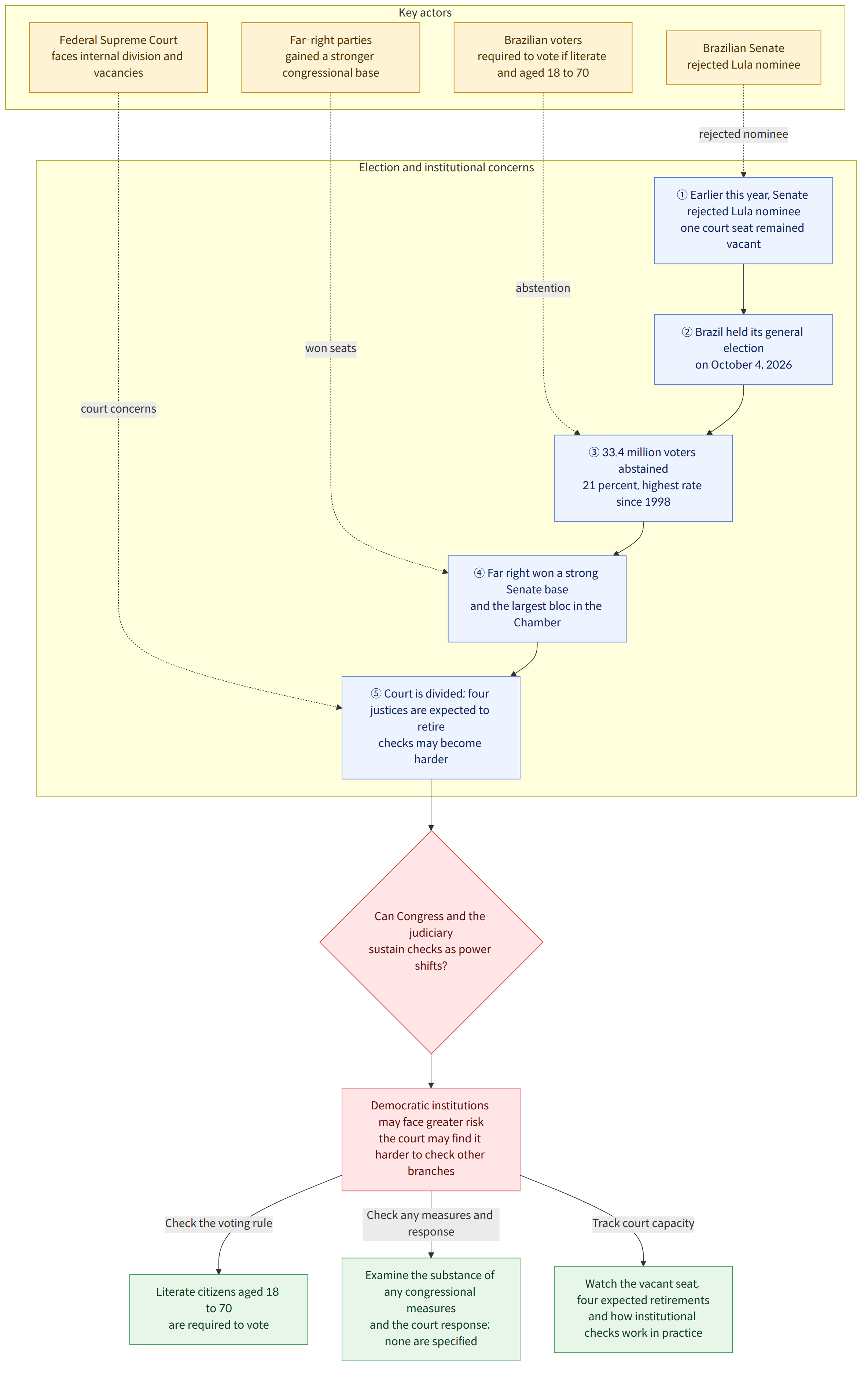
Brazil held its general election on October 4, 2026, and 33.4 million voters did not vote. That was 21% of the electorate, the highest abstention rate since 1998. Given that literate Brazilian citizens aged 18 to 70 are required to vote, the scale of nonparticipation is particularly striking. In the same election, the far right secured a strong base of seats in the Senate and became the largest single bloc in the Chamber of Deputies.
Background and context
Rising abstention and the far right’s gains in Congress each point to changes in voter participation and the party landscape. The fact that both occurred in the same election does not, by itself, support the conclusion that voters who did not cast ballots backed the far right, or that abstention directly led to the far right winning seats. The original article does not establish a specific cause for the rise in abstention, instead presenting political fatigue and distrust, among other factors, as tentative explanations.
Changes in Brazil’s party landscape are also part of the background emphasized in the original article. The Workers’ Party (노동자당; PT) governed for 14 years, from 2003 to 2016, under President Lula, and returned to power from 2023 to 2026 after former President Jair Bolsonaro’s 2018–2022 term. The article says that during this period, the Brazilian Social Democracy Party (브라질 사회민주당; PSDB), which had served as an alternative governing party, lost the ability to field competitive candidates in the 2018 and 2022 presidential elections.
The realignment of right-wing parties also continued. The right-wing Democrats (우파 민주당; DEM) merged with the Social Liberal Party (사회자유당; PSL), which Bolsonaro belonged to during the 2018 presidential election, to form Brazil Union (브라질연합당; União Brasil). According to the original article, the Liberal Party (자유당; PL) occupied space for the far right in Congress and became competitive in presidential elections, absorbing right-wing parties that had been committed to democracy. This analysis links the election results not simply to competition between left- and right-wing blocs for seats, but also to changes in the existing political alternatives, including parties that support democracy.
What this news means
As the far right grows stronger in Congress, its political power to change laws and institutions may also increase. The original article interprets this as a risk to democratic institutions. In particular, the combination of a strong far-right base in the Senate and the largest single bloc in the Chamber of Deputies makes it worth watching what role Congress will play in checking the executive and the judiciary. However, the original article does not give specific seat counts for each party or identify measures that will actually be pursued, so it cannot be taken to mean that institutional changes have already been decided.
The state of the judiciary is presented as an additional source of concern. According to the original article, the Federal Supreme Court (연방대법원; STF) is deeply divided internally, and several justices are facing public calls to explain themselves in connection with the inappropriate conduct of some justices. In addition, four justices are expected to retire upon reaching the mandatory retirement age, and one seat remains vacant after the Senate rejected President Lula’s nominee earlier this year. The article argues that these circumstances, taken together, could make it harder for the court to protect the Constitution and check the other branches of government. But the prospect that the court could actually fall under far-right influence is presented as a concern, not an established fact.
The author of the original article explains that emotions such as political fatigue, anger, and resentment may be linked to voter distrust. The author also offers backlash against social inclusion and changes in behavior, as well as the spread of information that stokes resentment in digital spaces, as hypotheses for interpreting political trends. These are the author’s analyses, not findings that confirm the motivations of individual voters who abstained. The key takeaway for readers is therefore not to assume voters’ views based on the abstention rate alone, but to examine separately the reasons for nonparticipation, changes in the party landscape, and how institutional checks operate in practice.
For example, if measures related to the judiciary’s powers or constitutional checks are discussed in Congress, readers can examine both the substance of those measures and the court’s response. The original article does not say, however, that such measures will actually be pursued. An analysis that election results could heighten risks to democracy should be distinguished from a conclusion that those risks have become reality.
What is confirmed and what is not yet known
Confirmed facts
- The general election was held on October 4, 2026.
- Literate Brazilian citizens aged 18 to 70 are required to vote, and 33.4 million voters, or 21% of the electorate, did not vote.
- The abstention rate was the highest since 1998.
- The far right won a strong base of seats, particularly in the Senate, and became the largest single bloc in the Chamber of Deputies.
- The Federal Supreme Court is internally divided, four justices are expected to retire upon reaching the mandatory retirement age, and one seat is vacant.
What is not yet known
- The original article does not provide the specific number of seats each party secured in the Senate and Chamber of Deputies.
- The original article does not establish the specific reasons for the increase in nonparticipation.
- It is not yet known what changes in laws or institutions the far right’s strength in Congress may lead to, or how the Supreme Court’s composition and role may change.
What readers should watch
- If specific seat counts for each party in the Senate and Chamber of Deputies are published or finalized, check what the far right’s gains mean in terms of its seat base.
- Watch for follow-up analyses of the reasons for rising abstention, and distinguish hypotheses such as political fatigue from confirmed causes.
- Follow subsequent procedures and congressional discussions concerning judicial retirements and the vacant seat to see what changes, if any, actually occur in checks and balances.