

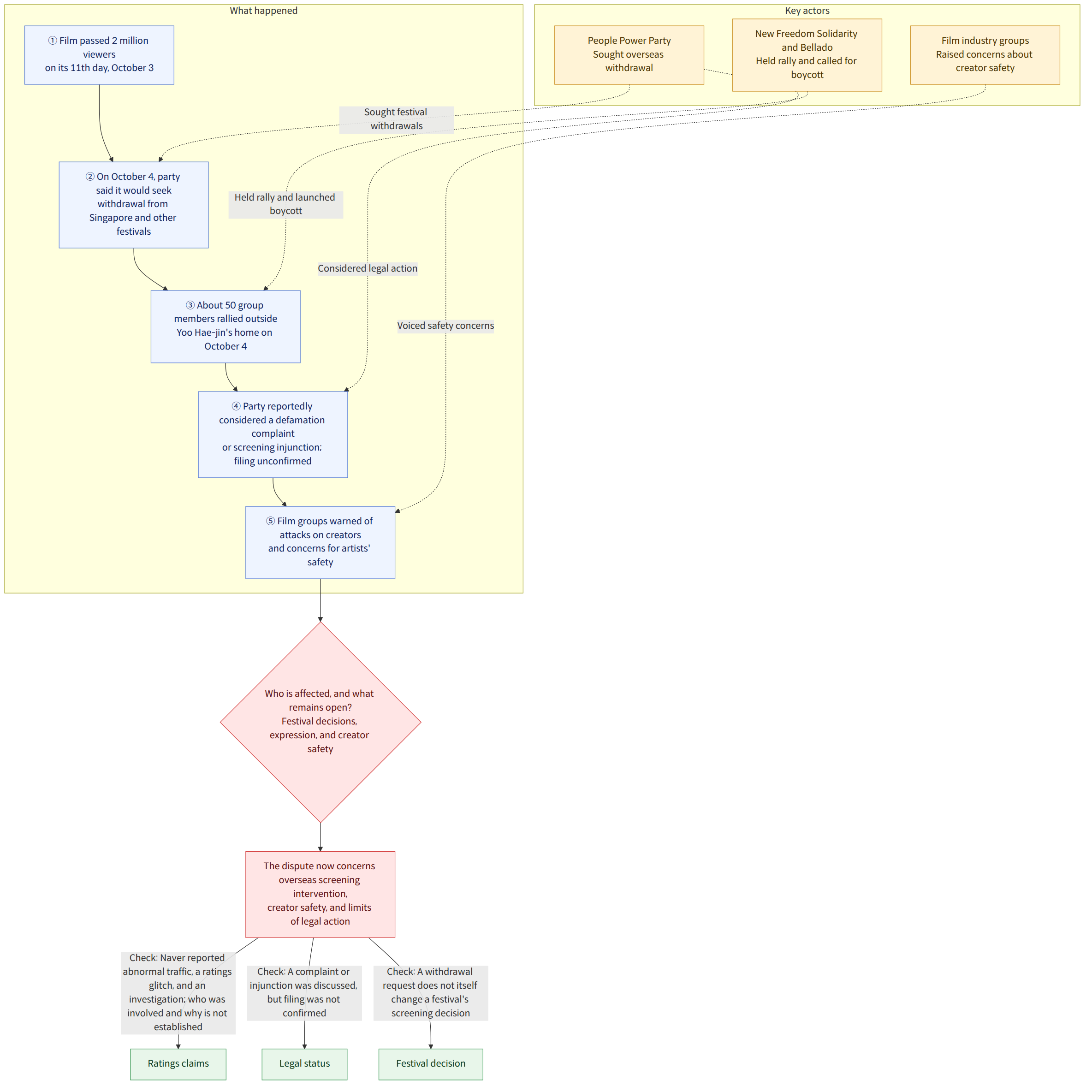
On October 4, 2026, the People Power Party said it would send a letter asking for the withdrawal of “Assassin(s),” a film about the 1974 assassination attempt on Madam Yuk Young-soo, as the opening film of the Singapore International Film Festival. Rep. Joo Jin-woo said the party also planned to ask other international film festivals, including ones in Brazil and Toronto, Canada, to withdraw the film. That same day, about 50 members of conservative groups held a rally outside actor Yoo Hae-jin’s home, calling for screenings to be halted and for an apology, among other demands.
The controversy goes beyond a political dispute over the film’s historical interpretation. It has brought together efforts by domestic politicians to influence whether an overseas film festival screens the film, a rally outside an actor’s home and a boycott campaign, as well as concerns in the film industry about the safety of creators. “Assassin(s)” surpassed 2 million moviegoers on October 3, its 11th day in theaters, but the number of viewers does not determine the nature of the controversy surrounding the film.
Background and context
Rep. Joo said he would seek to stop the film from being screened at the Singapore International Film Festival and planned to ask other festivals, including ones in Brazil and Toronto, Canada, to withdraw it. Choi Bo-yoon, the People Power Party’s chief spokesperson, said the party would gather the views of lawmakers who had expressed interest in taking part and then proceed with sending a letter through its parliamentary caucus. Party leader Jang Dong-hyuk was scheduled to visit the birthplace of Madam Yuk Young-soo in Okcheon, North Chungcheong Province, on October 5.
The People Power Party cited the fact that the Industrial Bank of Korea (기업은행) and the Korea Development Bank (산업은행) had participated directly or indirectly in financing the film to allege that the Lee Jae-myung administration had intervened. It also raised suspicions of manipulation of the film’s ratings. However, the article also included separate facts about the ratings issue. Naver (네이버) announced that it had asked for an investigation after detecting abnormal traffic on some films. It said that, for “Assassin(s),” automated abuse had been detected during a period when a glitch allowed duplicate “helpful” and “not helpful” ratings to be submitted, and that it had temporarily changed the default sorting method to “newest first.” These details do not establish who was involved or what their purpose was.
The political response extended to calls for the film to be withdrawn from overseas screenings and consideration of legal action. Reports said the People Power Party was also considering a complaint for posthumous defamation (사자명예훼손) or an injunction to ban screenings, but it has not been confirmed whether a complaint or application was actually filed. Meanwhile, members of the conservative groups New Freedom Solidarity (신자유연대) and Bellado (벨라도) rallied outside Yoo’s home, demanding that the film be withdrawn, that he apologize to the public and that he promise it would not happen again. They were also reported to have launched a boycott of Burger King and Kiwoom Securities (키움증권), companies for which he serves as an advertising model.
There were also voices opposing the political criticism. Jeon Eun-su, a spokesperson for the Democratic Party of Korea (더불어민주당) parliamentary caucus, criticized political intervention in the arts and culture to decide what people may see as censorship. Cho Kuk, head of the Innovation Policy Research Institute of the Cho Kuk Innovation Party (조국혁신당 혁신정책연구원), proposed making relevant government agency documents public. The Korea Film Directors’ Guild (한국영화감독조합) said criticism of a work should be distinguished from attacks targeting individual creators, and that criticism should not be allowed to destroy creators’ lives and livelihoods. The Korean Film Producers Association (한국영화제작가협회) and the Korean Film Producers Guild (한국영화프로듀서조합) also expressed concern, saying political attacks had gone as far as threatening the safety of the artists involved.
What this news means
First, it is notable that the focus of the controversy has expanded from the film’s content to whether it will be screened overseas. A request to withdraw a film does not, by itself, change a festival’s decision. But the move to communicate directly with an overseas cultural event raises questions about the boundary between freedom of expression and political intervention. The People Power Party argued that the film distorts history and makes many people uncomfortable, while Jeon Eun-su, the Democratic Party’s caucus spokesperson, criticized efforts by politicians to decide whether it can be screened as censorship. The two positions can be understood not as a dispute over the facts, but as a disagreement over how far political intervention in a film should be permitted to go.
Second, criticism of a work and actions targeting people who took part in it affect different parties. The Korea Film Directors’ Guild said creators can face criticism of their work, but that such criticism should not destroy their personal lives and livelihoods. With a rally outside the actor’s home and a boycott of companies that advertise with him, the controversy could affect actors’ and creators’ safety and work, extending beyond audience responses to the film. This is a concern that can be drawn from the reported actions; it is not a finding that the rally or boycott was unlawful.
Third, it is important for audiences and the public to distinguish allegations from confirmed facts. For example, if you encounter a claim online that a film’s ratings were manipulated, do not treat a political party’s allegation and a technical anomaly that a platform says it detected as equivalent. Check separately what has been confirmed and who carried out the activity. Naver’s announcement, as reported in the article, said automated abuse had been detected, but did not identify those responsible or their motives.
Relevant legal and support information
The legal actions the People Power Party was reported to be considering involve different questions in the case of defamation and an injunction. According to a legal guide, the key question in defamation is whether specific facts that could lower a person’s social standing were publicly disclosed; an insult (모욕) concerns the expression of contempt without stating facts. The content and context of the statement, whether the person it refers to can be identified, the likelihood that it would be conveyed to multiple people and the public interest must all be considered. Accordingly, the legality of criticism of the film or related comments cannot be determined from those statements alone.
However, the legal guide provided explains only the general criteria for defamation and insult; it does not provide a specific analysis of whether the posthumous defamation offense discussed in this case has been committed. It therefore cannot be used as a basis for concluding that the film or statements by politicians constitute that offense. The issues can be narrowed down only after specific facts are confirmed, including whether any action was actually taken, which statements are being challenged and who the parties are.
An injunction is a temporary measure intended to preserve rights or prevent risks to a legal relationship before a ruling on the merits. But the fact that an injunction to ban screenings was discussed does not mean an application was filed or a decision was made. Its actual effect depends on the application, the rights it seeks to preserve and whether it is enforced, among other things. The injunction guide provided also explains general principles and does not determine whether the film can be barred from screening.
What has been reported is a plan to consider legal action. It is important not to conclude that legal action has been taken unless and until an actual complaint or injunction application, or a court ruling, is confirmed.
Points reported differently
The two reports differ in how much detail they provide about the progress of sending the letter. One report said Rep. Joo had already sent a document to the festival and that a letter in the name of all People Power Party lawmakers was expected to be submitted, led by the party’s parliamentary leadership. The other said the party had decided to gather lawmakers’ views and proceed with sending a letter through its parliamentary caucus.
What is confirmed and what remains unknown
Confirmed
- The People Power Party said it was pursuing a letter asking for “Assassin(s)” to be withdrawn as the opening film of the Singapore International Film Festival and planned to make requests to other international film festivals as well.
- About 50 members of conservative groups held a rally outside Yoo Hae-jin’s home on October 4, calling for screenings to be halted and for an apology, among other demands.
- Reports said rally participants had begun a boycott of companies for which Yoo serves as an advertising model.
- Film director, production and producer groups issued statements expressing concern about the safety of creators and participating artists.
- The film surpassed 2 million moviegoers on October 3, its 11th day in theaters.
Still unknown
- Reports have not confirmed how the Singapore International Film Festival or other festivals, including those in Brazil and Toronto, responded to the requests to withdraw the film.
- It has not been confirmed whether the People Power Party actually filed a complaint for posthumous defamation or applied for an injunction to ban screenings.
- The information provided does not identify who carried out the automated abuse related to the ratings or what their purpose was.
What readers should check
- When checking whether an overseas festival will screen the film, distinguish reports that a withdrawal request was made from the festival’s official decision or response.
- In follow-up coverage of legal action, note that considering action, actually filing an application or complaint, and receiving a court ruling are separate stages.
- When you encounter allegations of ratings manipulation, separately check the political party’s claim, the technical anomaly the platform says it detected, and confirmed facts about who was responsible and their motives.
References
- Crimes Against Reputation: A Guide to Defamation and Criminal Insult
- Key Guide to Applying for, Enforcing, and Canceling Provisional Dispositions
- Other coverage consulted: hani.co.kr
- Other coverage consulted: hani.co.kr

















