
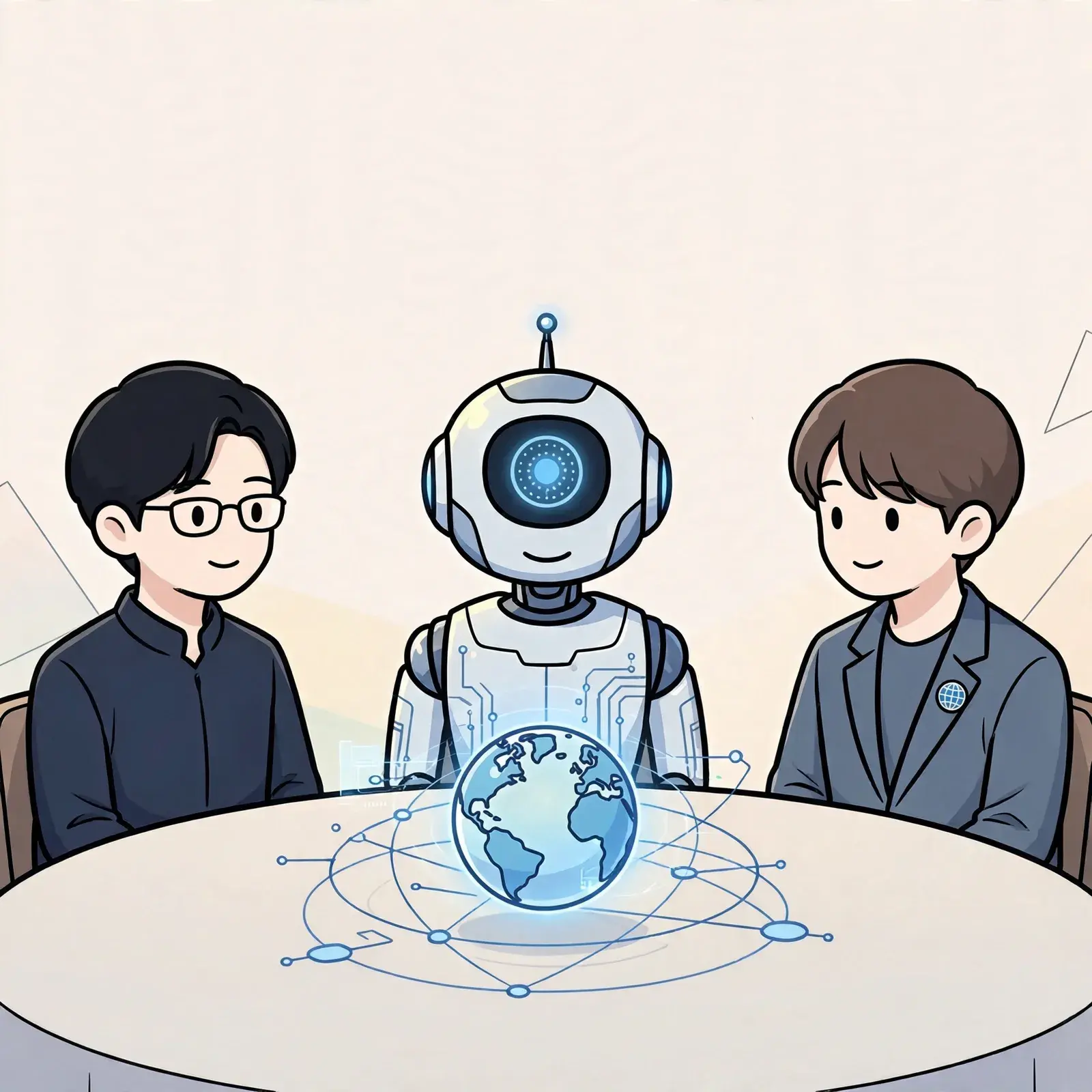
A forum focused on overlapping global shifts
The 17th Asia Future Forum is scheduled for October 28 at the International Conference Hall of the Korea Chamber of Commerce and Industry in Seoul. This year’s theme is “In an Era of Upheaval: The Path to Becoming a Leading Nation.” The program will consider how South Korea can respond to major changes in global politics and the rapid spread of artificial intelligence (AI, computer systems that can perform tasks such as writing, analysis and image recognition).
The forum has focused on ways to support a sustainable society and a stronger sense of community. This year’s agenda links those goals to two forces reshaping everyday life: changes in international relations and the growing use of AI. Organizers say the central question is how South Korea can prepare for these shifts while enabling people and communities to live alongside one another.
The forum’s central question is whether South Korea can turn a period of global disruption into a path toward more inclusive and responsible leadership.
Why the international order is on the agenda
The program’s morning sessions will examine changes in the global order and discuss the choices facing South Korea. The forum announcement describes a period in which established arrangements are under strain, while geopolitical tensions, conflict, insecurity in community life and uncertainty about work are becoming more prominent. These pressures can affect people far beyond foreign policy—for example, when international disputes disrupt trade, raise costs for businesses or make jobs less secure.
Amitav Acharya, a distinguished professor at American University and the author of The Once and Future World Order, is due to discuss South Korea’s options in a more diverse international community without a single dominant power. A world without one country setting the rules is often described as multipolar (a system in which influence is shared among several countries or groups). In such a setting, governments may need to build partnerships with different countries on different issues rather than rely on one central ally.
Kim Heung-kyu, president of the Korea National Diplomatic Academy, and Kim Yang-hee, a professor at Daegu University and head of the economic security division of the National Economic Advisory Council, are also scheduled to discuss foreign policy and economic security. Economic security means protecting the supplies, technologies and industries a country needs to keep its economy functioning—for instance, ensuring access to key materials used in semiconductors or batteries.
Lee Keun, an honorary president of the Korea Economic Association, will lead a discussion on South Korea’s choices in an era of geoeconomic uncertainty. Geoeconomics refers to the use of trade, investment, technology and supply chains as tools of national influence. A practical example is how restrictions on technology exports can affect companies and workers in countries that depend on those products.
AI policy, public interests and democracy
The afternoon program will turn to the opportunities and risks associated with AI, as well as policies intended to make technological change serve the public. AI is increasingly used in areas such as customer service, education and office work. Its spread can make some tasks faster, but it also raises questions about who benefits, how decisions are made and what happens to people whose jobs change.
Cha Ji-ho, a lawmaker from the Democratic Party of Korea, is scheduled to present ideas on the conditions needed for an AI-leading country, including the direction of an “AI basic society.” The term describes an approach that seeks to ensure people can share in the benefits of AI and receive support as society changes. Cha will take part in a conversation with Lee Joo-hyun, a senior reporter at the People and Digital Research Institute.
Nabiha Syed, executive director of the Mozilla Foundation, and Kwon Oh-hyun, head of the social cooperative Parti and a member of the National AI Strategy Committee’s AI Democracy division, will discuss “democratic AI” and alternatives to the power of big technology companies. Democratic AI generally refers to efforts to make AI development and use more accountable and open to public participation. In everyday terms, that could mean giving people a say in how automated systems affecting their lives are designed and setting clear rules for how those systems use personal information.
The AI discussions will look beyond the technology itself to the policies, rights and public oversight that shape how it is used.
Work and the pressures facing younger generations
The forum will also address how AI-driven change may affect workers, particularly younger people entering or trying to establish themselves in the labor market. Kim Jong-jin, director of the Working Citizens Research Institute, will examine youth employment policy in the AI era. Byun Geum-sun, director of the Population Change Response Research Center at the Seoul Institute, will lead a discussion on possible responses to challenges facing young workers.
The questions are practical as well as economic. If software takes over routine tasks, for example, some jobs may change even when they do not disappear entirely; workers may need access to training, reliable employment protections and ways to move into new roles. The sessions are intended to consider how policy can respond to these shifts, rather than treating technological adoption as a matter affecting businesses alone.
Looking beyond employment
Work is closely tied to income, stability and participation in society. The program’s focus on younger workers therefore connects AI policy to a broader question: how can a community share the costs and benefits of a fast-moving transition? The forum announcement frames coexistence and social resilience as central concerns alongside national competitiveness.
A wider view of change and community
The main program will also include a special lecture by Shim Chae-kyung, head of the Planetary Exploration Center at the Korea Astronomy and Space Science Institute. Her talk will explore how people can approach questions of personal identity in the face of large-scale change, drawing on the study of the universe and planetary exploration.
Separate from the main sessions, two discussion groups will consider social and economic approaches to strengthening communities. One will focus on social and solidarity economy (economic activity organized around cooperation and shared benefit) and networks of mutual support at the local level. A neighborhood cooperative that connects residents, local businesses and community services is one example of the kind of locally rooted cooperation this topic can encompass.
The other group will examine South Korean society in transition, public-interest organizations, the social use of assets and the future of impact finance (investment intended to produce measurable social benefits as well as financial returns). These topics ask how resources can support public goals—for example, by financing projects designed to address community needs rather than focusing only on short-term profit.
Registration and what the forum aims to address
Advance registration for the 17th Asia Future Forum is available through the event’s website. The announced program brings together international relations, economic security, AI governance, employment and community-focused economic models, reflecting how these subjects increasingly overlap in public policy.
The event’s broad challenge is how a country can remain capable and competitive without leaving communities and workers behind. Its sessions will consider possible answers from different perspectives, from foreign policy and technology rules to local cooperation and the changing nature of work. The forum is scheduled for October 28 at the Korea Chamber of Commerce and Industry’s International Conference Hall.

















